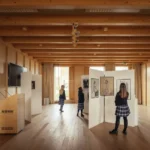
2026 Pritzker Architecture Prize winner
March 12, 2026
Smiljan Radić Clarke, Recipient of the 2026 Pritzker Architecture Prize
The Pritzker Architecture Prize announces Smiljan Radić Clarke, of Santiago, Chile, as the 2026 Laureate of the Pritzker Architecture Prize, the award that is regarded internationally as architecture’s highest distinction.
Smiljan Radić Clarke – 2026 Laureate of the Pritzker Architecture Prize:

“Architecture exists between large, massive, and enduring forms—structures that stand under the sun for centuries, waiting for our visit—and smaller, fragile constructions—fleeting as the life of a fly, often without a clear destiny under conventional light. Within this tension of disparate times, we strive to create experiences that carry emotional presence, encouraging people to pause and reconsider a world that so often passes them by with indifference,” expresses Radić.
2026 Pritzker Architecture Prize Winner – Smiljan Radić Clarke
Radić refuses a repeatable architectural language; instead, each project is approached as a singular inquiry, grounded in first principles and informed by noncontinuous history. Context, use and anthropological awareness take precedence. Site is understood not only in physical terms, but also as a convergence of history, social practice, and political circumstance.
The 2026 Jury Citation states, in part, “Through a body of work positioned at the crossroads of uncertainty, material experimentation, and cultural memory, Smiljan Radić favours fragility over any unwarranted claim to certainty. His buildings appear temporary, unstable, or deliberately unfinished—almost on the point of disappearance—yet they provide a structured, optimistic and quietly joyful shelter, embracing vulnerability as an intrinsic condition of lived experience.”
Across his work, site-specific strategies recur in varied forms, allowing each building to emerge from its particular conditions rather than a signature formula.
Buildings may be partially embedded in the ground rather than placed upon it as at Restaurant Mestizo (Santiago, Chile 2006), oriented to shelter from prevailing winds or harsh light such as in Pite House (Papudo, Chile, 2005), or shaped through adaptive reuse rather than replacement as with Chile Antes de Chile, the extension of the Chilean Museum of Pre-Columbian Art (Santiago, Chile, 2013).
“In every work, he is able to answer with radical originality, making the unobvious obvious. He reverts back to the most irreducible basic foundations of architecture, exploring at the same time, limits that have not yet been touched. Developed in a context of unforgiving circumstances, from the edge of the world, with a practice of just a few collaborators, he is capable of bringing us to the innermost core of the built environment and the human condition,” comments Alejandro Aravena, Chair of the Jury and 2016 Pritzker Prize Laureate.
Radić’s architecture reveals its rigor not through formal assertion, but through the discipline of its construction. His work often appears austere or elemental, yet this impression conceals precise engineering and construction. Materials such as concrete, stone, timber, and glass are deployed in deliberate relation to one another to shape weight, light, sound, and enclosure. At the Serpentine Gallery Pavilion (London, United Kingdom, 2014), a translucent fiberglass shell rests on immense load-bearing, locally-sourced stones. Light is filtered rather than displayed and enclosure remains partial, allowing visitors to experience shelter without complete separation from the surrounding park. At Teatro Regional del Biobío (Concepción, Chile, 2018), a carefully engineered semi-translucent envelope modulates light and supports acoustic performance through restraint. Construction becomes a kind of storytelling, where texture and mass carry as much meaning as form.
As the Jury Citation further notes, “To render the qualities of his architectural work in spoken language is intrinsically difficult, for in his designs he works with dimensions of experience that are immediately palpable but escape verbalization—like the perception of time itself: immediately recognizable, yet conceptually evasive. His buildings are not conceived simply as visual artifacts; rather, they demand embodied presence.”
His works are marked by a quiet emotional intelligence, informed by empathy for the human experience and calibrated to shape how architecture is felt over time. His buildings feel protective, inwardly focused, and attentive to human fragility. House for the Poem of the Right Angle (Vilches, Chile, 2013) signifies contemplative retreat, with thoughtfully placed openings, oriented upward to capture light and time, encouraging stillness and introspection.
At his home studio, Pequeño Edificio Burgués (Santiago, Chile, 2023), the residence provides shelter and privacy while maintaining an expansive relationship to the city below. From within, residents overlook urban landscape below, while from the outside, the interior remains concealed behind chain-link curtains. Single-pane glass walls invite rain, sound, and shifting light into the space, allowing daily weather to be felt as much as seen. Below, the subterranean studio occupies a quieter register, as the same walls are tempered by an earthen berm that filters sunlight, brings nature into view, and creates a protected environment for work.
Interventions are neither restoration nor replacement, rather intentional calculations of scale and use. At NAVE (Santiago, Chile, 2015), Radić reframes an early-twentieth-century residential heritage building damaged by natural disaster, retaining the existing structure while inserting new volumes dedicated to open-ended performance, rehearsal, and workshop spaces. Above, a rooftop terrace capped by a circus tent introduces an unexpected lightness and an atmosphere of provisional celebration programmed with community events, that contrasts with the grounded intimacy below. Previous layers remain visible, treating adaptation as continuity rather than compromise.
This attentiveness to layers extends beyond construction. In 2017, Radić established Fundación de Arquitectura Frágil in Santiago, conceived as both a platform for public exchange and a working archive. The foundation’s collection, comprised of experimental works, studies, and references from other architects, forms a body of inquiry that often informs his own projects. The work of others becomes another layer through which architecture continues to evolve.
Developed over more than three decades, Radić’s practice spans cultural institutions, civic spaces, commercial buildings, private residences, and installations throughout Albania, Austria, Chile, Croatia, France, Italy, Spain, Switzerland, and the United Kingdom, with additional defining works including Guatero, for the XXII Chilean Architecture Biennial (Santiago, Chile, 2023); London Sky Bubble (London, United Kingdom, 2021); Chanchera House (Puerto Octay, Chile, 2022); Prism House (Conguillío, Chile, 2020); Vik Millahue Winery (Millahue, Chile, 2013); The Boy Hidden in a Fish, with Marcela Correa, for the 12th International Architecture Biennale of Venice (Venice, Italy, 2010); and CR House (Santiago, Chile, 2003).
Smiljan Radić Clarke is the 55th Laureate of the Pritzker Architecture Prize and the founder of the practice, Smiljan Radić Clarke, established in 1995. Born in Santiago, Chile, he resides and works in his native city with upcoming projects in Albania, Spain, Switzerland, and the United Kingdom.
+++
About the Pritzker Architecture Prize
The Pritzker Architecture Prize was founded in 1979 by the late Jay A. Pritzker and his wife, Cindy. Its purpose is to honor annually a living architect whose built work demonstrates a combination of those qualities of talent, vision and commitment, which has produced consistent and significant contributions to humanity and the built environment through the art of architecture.
Visit pritzkerprize.com for more information.
Copyright © 2026 The Pritzker Architecture Prize
The Pritzker Architecture Prize
150 N. Riverside Plaza
Suite 3200
Chicago, IL 60606
+++
Previously on e-architect:
Laureate of The Pritzker Architecture Prize Archive
Liu Jiakun, Recipient of the 2025 Pritzker Architecture Prize

photo courtesy of The Hyatt Foundation / The Pritzker Architecture Prize
2025 Pritzker Architecture Prize
2024
Riken Yamamoto receives the 2024 Pritzker Architecture Prize

photo courtesy of Tom Welsh
2024 Pritzker Architecture Prize
2023
Sir David Alan Chipperfield CH Receives the 2023 Pritzker Architecture Prize
2018
Balkrishna Doshi Receives the 2018 Pritzker Architecture Prize
Professor Balkrishna Doshi, India, selected as the Pritzker Architecture Prize 2018 Laureate
2017
2017 Pritzker Architecture Prize
RCR Arquitectes – Rafael Aranda, Carme Pigem and Ramon Vilalta have been selected as the 2017 Pritzker Architecture Prize Laureates.
Pritzker Architecture Prize 2017 Laureates
Pritzker Prize Winner in 2016 – Alejandro Aravena, Chile
+++
Pritzker Prize Architect winners
Chronological:
Balkrishna Doshi 2018 – see RIBA 2022 Gold Medal for Architecture
RCR Arquitectes 2017
Alejandro Aravena 2016
Frei Otto 2015
Shigeru Ban 2014
Toyo Ito 2013
Wang Shu 2012
Eduardo Elísio Machado Souto de Moura 2011
SANAA 2010
Peter Zumthor 2009
Jean Nouvel 2008
Richard Rogers 2007
Paulo Mendes da Rocha 2006
Thom Mayne founder of Morphosis Architects, 2005
Zaha Hadid 2004
Jørn Utzon 2003
Glen Murcutt 2002
Jacques Herzog & Pierre de Meuron Pritzker Prize Winners 2001
Rem Koolhaas 2000
Norman Foster 1999 of Foster + Partners
Renzo Piano 1998
Sverre Fehn 1997
Rafael Moneo 1996
Tadao Ando 1995
Christian de Portzamparc 1994
Fumihiko Maki 1993
Alvaro Siza 1992
Robert Venturi 1991
Aldo Rossi 1990
Frank Gehry 1989
Gordon Bunschaft + Oscar Niemeyer 1988
Kenzo Tange 1987
Gottfried Böhm 1986
Hans Hollein 1985
Richard Meier 1984
Ieoh Ming Pei 1983
Kevin Roche (Roche Dinkeloo Architects) 1982
James Stirling 1981
Luis Barragan 1980
Philip Johnson 1979
2012
Wang Shu – 2012 Pritzker Architecture Prize winner
2011
Eduardo Souto de Moura – 2011 Pritzker Architecture Prize winner
2010
++
Pritzker Prize : further information re past winners
Architecture Awards
World Architecture Festival Awards
AR Awards for Emerging Architecture
Comments / photos for the 2026 Pritzker Architecture Prize winner, architect Smiljan Radić Clarke page welcome