Manchester Architecture Photos: Building Images
Architectural Images in northwest England, UK
post updated 18 November 2026
Manchester Building Pictures
Photographs © Adrian Welch / Isabelle Lomholt, 15 Sep 2014
Ancoats buildings, square and artwork:

Ancoats is an area of Manchester in Northwest England, next to the Northern Quarter, the northern part of Manchester city centre. Historically in Lancashire, Ancoats became a cradle of the Industrial Revolution and has been called “the world’s first industrial suburb”.

For many years, from the late 18th century onwards, Ancoats was a thriving industrial district. The area suffered accelerating economic decline from the 1930s and depopulation in the years after the Second World War, particularly during the slum clearances of the 1960s.


Birley Fields building:

One part of Hulme, the Birley Fields (site of the former Birley High School, Chichester Road) has been partly developed for a series of office blocks and partly left as green urban waste land. The blocks house companies such as Michelin and Laing O’Rourke as well as the University of Manchester/IFL/Server Hotel data centre.

The development site was the subject of a campaign by a group of Hulme residents which delayed the clearance of the site and the felling of a large tree. The “Birley Tree” was a 110-year-old Black Poplar.


Manchester housing in New Islington:

New Islington is an inner city area of Manchester, in Northwest England. Historically in Lancashire and part of Ancoats, it has taken a separate identity to reflect its changed status as a regeneration area.

Hulme buildings:

Hulme is an inner city area and electoral ward of Manchester, England, immediately south of Manchester city centre. It has a significant industrial heritage.
The name Hulme is derived from the Old Norse word for a small island, or land surrounded by water or marsh, indicating that it may have been first settled by Norse invaders in the period of the Danelaw. It suffers significant poverty, however many of the 20th Century deck-access housing blocks have now been demolished (Ed – as an architecture student in the city, plus long family ties, I know the area fairly well, and wrote my Diploma dissertation about the ‘end of Hulme’ party which I attended and documented).

Mancunian Photos © Adrian Welch / Isabelle Lomholt, 28 Oct 2011

Manchester University Buildings

Manchester Metropolitan University
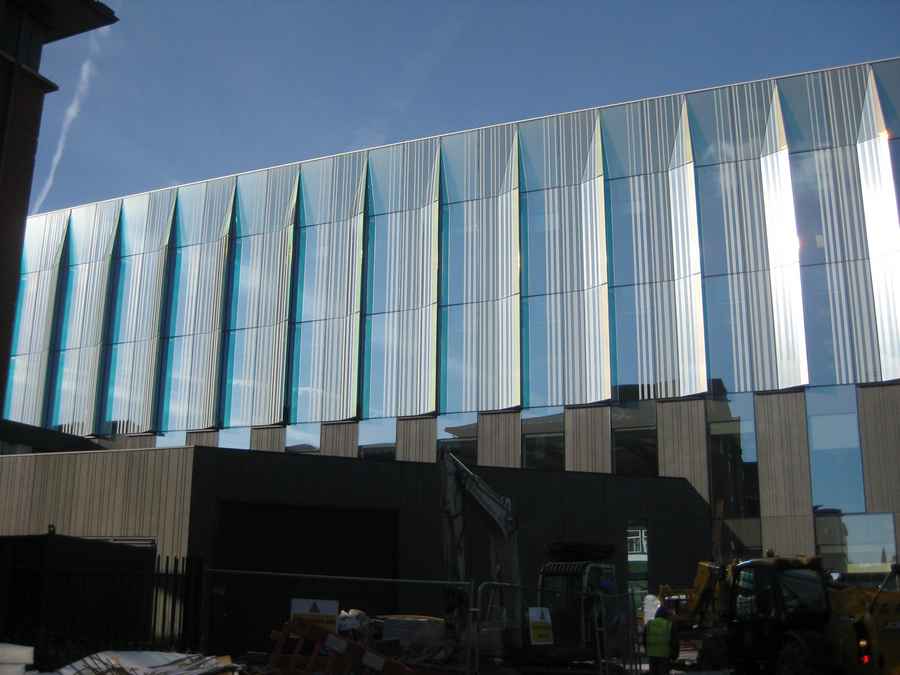


Oxford Road Building

Palace Theatre, Oxford Road

Barton Arcade, Deansgate / St Ann’s Square


Manchester Royal Infirmary, Oxford Road


Peter Street Building

St Augustine’s Catholic Church, at Manchester Metropolitan University


The Palace Hotel, Oxford Road


BBC Building, Oxford Road


Debenhams Manchester

Manchester Building Images
Photos © Adrian Welch, May 2011:
New Islington – houses at Islington Square by FAT

Manchester Central – Conference Centre


Old Trafford Manchester – Man Utd FC Stadium


The Point at Old Trafford Cricket Ground

Manchester Town Hall Redevelopment – Extension

Manchester Refuge Assurance Building – now the Palace Hotel

Milliners Wharf, close to New Islington, east of city centre


Piccadilly Basin – incl. BDP Architects offices on south side


Vantage Quay Buildings, east of city centre


Manchester Building Photographs
Photos © Adrian Welch, Apr 2010:
Skyline Central – just completed

Manchester Civil Justice Centre – Denton Corker Marshall Architects

Manchester Hilton Hotel : Beetham Tower – Tallest residential tower in Europe

Peoples History Museum – recently completed


Manchester Urbis – Ian Simpson Architects

Manchester Science Museum building

Deansgate Apartments – Ian Simpson Architects

Piccadilly Gardens – Tadao Ando Architect + EDAW

Manchester RBS offices Buildings


Bridgewater Hall – RHWL Architects


Oldham Street – famous for cutting edge record shops, Dry 201 bar & Affleck’s Palace:


Great Northern Tower
Assael Architects


Various other photos of Manchester buildings:
Albert Memorial

Art Deco Building

Barton Arcade


Canal bridge

Central Library


Chancery Place

Chetham’s School

Chinatown Manchester


Cornerhouse Theatre

Corporation Street square, adj. Triangle shopping centre & Selfridges

Former Fish Market – follow Oldham Street link (up this page) for more photos

Free Trade Hall

Freemasons Hall

Green Room, Whitworth Street


Hacienda Apartments


Harvey Nichols

Hotel Victoria, Oxford St / Whitworth St


Kendals – department store

King Street buildings


Litecraft building

Manchester canal

Manchester Cathedral


Manchester Central – formerly the GMEX


Manchester Courts

Manchester pub – Rising Sun

MEN arena


Midland Hotel


Mr Thomas Chop House

Opera house

Oxford St apartments

Palace Hotel – formerly Manchester Refuge Assurance Building


Palace Theatre

Piccadilly Manchester – Armada (former Piccadilly Hotel)


The Printworks


Renaissance Hotel


River Irwell Buildings


Royale Manchester


Shambles Square


Spinningfields Buildings


St Anne’s Church


St Anne’s Square


St George’s House

The Ritz – famous nightclub, Whitworth Street


Whitworth St apartments


Whitworth Street Building

Other examples of Manchester Architecture welcome: info(at)e-architect.com
15 Jun 2006
Manchester Building Photos
Manchester building photos © Adrian Welch 2006:
Castelfield buildings, south of city centre

Castelfield buildings
Castlefield is an inner city conservation area of Manchester in Northwest England. The conservation area which bears its name is bounded by the River Irwell, Quay Street, Deansgate and Chester Road. It was the site of the Roman era fort of Mamucium or Mancunium which gave its name to Manchester.
Castlefield was designated a conservation area in 1980. It became the United Kingdom’s first designated urban heritage park in 1982.
Manchester Science Museum building, southwest of city centre

Manchester Science Museum building
The museum opened at this site on 15 September 1983 and later expanded to include the whole of the former station. The museum used to be located on Grosvenor Street to the south of the city centre and had close ties with UMIST, having mostly grown out of the Department of History of Science & Technology.
Deansgate Apartments, northwest of city centre
Design: Ian Simpson Architects

Deansgate Apartments
RBS Manchester offices, off Deansagte, west of city centre

RBS Building Deansagte
John Rylands, west of city centre

John Rylands
The John Rylands Library and the library of the University of Manchester merged in 1972 into the John Rylands University Library of Manchester. Special collections built up by both libraries were progressively concentrated in the Deansgate building.
Manchester Law Courts, west of city centre

Manchester Law Courts
The Manchester Civic Justice Centre is the United Kingdom’s largest civil and family court to be built for more than 100 years. It has been honoured with over twenty architectural awards.
Manchester bridge – Calatrava structure, west of city centre

Manchester Transport Interchange, north of city centre

Manchester Urbis, north of city centre

CIS Tower, north of city centre

Triangle shopping centre, northwest of city centre

Manchester Piccadilly photos, east of city centre

Oldham Street, east of city centre

More Mancunian architectural photographs:
Great Northern Tower
–
Design: Assael Architects

The John Rylands Library refurbishment
Dates built: 2003-07
Design: Austin Smith: Lord / Lloyd Elans Pritchard


Arndale Centre
Dates built: 1972-75; 1975-79; redeveloped 2005
Design:

Arndale Centres were the first “American style” malls to be built in the United Kingdom. In total, 23 Arndales have been built in the United Kingdom, and 3 in Australia. The first opened in County Durham, in 1961.
Manchester had the largest of the Arndale Centres. It was constructed in phases between 1972 and 1979, at a cost of £100 million. It was redeveloped after the 1996 Manchester bombing.
Various Manchester Buildings:


Manchester building photos – scans (ie low quality) © Adrian Welch 1989-92:


Manchester building photos – © Adrian Welch Aug 2006:
Castlefield housing:

Manchester church buildings – Castlefield church:

Location: Manchester, Northwest England, UK
21 Sep 2006
New Manchester Developments Photos
Manchester building photos © Matthew Ansell, September 2006:
Manchester Law Courts building:

The Manchester Civic Justice Centre is the United Kingdom’s largest civil and family court to be built for more than 100 years. It has been honoured with over 20 awards including a Royal Institute of British Architects’ National Award for Architecture and the Australian Institute of Architects’ Jørn Utzon Award for Most Outstanding Work of International Architecture.
Manchester bridge – Calatrava structure:

Manchester housing – Moho for Urban Splash:

This inner city property development is by leading developer Urban Splash. They are a British company which regenerates decaying industrial warehouses, mills, Victorian terraced houses and other buildings. The company has its head office in Castlefield, Manchester, but works across the United Kingdom.
Manchester Urbis – building photos:

Urbis is a unique building in Cathedral Gardens, designed by Ian Simpson Architects with consulting engineers Martin Stockley Associates. The building opened in June 2002 as part of the redevelopment of Exchange Square known as the Millennium Quarter. The building has six storeys and a distinctive sloping form.
New Islington Manchester – Will Alsop model:

Islington Square, designed for Manchester Methodist Housing Association (MMHA) by architects FAT, comprises 23 new homes for the tenants of the former Cardroom Estate, which is now under going a radical transformation. Completing this month, it is the first realised scheme at New Islington, Manchester’s Millennium Community and creates an inspirational landmark for the site.
Various other photos of Manchester buildings:


Other examples of Manchester Architecture welcome: info(at)e-architect.com
Location: Manchester, Northwest England, UK
Manchester Architecture
Contemporary Manchester Buildings
Manchester Architecture Walking Tours
City Introduction
Manchester is a city and metropolitan borough in Northwest England with an estimated population of 512,000. It lies within the United Kingdom’s second most populous urban area which has a population of 2.5 million. Manchester is located in the south-central part of Northwest England, fringed by the Cheshire Plain to the south and the Pennines to the north and east, and an arc of towns with which it forms a continuous conurbation.
The local authority is Manchester City Council, and the city’s inhabitants are referred to as Mancunians. The recorded history of the city began with the civilian settlement associated with the Roman fort of Mamucium, which was established in c. 79 CE on a sandstone bluff near the confluence of the rivers Medlock and Irwell.
Historically, Manchester was in Lancashire, although areas of Cheshire, south of the River Mersey were incorporated into the city during the 20th century. Throughout the Middle Ages Manchester remained a manorial township but began to expand “at an astonishing rate” around the turn of the 19th century.
Source: wikipedia
Buildings / images for the Manchester Architecture Photos page welcome