
Terns Restobar Coimbatore, Tamil Nadu
30 January 2026
Design: Ksquare Architects
Location: 26, Terns Thottipalayam Pirivu, Goldwins, Civil Aerodrome Post, Coimbatore, Tamil Nadu, southern India, South Asia
Photos by PHX India
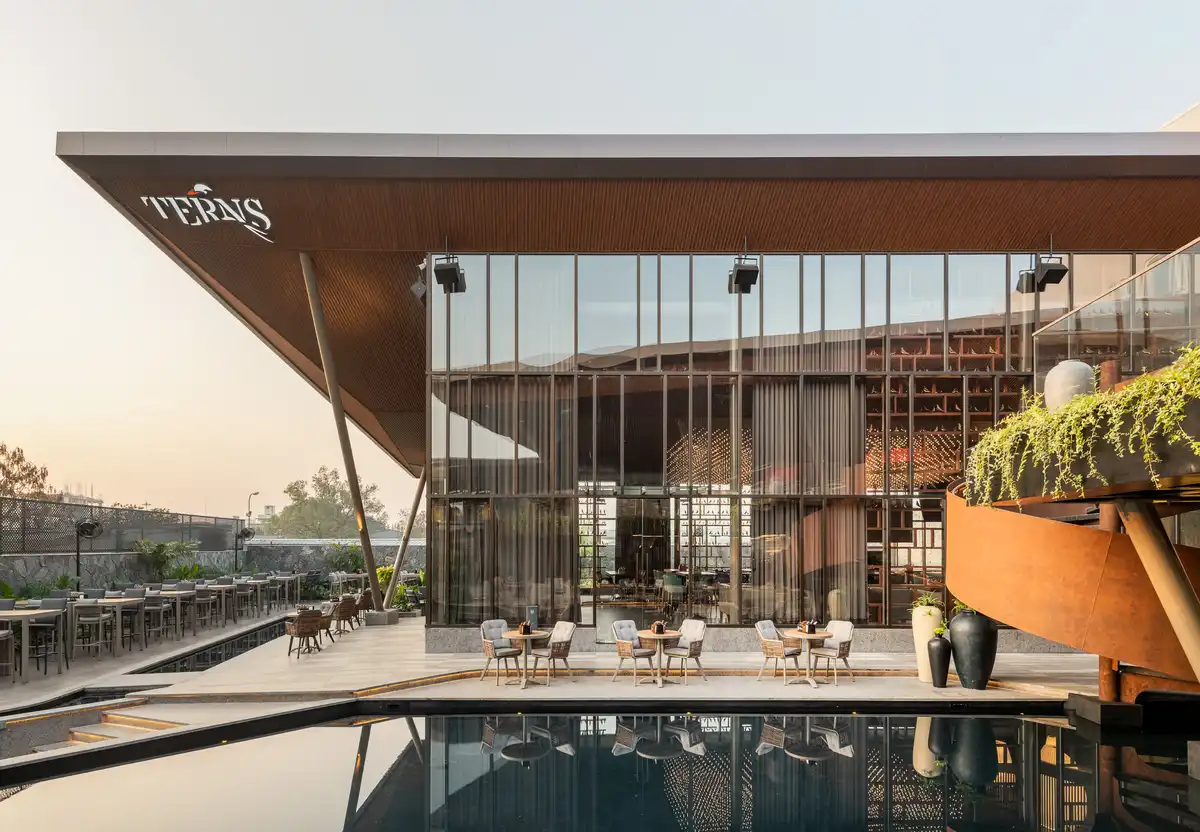
TERNS is not just a building, but an experience— where bold roof forms, transparent spaces, and water-led courts dissolve the line between inside and outside, shaping a seamless setting for gathering, movement, and pause.
1. Site context
Located in Coimbatore Civil Aerodrome Post, the site sits at a transition point between the city’s developing urban edge and its quieter semi-rural surroundings. Physically, it is framed by low-rise neighborhoods, industrial pockets, and open fields. Culturally, the area balances growing commercial activity with a familiar culture of outdoor gathering, social dining.
2. Client’s brief
The client, engaged in multiple industries including construction and textiles, approached the project with a clear brief: to transform an empty, undeveloped plot into a restobar destination that could welcome a wide spectrum of users—from family visitors to social gatherings and party crowds. Alongside the hospitality program, he envisioned the addition of compact hotel blocks to accommodate guests who wish to stay on-site.
Because the land is leased, the client emphasized that all structures must be temporary, removable, and reusable. This led to the decision to build primarily with steel and glass, enabling faster execution, future adaptability, and the freedom to explore a more dynamic architectural language than a conventional permanent build. The result is a framework designed for flexibility—an identity that can evolve, relocate, or grow with changing needs.
3. Project constraints & design response
Timeline & Construction Strategy:
As the land is leased, the client required the project to be designed, constructed, and operational within 12–15 months. Opting for a steel structural system enabled rapid fabrication, on-site assembly, and early occupation—making the timeline achievable without compromising design intent.
Dynamic Structure & Structural Expression:
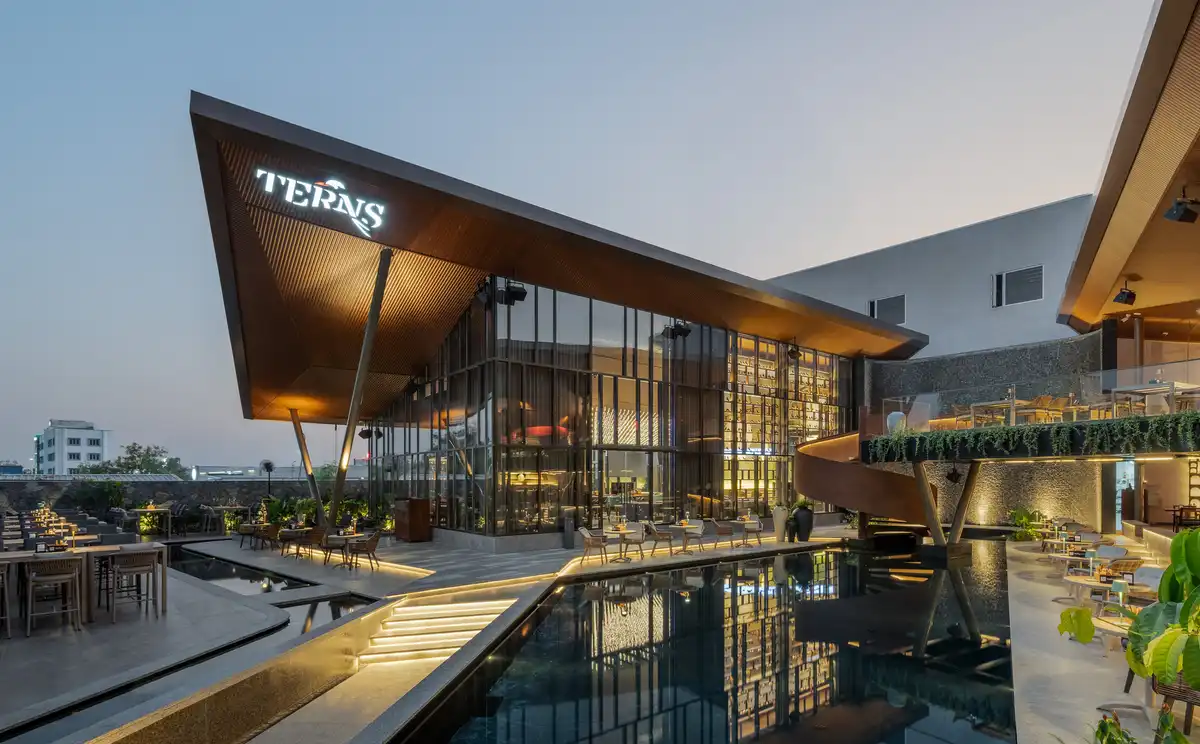
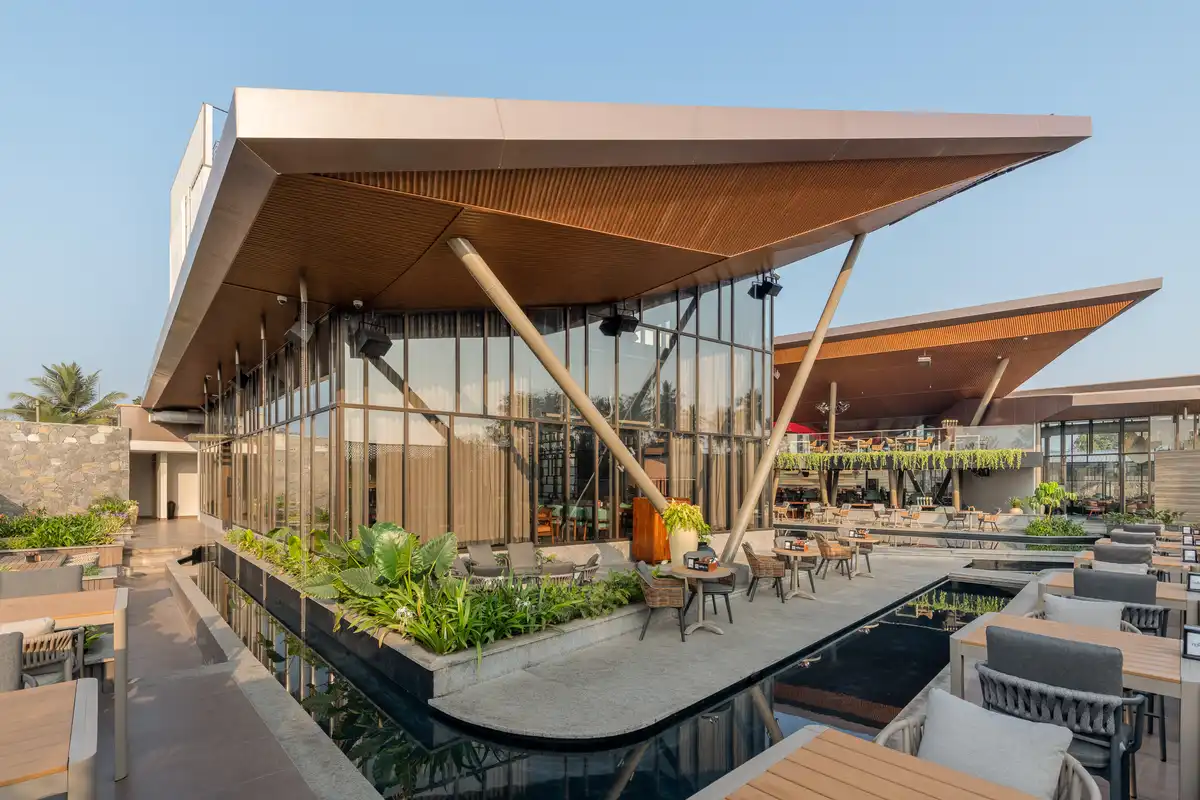
A defining requirement was to create a dynamic architectural character, highlighted by large, tilted roof planes extending in multiple directions. Conventional edge-supported columns diminished the cantilevered effect, so the design developed a system of V-columns originating from the central floor and branching outward to support the roof. Once the interior is furnished and occupied, these supports visually recede, allowing the roof to read as a floating plane. In the indoor dining zone, primary supports were shifted to the perimeter and wrapped in glass, further concealing their presence and reinforcing the floating roof expression.
Rules and regulations:
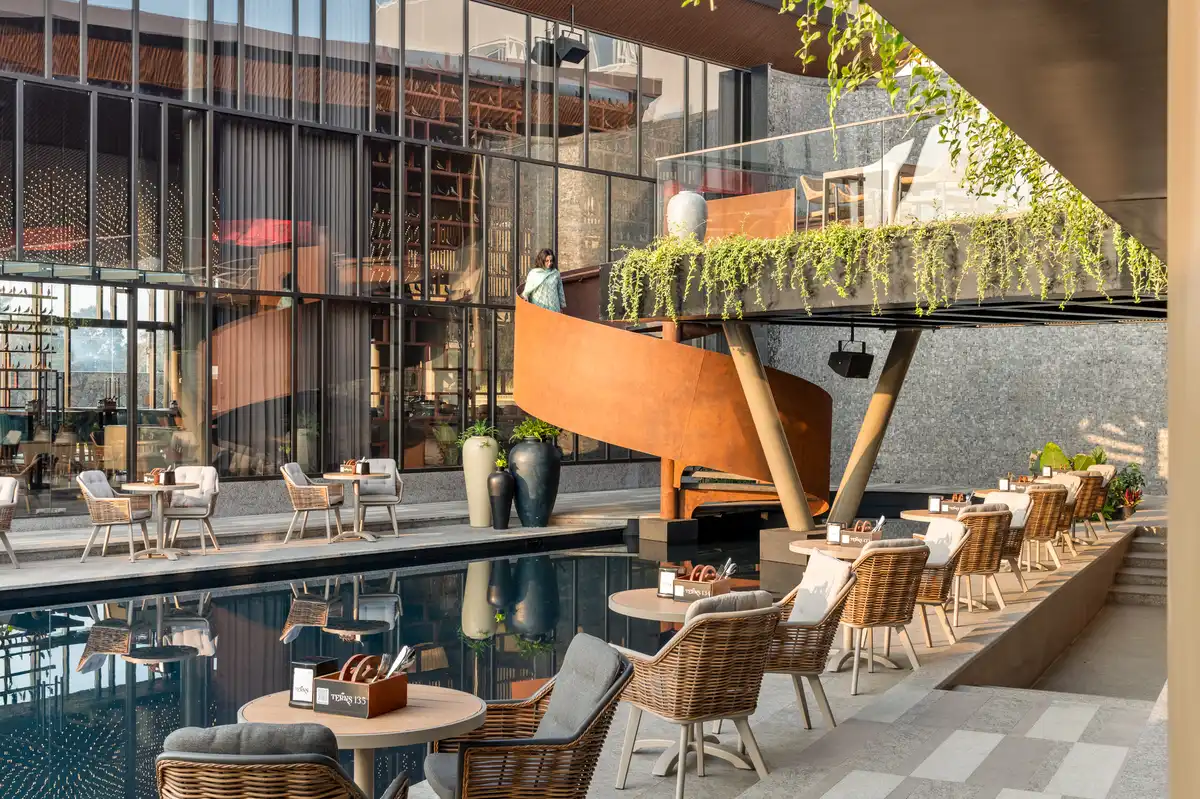
Rules required a large portion of the site at the perimeter to be remaining open to the sky, limiting construction. This area was reinterpreted as a landscape spine with water bodies, planting, and stepped outdoor dining pockets. What began as a restriction became one the key spatial feature, creating a buffer from the surroundings and giving the project a sense of being enclosed in its own landscape.
4. Design Concepts & Solutions
Central Courtyard as a Spatial Anchor
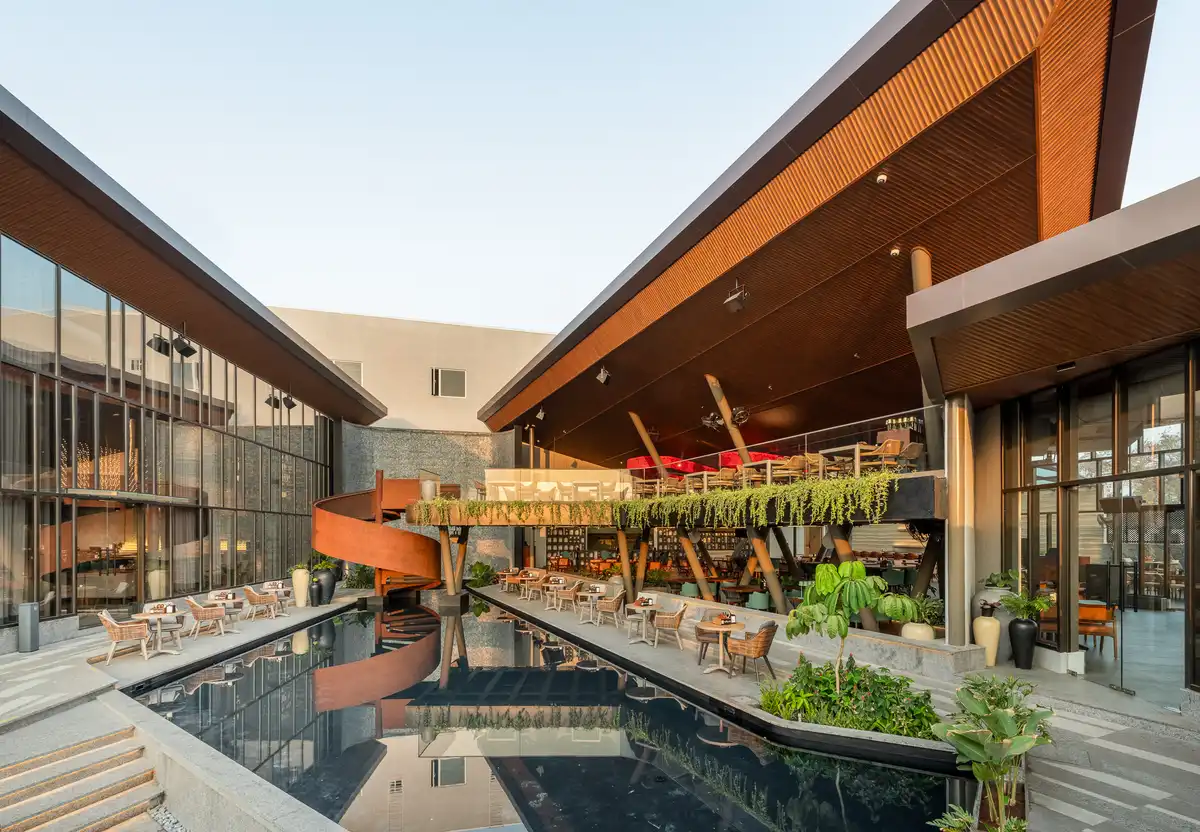
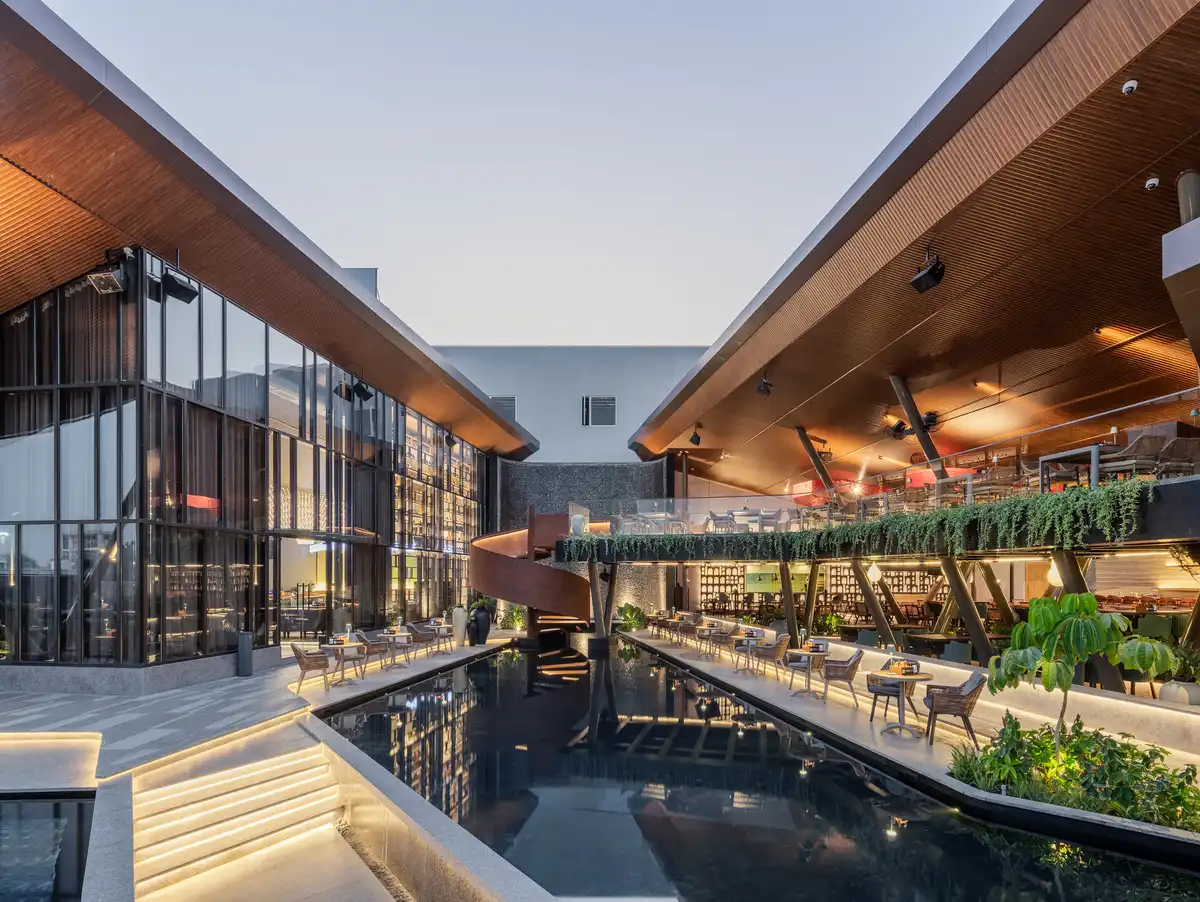
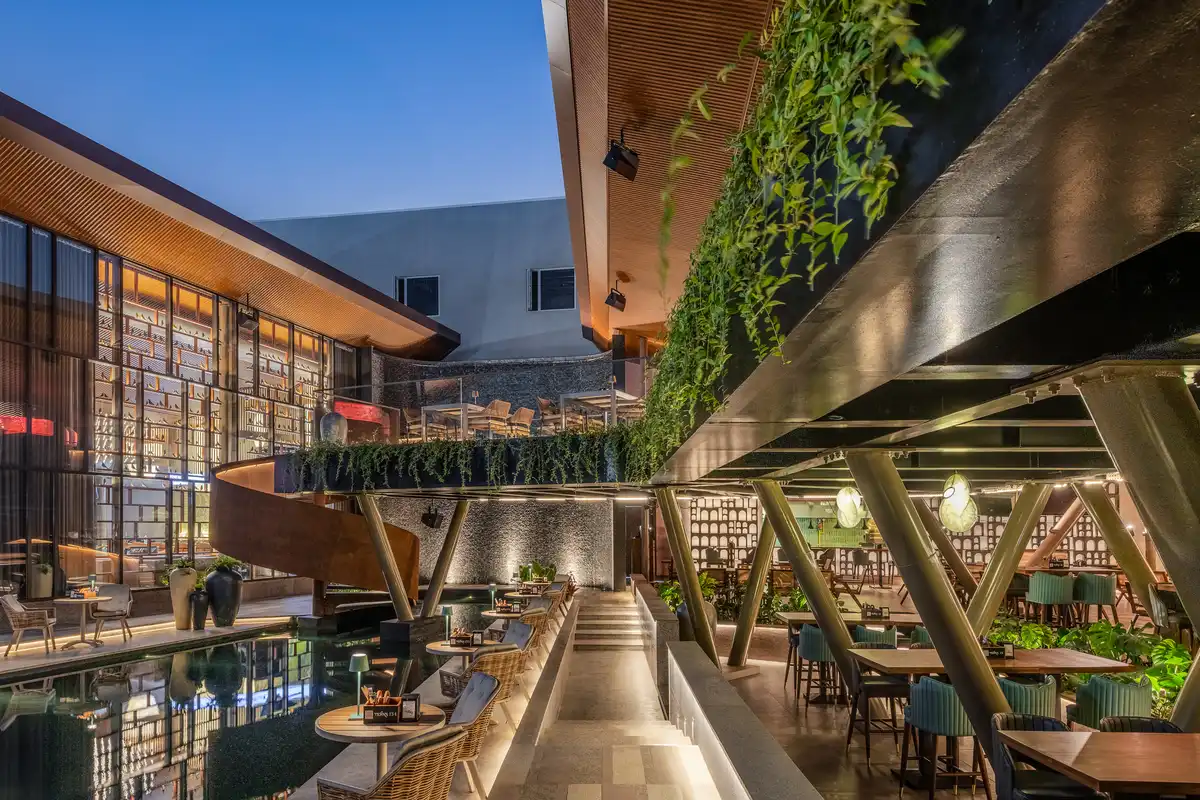
given the site’s location amid low-rise residential and commercial plots with constant movement around it, the design turns inward to create a sense of detachment. A central courtyard with a 23-foot free-standing water cascade and linear water body becomes the core, splitting the built mass into two wings on either side. Both indoor and semi-indoor dining spaces face this courtyard, while the water body extends into the setback as a landscaped spine, reinforcing the buffer from the surroundings.
Multi-Level Dining & Floating Bridge Deck:
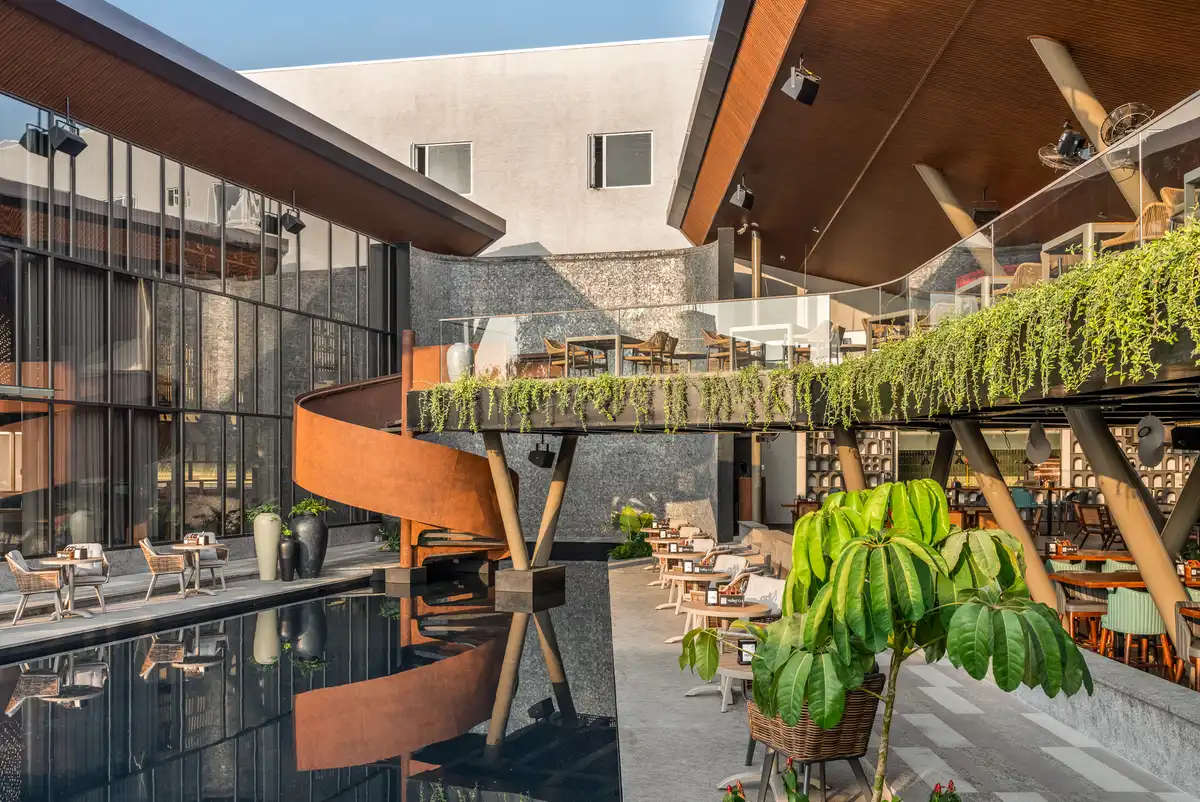
to enhance engagement with the water, the courtyard incorporates tiered floor levels with dining pockets at different elevations. A floating bridge deck spans above the central pool, accessed by a spiral staircase, offering elevated views of the cascade and layered user movement. This creates one of the project’s signature experiences—visitors encounter people circulating vertically, making the space feel active and animated from entry.
Roof Geometry:
The roof is split into three tilted planes: two rise from 12 feet at the setback edge to 25 feet toward the courtyard, framing views into the central space, while the third tilts toward the landscaped setback near the parking zone and it was divided by glass façade and a lush landscape infront of the glass to avoid visual of vehicular movement. This strategy directs visual focus inward, enhances openness, and shapes the project’s dynamic silhouette.
Lighting & Interior Installations:
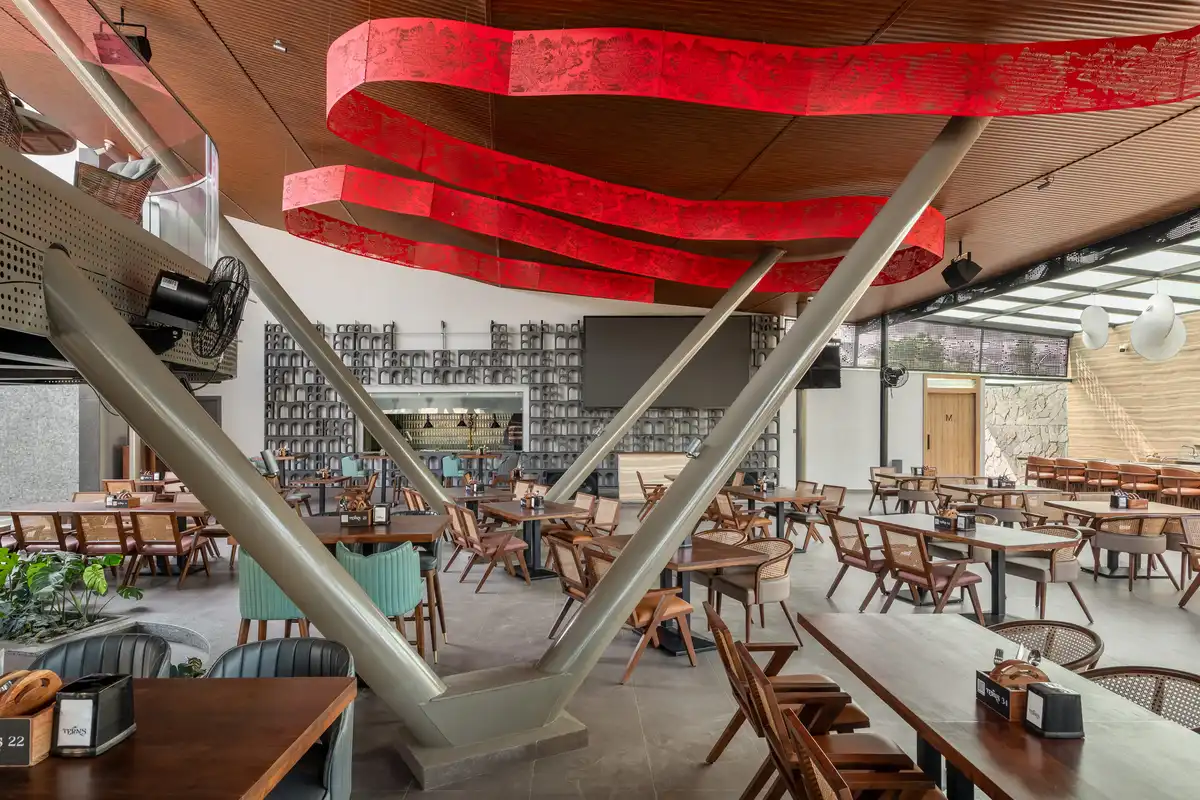
With the glass panels defining the enclosure, the interiors are animated through suspended installations and focused lighting. Q3 pendant lights frame the bar and dining zone as a visual anchor, while an aluminum partition with miniature bird figurines faces the courtyard, adding a crafted layer of detail. In the semi-outdoor area, a red ribbon-like metal installation etched with a cityscape introduces movement and color overhead. At the café core, clustered paper lanterns soften the atmosphere, balancing the structural expression with a warmer, more tactile character.
5. Design Techniques & Material Choices
With the primary skin built as a metal framework, the material palette was selected to balance its structural clarity with a nature-led atmosphere. The project combines Timber finish ceilings, concrete textures, granite flooring, corten steel accents, rubble stone cladding, and large contemporary glass panels, complementing greenery, water elements, and the overall tropical intent—so that the space feels warm, tactile, and closely connected to its tropical context.
6. Conclusion
TERNs contributes to its surroundings by creating an inward-facing environment that buffers noise, improves on-site microclimate through landscape and water, and reduces permanent impact with a removable steel-and-glass structural system. It serves the community as a shared space for diverse users—families, travelers, and social groups—becoming a public leisure node rather than just a commercial venue.
Its lasting legacy lies in showing how a temporary structure can still create place, identity, and atmosphere, proving that meaningful architectural impact doesn’t rely on permanence, but on experience.
Terns Restobar Coimbatore, Tamil Nadu, India – Property Information
Project Name – Terns
Projetc Category – Architecture & Interior Design
Project Location – Coimbatore, Tamil Nadu
Project Size – 35000 Sq.ft
Project Status – Completed – 2025
Architect / Designer – P.ar.krishna Kishore, P.ar.karthik Hariharan, Sr.ar.abubakkar Sithik, Sr.designer. Solai Karthik
Website: www.ksquarearchitects.com
Instagram Link: https://www.instagram.com/ksquarearchitects/?hl=en
Photographer Credits – PHX INDIA: https://phxindia.com/
Restaurant building designs + Bar designs
Terns – Restobar Coimbatore Tamil Nadu, India images / information received 300126 from Ksquare Architects
Address: 26, Terns Thottipalayam Pirivu, Goldwins, Civil Aerodrome Post, Coimbatore, Tamil Nadu 641014, India
Phone: +91 99433 77773
Location: Coimbatore, Tamil Nadu, India, southern Asia.
Tamil Nadu Buildings
Contemporary Architecture in Tamil Nadu
K-Home, Tamil Nadu, India property
Design: Cadence Architects
photo : Ekansh Goel
Learning Centre at Quest, Chennai, Tamil Nadu, southern India
Design: KSM Architecture
APathy House in Coimbatore, Tamil Nadu,
Gauri Aman Residential Complex Chennai,
ELA Residential Complex Chennai
+++
Indian Architecture
Indian Architecture Designs – chronological list
Comments / photos for K-Home, Tamil Nadu, India designed by Ksquare Architects page welcome.


