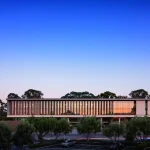
BIC Gelsenkirchen, Bildungs und Innovationscampus, Germany
2 June 2026
Design: C.F. Møller Architects
Location: Gelsenkirchen, Germany

BIC Gelsenkirchen – Bildungs und Innovationscampus News
Transformation of a central urban site in Gelsenkirchen into a new educational and innovation campus that combines vocational education, collaboration, and public activity within a flexible and open architectural framework.

The task was to create a new building for the Berufskolleg für Technik und Gestaltung (BTG) while strengthening connections between education, industry and the surrounding city. The architectural concept responds with a campus structure that links the new educational building with the neighbouring public swimming facility and future sports hall. Clear urban edges, visual axes and direct pedestrian routes organise the site and create a coherent campus environment. The main entrance at the corner of Florastraße and Overwegstraße establishes a visible address towards the city and connects the building to the public realm.

The building is organised around an open ground-floor level functioning as an accessible “anchor”. Public programmes such as workshops, a campus meeting space and a front office are arranged around a large foyer, enabling interaction between students, visitors and external partners. Generous daylight openings and visual connections between floors strengthen orientation and create transparent learning environments. Upper floors contain specialised teaching areas and flexible collaboration zones that allow different learning formats and interdisciplinary work.

Timber hybrid construction
The architecture uses a structural system based largely on timber elements, expressed throughout the interior and façade. The layered terraces step the building volume to mediate between the surrounding urban scales and create accessible outdoor spaces. Large balconies and planted areas support informal learning and social interaction.
Outdoor spaces are integrated as part of the campus concept. Green islands, planted zones and open pathways improve orientation, connect the buildings and provide areas for meeting and recreation. Workshops and campus facilities on the ground floor extend towards these exterior spaces, enabling flexible use and strengthening the relationship between building and city. A new sports hall in timber-hybrid construction complements the campus ensemble and strengthens the spatial and functional connections between education, sport and public use.
Together, the campus establishes a contemporary educational environment that combines vocational training, innovation and urban accessibility.

BIC Gelsenkirchen, Bildungs und Innovationscampus – Building Information
Client: Gelsenkirchner Entwicklungsgesellschaft (Ge mbH)
City: Gelsenkirchen, Germany
Size: 29.718 m²
Year: 2026-
Architect: C.F. Møller Architects
Landscape: C.F. Møller Architects
Collaborators: Diete+Siepmann (Quantity Surveying), Durth Roos Consulting (Trafik), IVT (Storkøkken), wilms Innenarchitektur (Laboratorier)
Engineer: Schüßler Plan (Statik), Gruner (Brand), Assmann Beraten+Planen GmbH (Installationer)
Sustainability: DGNB Gold / QNG
+++
2 June 2026
City of Gelsenkirchen unveils winning design for the new gateway to the campus
Gelsenkirchen’s education initiative is entering its next phase: while construction work on the future Education and Innovation Campus (BIC) has already been underway for several months with the development of the new swimming pool, the city today (Monday, 1 June) unveiled the winning design for the first central education and innovation building on the campus.

“Today marks another important step towards bringing together vocational education, economic development and innovation support in our city more closely and raising their quality to an entirely new level,” says Gelsenkirchen’s Mayor, Andrea Henze.
“The close collaboration between the city and partners from education, academia and industry will soon have a new home at this prominent location in the northern part of the city centre. And I am delighted that we now know what that home will look like.”
The new building, known as the Campus Gateway, will primarily house the Berufskolleg für Technik und Gestaltung (College of Technology and Design) (btg), which prepares more than 2,500 students for careers and further education in fields such as engineering, media and design. The college maintains close links with industry and the skilled trades and plays a central role in developing the region’s future workforce.

In addition to btg, further functions are planned for the central campus building. The Chamber of Industry and Commerce intends to lease space, while new initiatives such as a maker space, campus dining facilities and a competence centre for career guidance are also being developed.
“With this building, we are creating the gateway to the Gelsenkirchen Education and Innovation Campus, which will become a hallmark of our city,” Andrea Henze continues. “The campus will increase the visibility of vocational education and innovation support while strengthening our overall offer. Above all, however, it must be said today that the construction of this winning design will create a significant urban landmark.”
The City of Gelsenkirchen launched an architectural competition to realise its ambitious plans. More than 40 teams took part, and following a multi-stage selection process, C.F. Møller Architects, headquartered in Aarhus, Denmark, was chosen as the winner.

“The proposal by C.F. Møller Architects impressed us through its architectural quality, its clear urban design concept and its ability to bring together vocational education and public life,” says Christoph Heidenreich, Gelsenkirchen’s Head of Urban Development. “The design achieves both: it creates a place that is open to the wider community while giving the incoming btg college a strong identity of its own.”
At the heart of the building designed by C.F. Møller Architects is an open ground floor that will serve as an accessible anchor point connecting the campus with the city and its community. According to the plans, public functions such as workshops, a central campus meeting point and the main entrance will be arranged around a spacious foyer, encouraging encounters and interaction between students, visitors and external partners.
“By opening up the ground floor and creating strong visual connections throughout the building, we are establishing a transparent and welcoming learning environment. The upper floors provide specialised teaching facilities combined with flexible zones that support a variety of learning formats and interdisciplinary collaboration,” says Julian Weyer, Partner and Architect at C.F. Møller Architects.
“The winning design aligns almost perfectly with what we aim to achieve at the College of Technology and Design,” explains Dr Uwe Krakau, Principal of btg. “We want to give students across different programmes the opportunity to learn as independently as possible while providing the best possible support. These spaces will make that very achievable.”

Timber-Hybrid Construction
The proposed structure is based primarily on a timber-hybrid construction system, which will remain visible both internally and in the façade. Stepped terraces will integrate harmoniously into the surrounding urban context while creating accessible outdoor spaces. Balconies and landscaped areas designed to encourage collaborative learning and social interaction are also included.
The outdoor areas will feature green islands, planted zones and open pathways integrated into the campus design to improve wayfinding and strengthen connections between the buildings. Workshops on the ground floor will open onto these areas, allowing flexible use and fostering stronger links between the campus and the city.A new sports hall, also designed as a timber-hybrid structure, will complement the campus in the future. Together with the adjacent central swimming facility, it will strengthen the connection between education, sport and public use.

“The project brings together education, public life and urban connectivity within a single framework, creating a contemporary campus for vocational training and innovation,” says Julian Weyer.
“We are very pleased and proud to have received such an attractive and convincing winning proposal,” says Bastian Scholz, Technical Managing Director of Gelsenkirchener Entwicklungsgesellschaft mbH. However, he notes that C.F. Møller Architects’ submission prevailed against several other strong proposals in the competition.

Exhibition of Competition Entries
The entries from the final stage of the competition will be presented in an exhibition organised by the City of Gelsenkirchen. The exhibition features presentation boards and models from five architectural practices and will be on display from 1 June at the Hans-Sachs-Haus, Ebertstraße 11, Gelsenkirchen. Admission is free.
About C.F. Møller Architects
C.F. Møller Architects is one of Scandinavia’s leading architectural practices and draws on a century of architectural work across the Nordic region and internationally. The practice has offices in Berlin, Aarhus, Copenhagen, Aalborg, Oslo, Malmö, Stockholm and Gothenburg, and has extensive experience in the design of educational and healthcare facilities.
BIC Gelsenkirchen, Bildungs und Innovationscampus images / information from C.F. Møller Architects Office
Location: Gelsenkirchen, Nordrhein-Westfalen, north west Germany, western Europe.
Northwest Germany Architecture
Hans-Sachs-Haus Conversion
Design: von Gerkan, Marg and Partners (gmp)
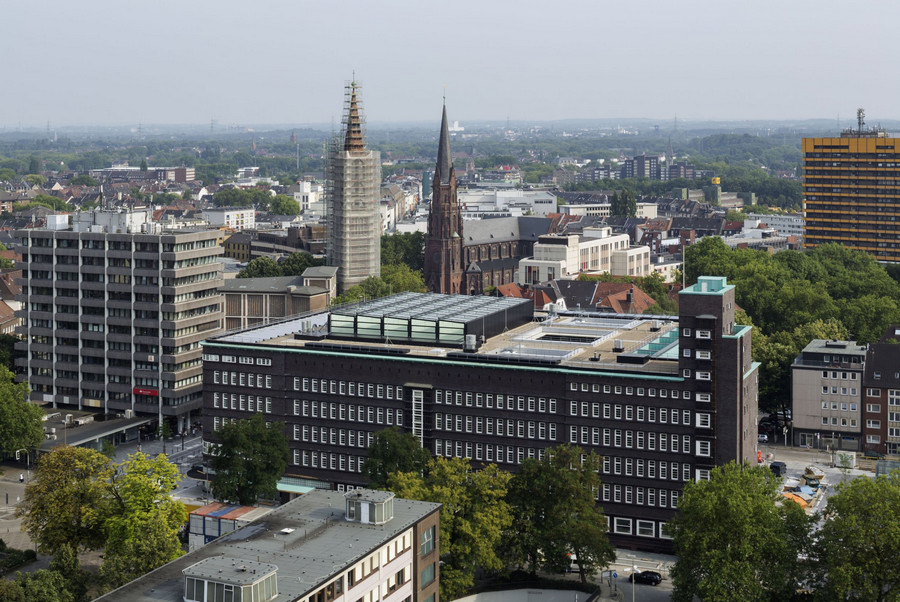
photo from architect office
+++
German Architectural Designs
i8, iCampus, Werksviertel, Munich, Bavaria, southern Germany
Architect: C.F. Møller Architects

photo : Yohan Zerdoun
Curve X Office Building, Düsseldorf, Germany
Architect: JSWD
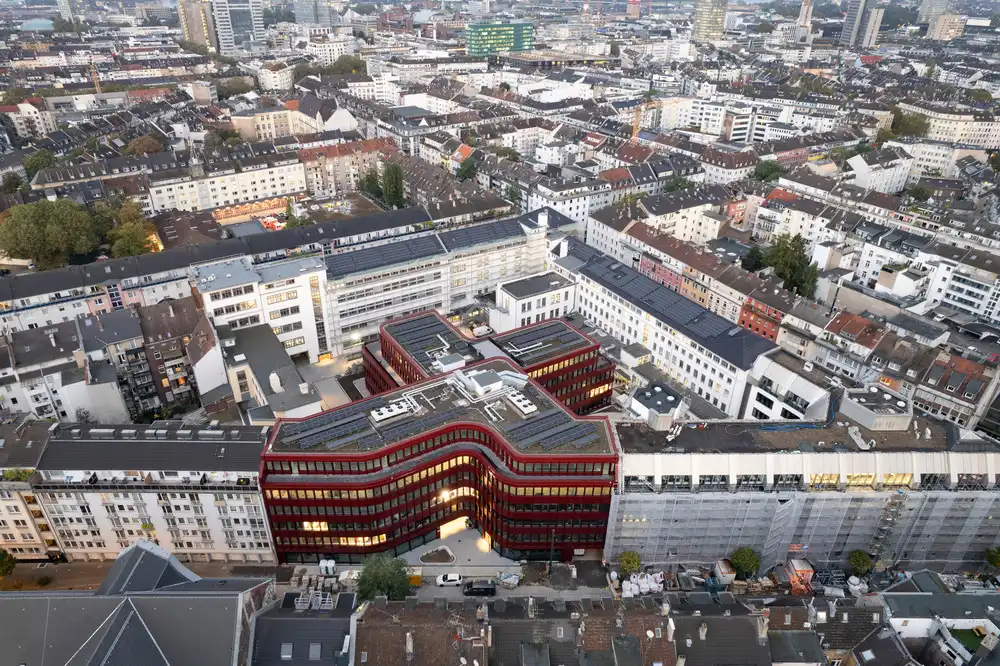
photo © Nils Koenning
++
Architecture in cities near Gelsenkirchen – selection:
Comments / photos for the BIC Gelsenkirchen, Bildungs und Innovationscampus – German Architecture design by C.F. Møller Architects page welcome.