Forestone Cabin in the Pyrenees: IAAC
4 February 2026
Architecture: The Institute for Advanced Architecture of Catalonia (IAAC)
Location: MónNatura Pirineu, Planes de Son, Pyrenees, north east Spain
Photos: Adrià Goula
Forestone by IAAC: an ecological shelter that helps fight wildfires in the Pyrenees
• The Institute for Advanced Architecture of Catalonia (IAAC) has developed this prototype in collaboration with industrial and social entities from the Pyrenees.
• The 2025 cohort of the Master in Ecological Architecture and Advanced Construction was responsible for the design and construction of Forestone Cabin, integrating hands-on fabrication and architectural research
• The structure and envelope were built using locally sourced cross-laminated timber (CLT) panels and charred wood from nearby forests.
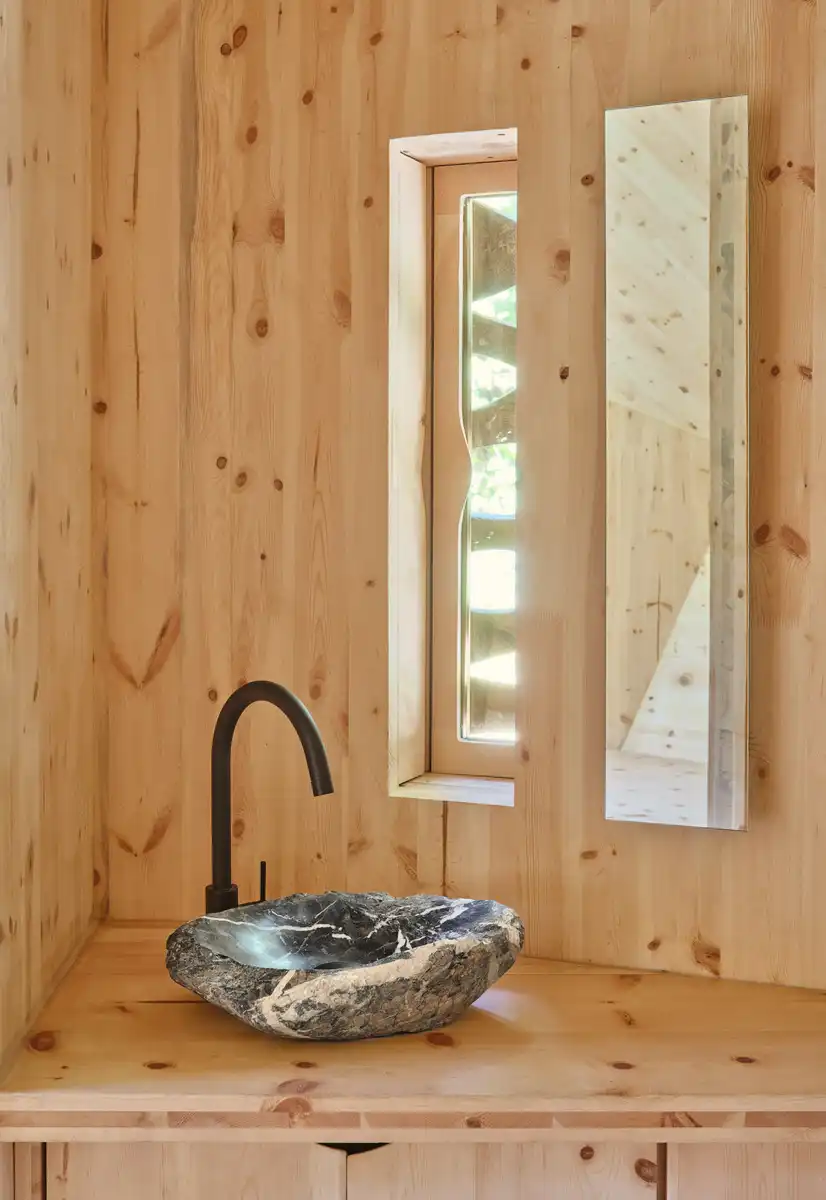
• The interiors incorporate custom-made CLT furniture, local wool textiles, and a hand-carved stone washbasin, merging local craftsmanship with the building’s architecture.
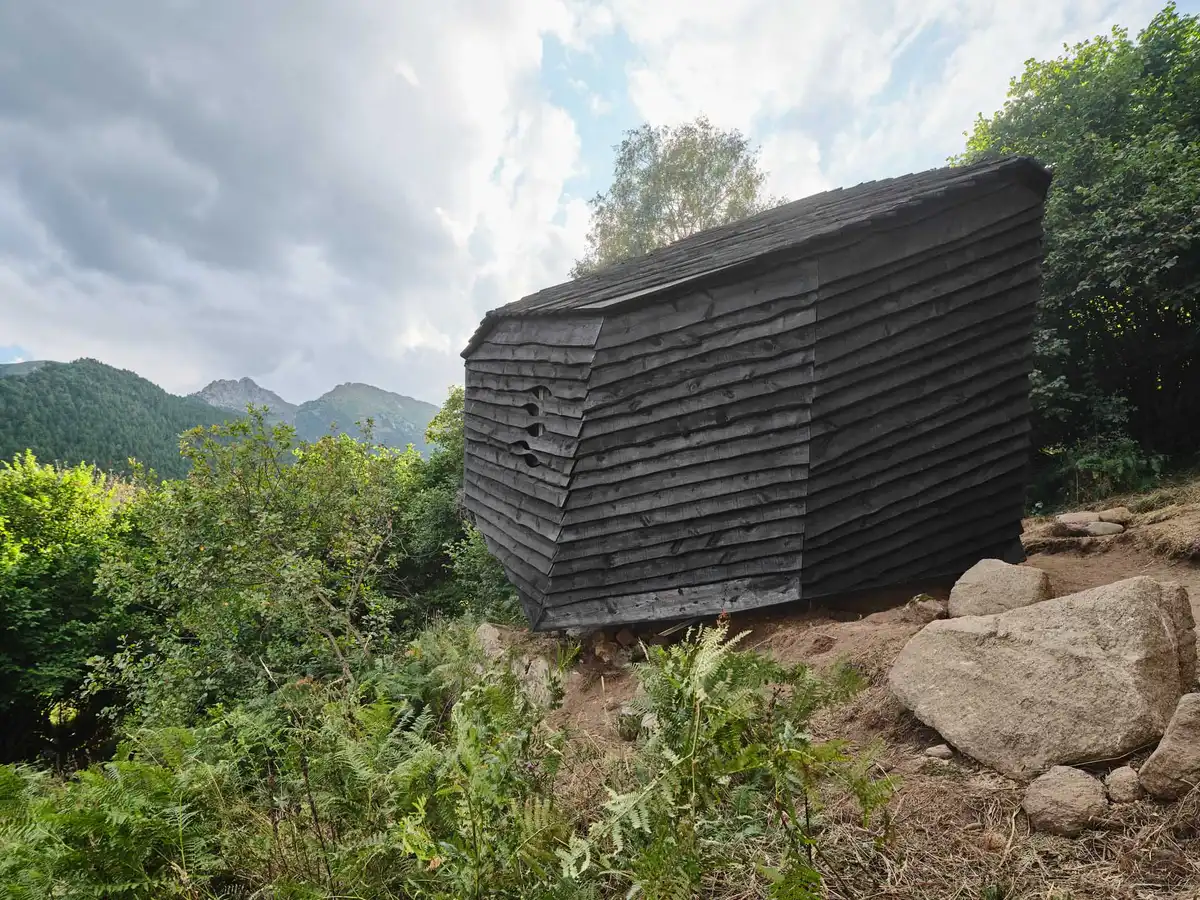
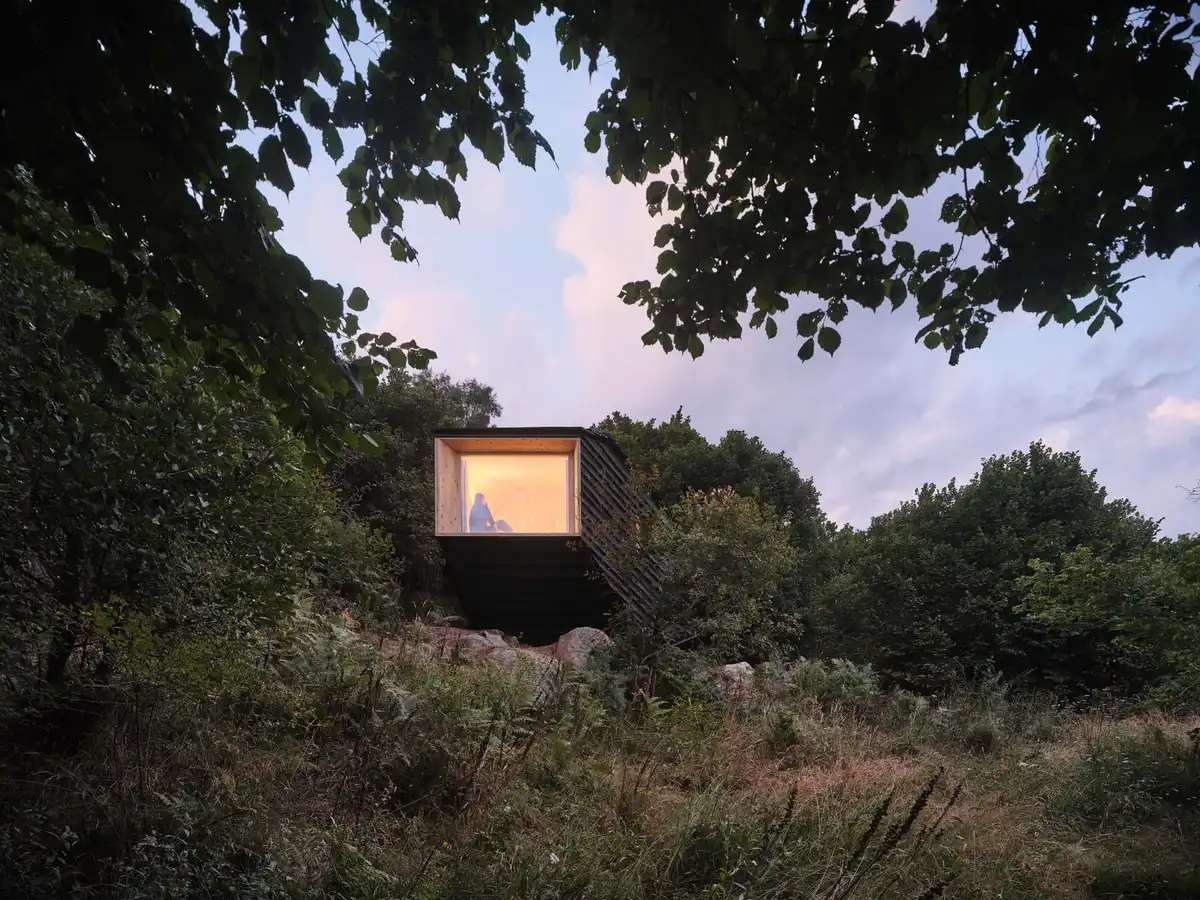
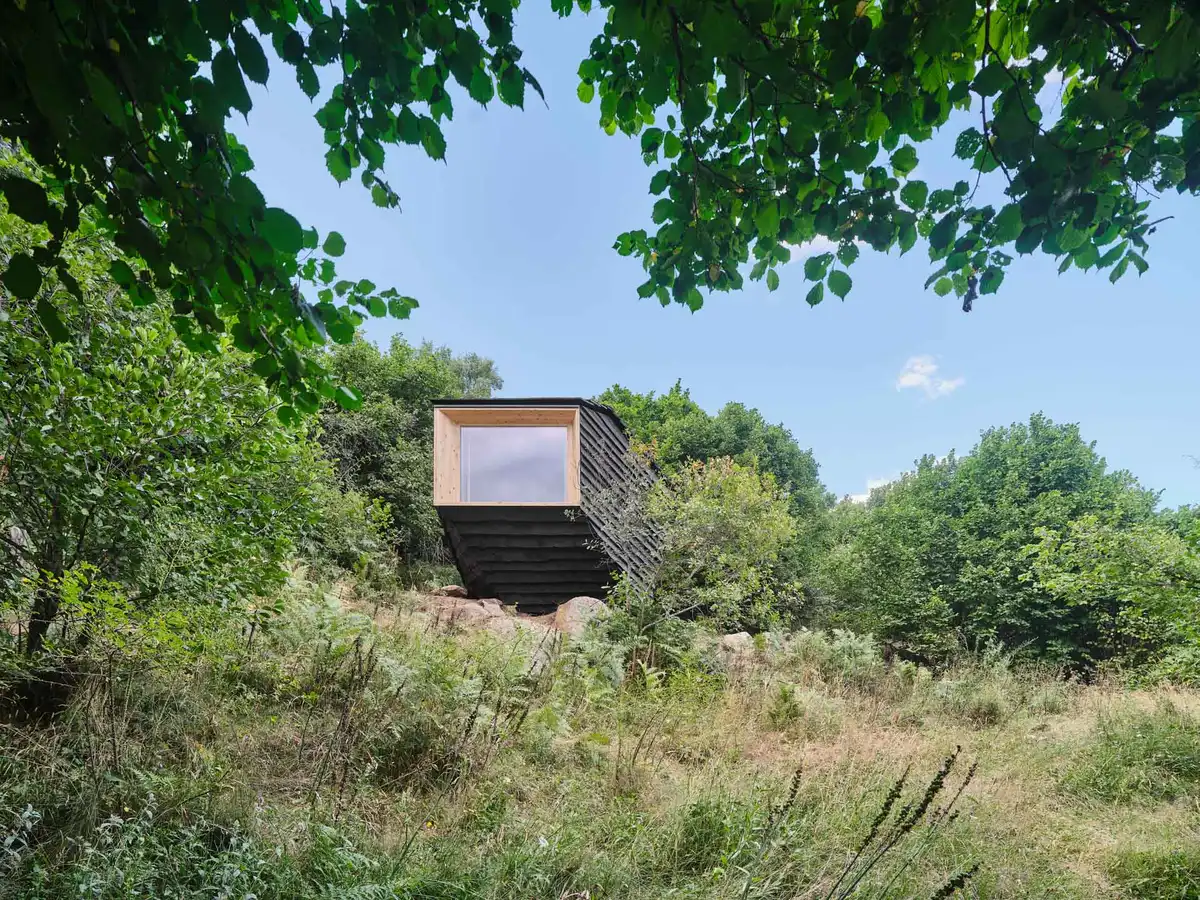
Barcelona, February 2026 – Forestone Cabin is a 20 m² experimental wooden dwelling designed and built by the 2025 cohort of IAAC’s Master in Ecological Architecture and Advanced Construction, as part of the Bio for Piri initiative. Led by the Fundació Catalunya La Pedrera and funded by the Biodiversity Foundation with European Next Generation funds, this initiative promotes regenerative forestry and the sustainable use of local timber from Pyrenean forests, specifically in Alinyà (Lleida). Located at MónNatura Sort, in the Pyrenees, the cabin sits on a sloping site just a few steps from the existing hostel, offering temporary accommodation for two people, with a sleeping area, workspace, and bathroom.
A resting rock: where wood meets the Pyrenees
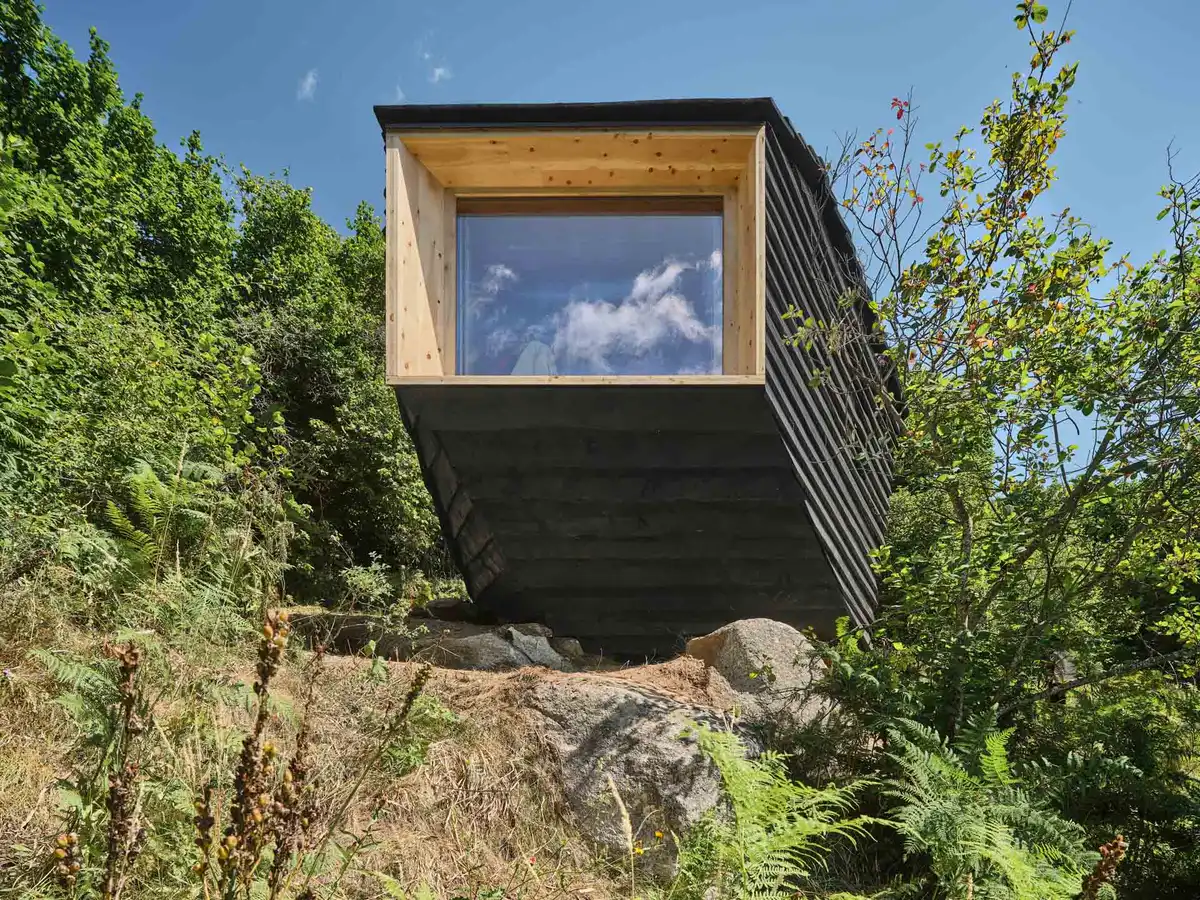
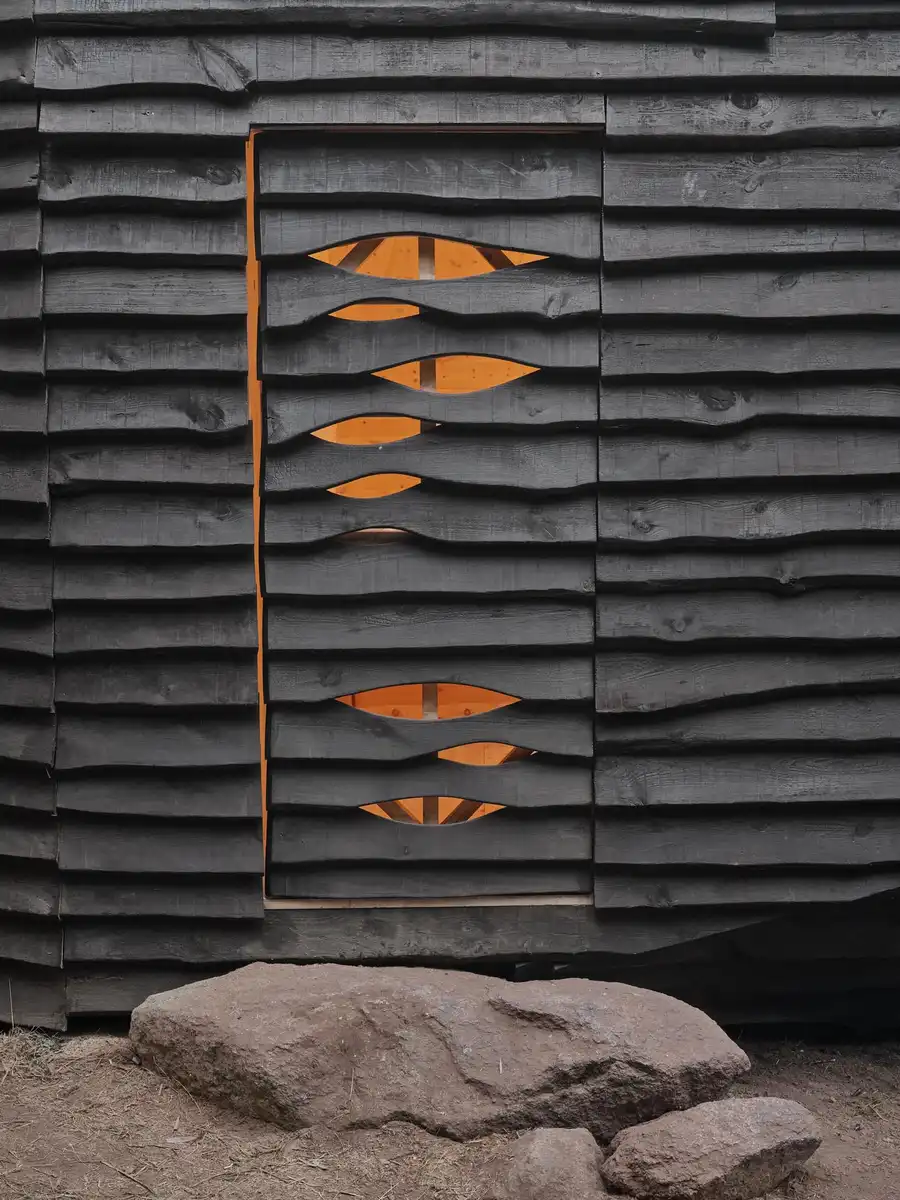
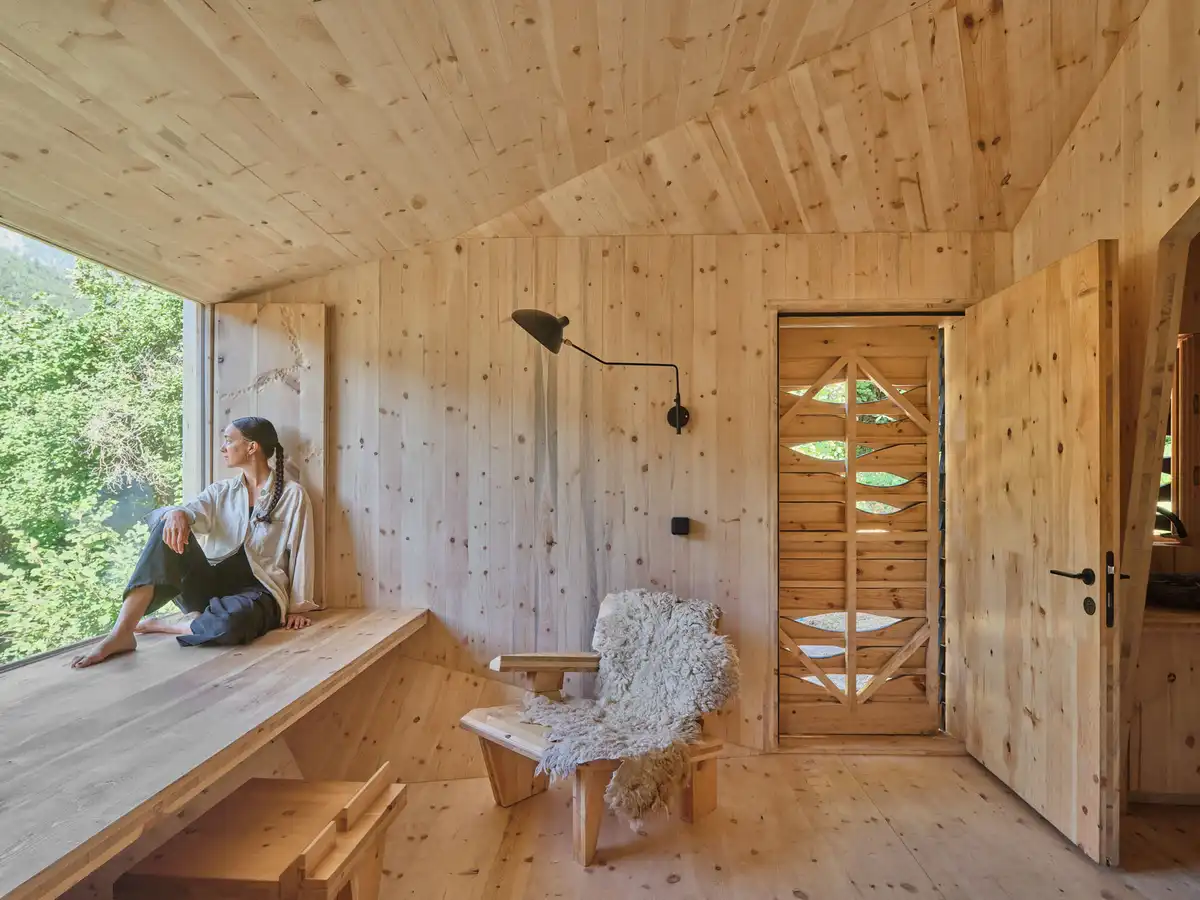
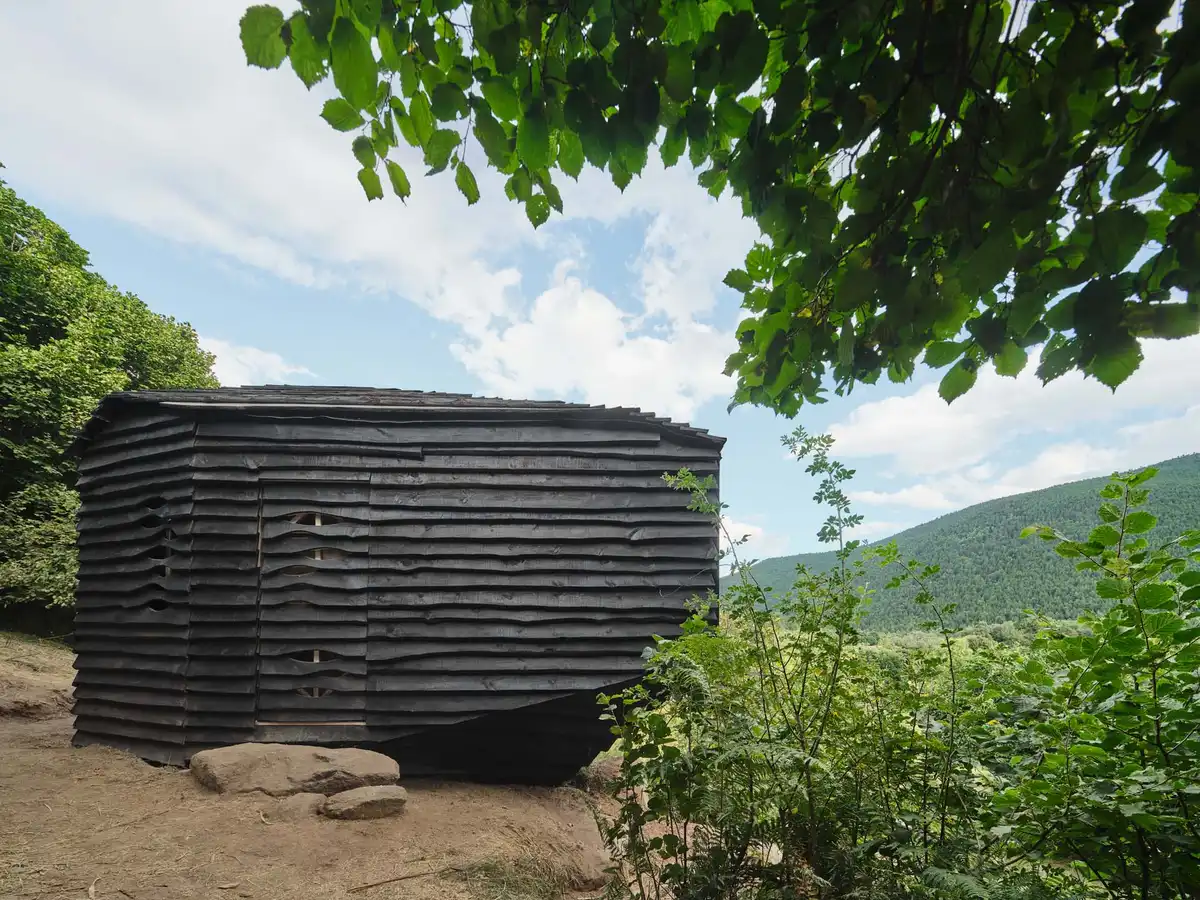
The cabin’s sculptural form is inspired by the rocky terrain of the Pyrenees. Conceived as a block of stone that appears to have rolled down the mountain and come to rest naturally on the site, its faceted geometry is composed of inclined walls and a sloping roof that respond to programmatic needs, climatic conditions, and solar exposure. The geometry subtly adjusts ceiling heights and spatial proportions to accommodate different uses within a compact footprint, while carefully positioned openings frame views of the surrounding mountains and enable cross-ventilation. Operable wooden shutters ensure complete darkness at night, preventing light pollution and supporting the site’s astronomical activities.
The exterior façade is made of pine boards with natural edges that have been charred following the Japanese Yakisugi or Shou Sugi Ban (焼杉) technique, which involves burning the surface layer of the wood to protect it from insects, water, fire, and mold. These boards, cut to size and charred by the students themselves, not only increase the durability of the material but also symbolically evoke fire management and prevention—an essential aspect of regenerative forestry in the Pyrenees, the mountain range that separates Spain and France and whose name, Pyros, comes from Greek and means fire.
Forging a home from the forest: hands, fire, and wool
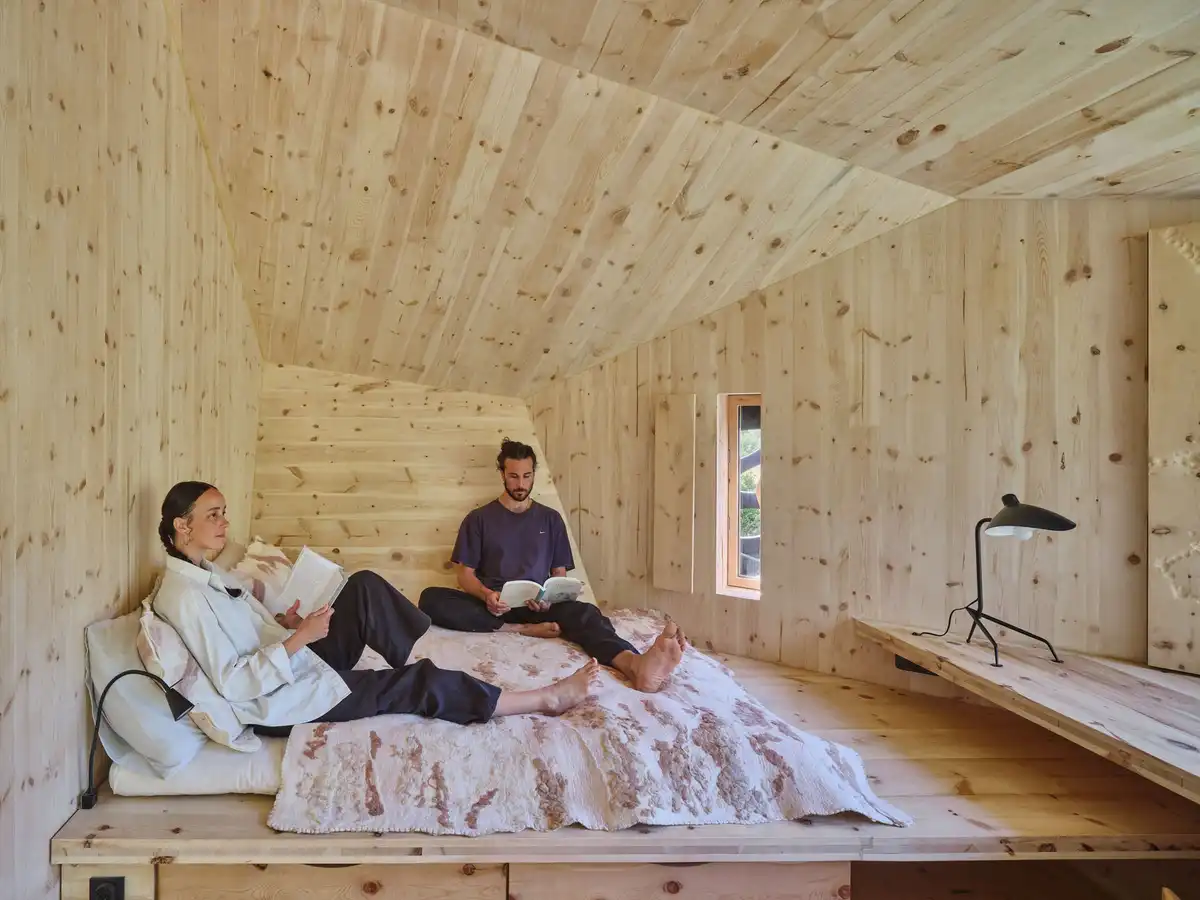
Inside, the cabin becomes a fully integrated wooden space. Custom-made CLT elements—including the bed, built-in furniture, washbasin counter, and seating—were designed and fabricated by the students at Valldaura Labs, reinforcing a hands-on approach in which architecture, structure, and furniture form a single material system.
The cycles of local materials extend beyond wood. During an annual wool festival in the nearby town of Sort, students collaborated with local farmers to collect sheep’s wool, which was later washed, dried, and transformed into felt at Valldaura, with the help and support of Dutch artist Rian van Dijk. The resulting blankets, rugs, and pillowcases furnish the cabin, integrating local craftsmanship and agricultural by-products into the project. On the same visit, students brought back a stone from the surrounding landscape, which they manually carved using power tools to create a unique washbasin, further consolidating the project’s connection to its geographical and cultural context.
From the outset, the project was conceived with an emphasis on replicability. Forestone was designed as a prototype demonstrating how small-scale architecture can be built using local timber, regional knowledge, and low-impact construction methods, while inhabiting forest landscapes without altering existing ecosystems. The use of modular CLT elements, dry-assembly techniques, and locally available materials allows the cabin to be adapted, replicated, or dismantled as needed, offering a model of sustainable forest habitation that aligns architectural production with long-term environmental stewardship.
Forestone exemplifies the integration of education, local industry, craftsmanship, and regenerative forestry. Through its careful detailing, layered construction, and deep connection to place, the project proposes an alternative approach to building in sensitive landscapes, grounded in local resources, knowledge transfer, and ecological responsibility.
From January 2026, the cabin is open to guests at MónNatura Pirineu, in Planes de Son, offering visitors the opportunity to inhabit the prototype and experience firsthand its relationship with the landscape, materials, and climate.
IAAC
The Institute for Advanced Architecture of Catalonia (IAAC) is a center for research, education, production, and dissemination, based in Barcelona with more than 20 years of experience. Its goal is to envision the future habitat of our society and build it in the present. IAAC supports the digital revolution at all scales to expand the boundaries of architecture and design and to address the challenges facing humanity. It is an experimental center where learning takes place through doing, using a trial-based methodology that fosters the development of real-world solutions.
Master in Ecological Architecture and Advanced Construction
The Institute for Advanced Architecture of Catalonia (IAAC) Valldaura Labs and its Master’s program in Ecological Architecture and Advanced Construction are engaged in the learning and development of ecological projects, parametric design techniques, and the processing of locally sourced materials. Founded on the principle of a circular bioeconomy, Valldaura Labs is known for its interest in exploring the boundaries of self-sufficiency and seeking to meet essential human needs, such as food, energy, and everyday use objects. In the previous years, students built the acclaimed projects, the Niu Haus, the VOXEL Quarantine Cabin, the Solar Greenhouse, FLORA, MOCA, and now CORA.
Forestone Cabin in the Pyrenees by IAAC, Catalunya, Spain – Building Information
PROJECT CREDITS:
Direction:
Vicente Guallart, Daniel Ibañez, Michael Salka
Developed by:
The students of the Masters programme in Ecological Architecture and Advanced Construction, 2024/25 class:
Alexander Bruce Herbig, Ateet Singh, Atticus Cummings, Breno Teixeira Martinelli, Dammes de Zoeten, Georgia Ann Hoyer, Isabel Flores, Jasper Runge, Magdalena Kurdzialek, Nina Poort, Pragyna Madhav Thondapu, Reuben Diamond, Shivani Edukulla, Shanon Shahan, Santosh Shyamsundar, Sipan Celiker Sporidis
Host:
Mon Natura Pirineus, Fundació Catalunya la Pedrera
Valldaura Management :
Laia Pifarré
Project Coordination:
Esin Aydemir
Assisted by:
Bruno Ganem, Oliver Needham, Alkis Avarkiotis
Structural assembly: Fustes Sebastia ( Sergi Sebastia, Emma Sebastia Sarroca, Estel Arnal Llunell) y Tallfusta (Ignasi Caus, David Valldeoriola)
Advised by: Miquel Rodriguez, Elena Orte, Guillermo Sevillano, Firas Safieddine, Rian van Dijk
With the support of: Fundació Catalunya-La Pedrera
Volunteers: Andrew Cardona, Grace Yang, Maeve Daley, Sam Hoshin
Photography: Adrià Goula, Alexander Herbig (Autumn series), Nina Poort (Winter series)
Drawings and diagrams: IAAC Students of Master in Ecological Architecture and Advanced Construction
Communication: Pati Nuñez Agency
Watch the making of video: Forestone Cabin on YouTube
Forestone Cabin in the Pyrenees by IAAC images / information received 030226
Location: MónNatura Pirineu, Planes de Son, The Pyrenees, northeast Spain
Barcelona Architectural Designs
Contemporary Architecture in Barcelona – architectural selection below:
Barcelona Architecture – recent designs:
CORA (Cathedral of Robotic Artisans), Parc de Collserola
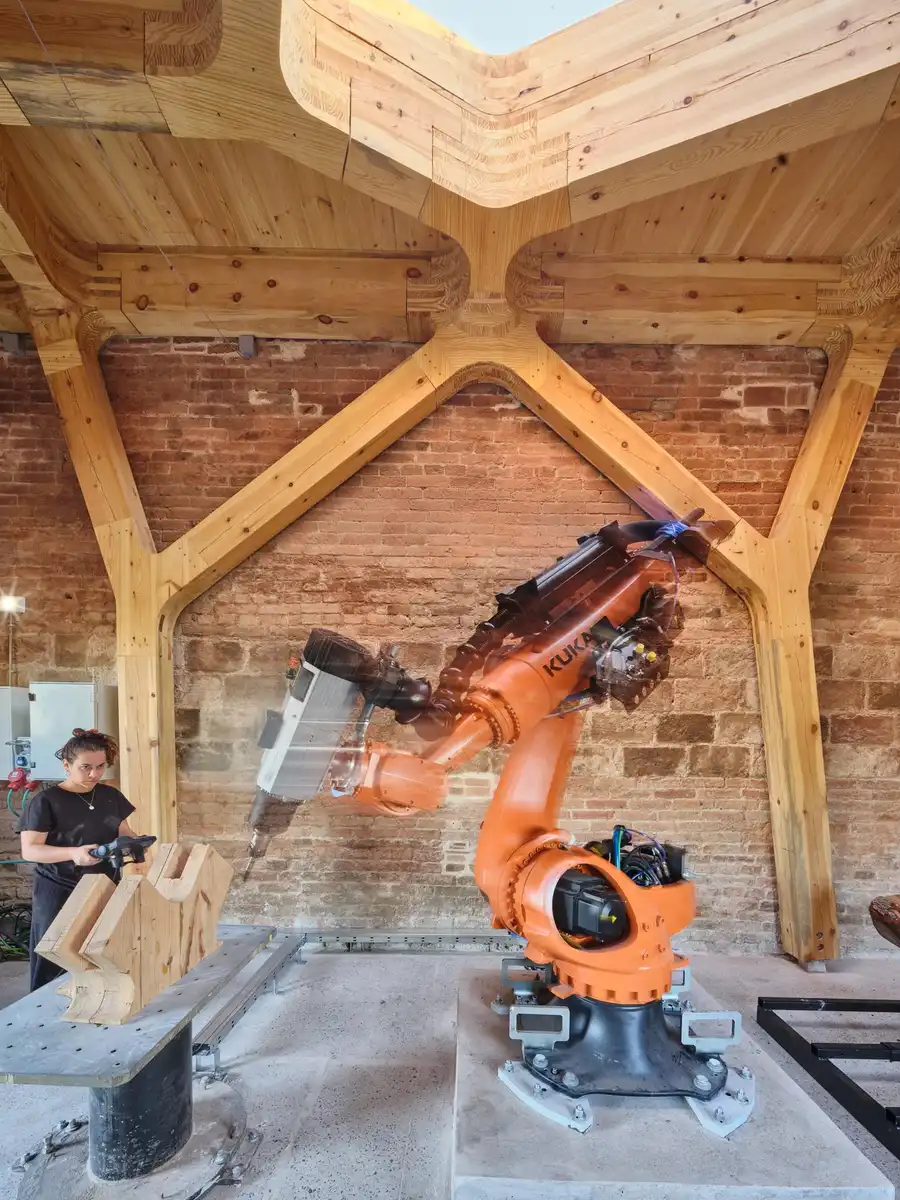
photo : Adrià Goula
ACCIONA Energía Pavilion building, Moll de la Fusta
Architects: Institute for Advanced Architecture of Catalonia (IAAC)
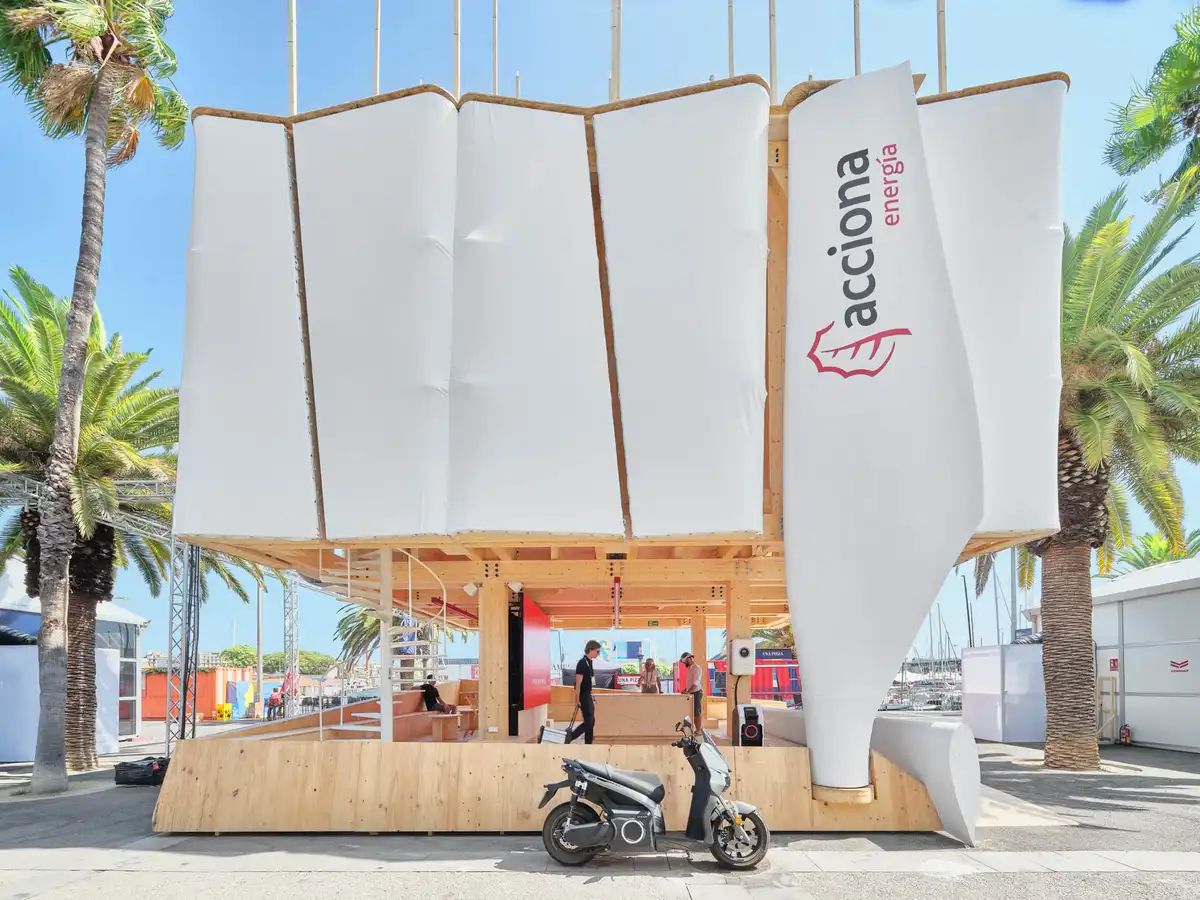
photo : Adrià Goula
Forest Lab for Observational Research and Analysis – FLORA, Collserola Natural Park
Architecture: IAAC and MAEBB
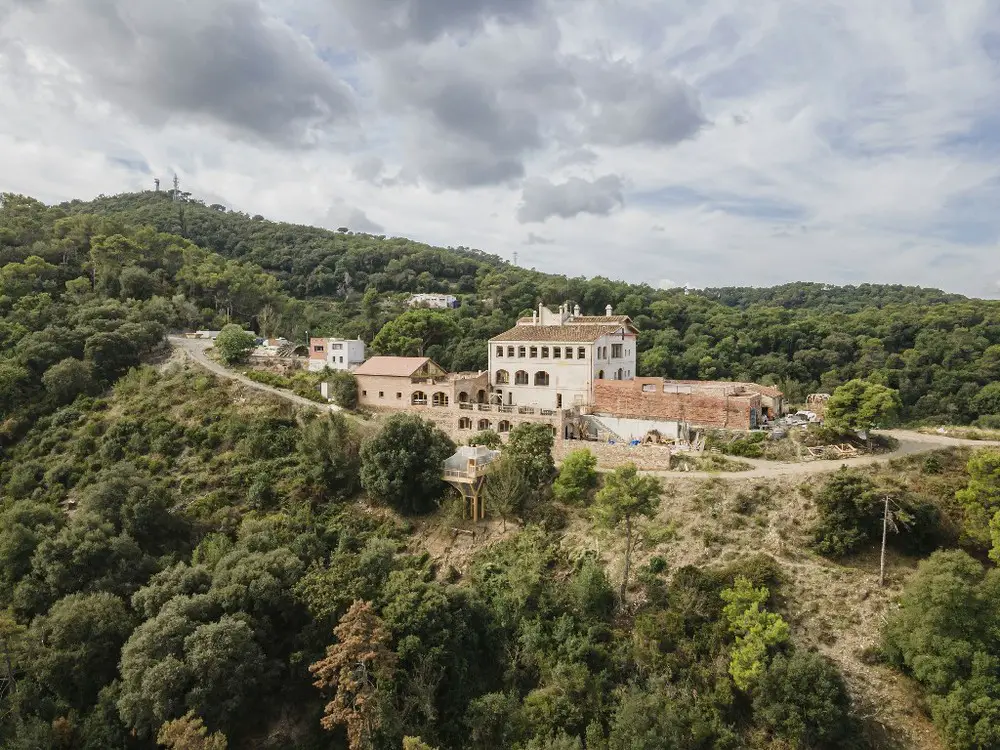
photo : Adria Goula
+++
Catalunya Architecture Design
Barcelona Architectural Walking Tours – tailored city walks by e-architect guides
Barcelona Architect Studios – architectural firm listings on e-architect
Key Barcelona Buildings
Comments / photos for the Forestone Cabin in the Pyrenees by IAAC, Catalunya, Spain, page welcome.