FRAME Awards 2026 Winners : Architecture Design Prize
27 + 26 October 2026
Less spectacle, more care: what the FRAME Awards 2026 winners tell us about the spaces we share
Eleni Stefania Kalapoda, architect and urban designer, who served on the FRAME Awards 2026 Grand Jury for the Institutions categories

Every awards season holds up a mirror to where design is heading. This year’s FRAME Awards, announced on 22 October in Eindhoven during Dutch Design Week, chart that direction with exceptional clarity and conviction. Chosen from more than 1,000 submissions and assessed by 100 jurors across ten panels, the winners of the Spatial categories share a striking restraint. FRAME itself describes them as rethinking established typologies, finding new purpose in existing structures, and exploring how materials and experiences can reshape our relationship with space. Spectacle still has its place, but it has quietly yielded the stage to care.
This year I had the privilege of serving on the Grand Jury for the Institutions categories, alongside Karin Fendt, Carla Baz, Isabel Yidong Li and Michael Yarinsky. What passes between jurors rightly stays within the jury room; the winning projects, however, now belong to everyone, and they speak with rare clarity about the buildings that shape our daily lives most deeply: the places where we learn, heal, gather and travel.
Funamoto Dental Clinic, Uchinada, Japan, by STUDIO ALUC:

photo : Kenta Hasegawa
The institutions we actually use
Institutional interiors are seldom glamorous. Schools, clinics and stations are shaped by budgets, regulations and the needs of people who rarely choose to be there. That is precisely what makes them so revealing. When design succeeds in these spaces, it enriches lives at scale, often without anyone noticing.
Learning Space of the Year went to Frog School by Modus Architects, which FRAME’s published commentary describes as “a vibrant school pilot that introduced a refreshing spatial organization.” The word pilot is telling. Education remains among the most conservative of building types, and a school willing to test a new spatial order does more than house its classes; it helps rewrite the brief for the schools that follow.
Healthcare Center of the Year went to Funamoto Dental Clinic by Studio Aluc. Carla Baz’s published citation captures it beautifully: “deeply considered architecture that turns circulation, light and materiality into instruments of comfort and reassurance.” Few rooms hold as much quiet apprehension as a dentist’s waiting room. Design that soothes it through light, sequence, and touch rather than ornament is an act of care, and it deserves to be recognized as one.
Eurostar UK Terminal Amsterdam Central Station building by ZJA Architects & Engineers and Superimpose Architecture:

photo : Marc Goodwin
Mobility Space of the Year went to the Eurostar UK Terminal by Superimpose Architecture and ZJA Architects & Engineers, a project many e-architect readers will know well. As Agata Kurzela observes in FRAME’s commentary, light shifts “between radically different conditions – from the intimacy of a museum-like display and the shelter of a tent to the disorientation of a blinding snowstorm.” Transport spaces, it reminds us, are not mere corridors to be optimized. They are thresholds, the first and last impressions of a journey, and they merit the same emotional intelligence we bring to a gallery.
New Sydney Fish Market by Danish architects 3XN:

photo © Rasmus Hjortshøj
Landscape as architecture
The winner of Cultural Space of the Year, Anji Hood by RoarcRenew Architects, nestled among the tea terraces of Anji, China, embodies the shift I find most encouraging. In my published citation for FRAME, I described it as “a landscape-led rural intervention, where umbrella canopies on point foundations follow the contour lines of the tea terraces, avoiding large earthworks,” with open, semi-outdoor spaces that “invite locals and visitors to inhabit the tea culture.”
In Anji Hood, image and method are inseparable: its beauty is the visible trace of how gently it was made. Point foundations rest lightly on the ground. Canopies follow the land rather than flattening it. Permeable edges extend the building into the landscape, and into the community that tends it. In an age of climate stress and rural decline, this is a credible, low-impact model for revitalization, one that can grow and evolve with the land and its people. Cultural buildings have long been expected to make a statement. This one makes a relationship.
Tea terraces in Anji, Zhejiang, the landscape that shapes Anji Hood, Cultural Space of the Year:

photo © Fumikas Sagisavas / Wikimedia Commons, CC0
Reuse, soil and circularity
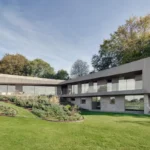
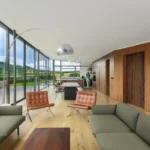
The same sensibility runs through the wider list. House of the Year went to Haniyasu House by Aatismo, a renovation that, in Cecilia Morosi’s words, gives an existing structure “a new identity”, weaving excavated soil and ceramic waste into its architectural language. In the Shows categories, Fatma Al Mahmoud praised NewNew by Nexus Designs for “embedding circularity in every detail”, from reclaimed timber to borrowed flooring and rented art. And in Daichi’s Silent River Tree Sauna, winner of Wellness Space of the Year, Budiman Ong saw a building that “appears to permeate and weave seamlessly through the trees.”
Together, these projects suggest that sustainability has moved from the technical appendix to the very heart of the design idea. Reuse is no longer a constraint to be managed but a source of character. Materials carry memory. Landscape is no longer a backdrop, but a collaborator.
Dutch Design Week, Klokgebouw, Eindhoven, home of the FRAME Awards announcement:

photo : Ymnes / Wikimedia Commons, CC0
Light, reduction and the long view
FRAME’s editorial honors point in the same direction. Berlin’s Gonzalez Haase AAS, named Designer of the Year, is celebrated for its exacting command of light, material and spatial composition, in work ranging from Ferrari’s London fashion flagship to an exhibition at the Bauhaus Dessau. And Jo Nagasaka of Schemata Architects, this year’s Lifetime Achievement honouree, has built a body of work rooted in reduction and light-touch intervention. Both remind us that restraint, done well, is not the absence of ambition but its most demanding form.
Haniyasu House, Kamakura, Japan, FRAME Awards 2026 House of the Year
Architecture: AATISMO. Structural design: TECTONICA INC., Mitsuhiro Kanada. Construction: Yukari Construction. Plastering supervisor: Imajo Sakan.


photos : Shinya Sato
What this means for practice
For architects and clients in the UK and beyond, this year’s winners offer three lessons. First, the most meaningful innovation is unfolding in everyday institutions, not only in flagship projects. Second, working with what already exists, from structures to soil, has become a design strength in its own right. Third, the most compelling spaces measure success by how people feel within them: reassured in a clinic, curious in a classroom, at home in a landscape.
Awards do more than celebrate. At their best, they show the profession what to value next. This year, the message could hardly be clearer: design that cares for people and place is no longer the alternative. It is the standard.
New Sydney Fish Market building design by 3XN architects:

photo © Rasmus Hjortshøj
About the author
Eleni Stefania Kalapoda is an ARB-registered architect and urban designer. She began her professional experience through collaborations with the Renzo Piano Building Workshop team on the Stavros Niarchos Foundation Cultural Center. She later worked in London (Foster + Partners-KSIA) and New York (Perkins Eastman- Resorts World and Landmark Adaptive Reuse Schemes) on projects at building and city scale.
She served on the FRAME Awards 2026 Grand Jury for the Institutions categories and as a sustainability expert on a RIBA London Awards jury that assessed Lion Green Road, which went on to win the 2026 RIBA Stirling Prize. She is a 2026 Beverly Willis Architecture Foundation Emerging Leaders Fellow, a 2026 WICE Awards finalist in Women in Architecture, a LEED v5 Subject Matter Expert for the US Green Building Council, and a member of the Autodesk Advisory Council (2025–27).
Source
FRAME, Meet the spatial winners of the FRAME Awards 2026 (22 October 2026)
+++
Architecture Awards in 2026
Latest Architecture Awards and Design Prizes selection from e-architect:
2026 Praemium Imperiale Awards – Daniel Libeskind Architect
2026 Pritzker Architecture Prize Winner
Stephen Lawrence Prize 2026 Shortlist
2026 Neave Brown Award for Housing Shortlist
World Architecture Festival 2026 Shortlist News
RIBA President candidates 2026 news
Sixth Annual LIV Hospitality Design Awards

Mandarin Oriental, Costa Navarino – photo © Claus Brechenmacher & Reiner Baumann, Helen Cathcart
+++
Architecture Awards News in 2025
RIBA House of the Year 2025 Shortlist
2025 European Prize for Architecture Winner
Stirling Prize 2025 Shortlist building + architects
Xu Tiantian – Le Prix Charlotte Perriand Winner

Comments / photos for the FRAME Awards 2026 winners – International Architecture Prize Analysis by Eleni Stefania Kalapoda page welcome.