Senior Citizens’ Home in Nový Bydžov, Czech Republic housing project photos, modern CZ residential design
Senior Citizens’ Home in Nový Bydžov, Cz
1 March 2026
Architecture: Architektura
Location: V aleji, 504 01 Nový Bydžov, Czech Republic

Photos: Filip Šlapal
Senior Citizens’ Home, Czech Republic
The client’s brief was to design a new retirement home on the site of a former orchard adjacent to a hospital. The building is conceived as four independently functioning households for approximately 60 residents, fully barrier-free.

Abstract
An orchard and brick walls near a cemetery with a church, a historic town with a beautiful town hall. Tall trees. And then old age as a phenomenon—calm, silence, brick as the archetype of home. The proximity of the hospital and cemetery may invite bitter associations; here, however, we see quality, an image of quiet and contemplation, an image of the peaceful edge of town. A chateau-like, symmetrical, almost classicist layout brings atriums, gardens, views, and abundant daylight into the Home.

Old Age
Old age is one of today’s European themes. How do we approach ageing? What do we do for older people, how do we perceive them, what do we offer them—and what do we ask of them? What is it like to be an elderly person in the Czech Republic in 2026?
At the beginning of the design process, we asked ourselves: what kind of old age would we wish to live? How can we materialize the phenomenon of home? Old age does not have to be a burden or suffering; it can be active, full, and in a certain sense still vital. It may represent (finally) a calming down, or a liberation. An elderly person can reflect on the meaning of life, has time to think, and can take stock. For a believer, the nearness of death may even be a form of release.

A wise society does not regard older people as helpless bodies to be pitied, stored away, and merely cared for. In such a society, old age can bring wisdom, peace, and freedom from unnecessary things; it can pass on experience and offer perspective beyond the bustle of everyday life. Old age also brings tenderness (grandchildren) and, in a positive sense, slows things down—our rushing society needs to calm itself. An elderly person should feel useful, for they still have much to offer. We may perceive old age as our mirror, or as a return to the beginning of our earthly journey. There is much in common between children and the elderly.

Red Line in Infinite Green
The assignment of the Town of Nový Bydžov was to design a Home for Senior Citizens on the site of a former orchard adjacent to the hospital. Across the street lies a cemetery with a church, beautiful brick buildings, the first objects that one sees when arriving in the town. The silence and symbolic predestination of the place is slightly disturbed only by the road, which, however, brings the excitement of life—not only cars, but also mothers with strollers, people walking dogs, pedestrians hurrying to do their duties.

The cemetery with the church is distinctive, symbolic, with huge trees and a magical atmosphere. The brick walls are long and low, while the church tower, on the other hand, points upwards. The size of the plot allowed for a single-storey, large-area building, which is also accessible and walkable. With a little imagination, one would say—yes, I would expect a home for senior citizens here. The surrounding landscape is flat, with forests and fields, with long roads running through them. It is visually beautiful, typical of “Central Bohemia” with horizons on which there are silhouettes of villages. In this environment, we place a one-story house, a kind of five-leaf clover formed by four households connected by a central core. A symbol of the four elements and also the four cardinal points, or the object is placed orthogonally in their directions.

Concept of Households with Internal Atriums
The spatial solution is based on dividing the entire volume of the building into four self-sufficient groups—households for approximately sixty clients. Each of them can accommodate fifteen clients and the required staff, and ensures a completely independent operation. The households are designed in such a way that the arrangement of the rooms does not give rise to long linear corridors.


On the contrary, by being located around a common atrium, the rooms create a compact composition, and the common corridors bypass the atrium. Each household has technical and storage rooms, facilities for staff, and a common area with direct access to the internal garden. The concept of internal atriums allows for generous lighting of the corridors and creates pleasant internal spaces. Each room has a small terrace with direct access. Individual households have their own covered internal courtyard and also an exit to a larger common garden, connecting two households at a time. All four households are connected by a central core.

The rooms are combined into one composition according to the same principle—they are located around the perimeter of the central atrium. The internal atriums play an important role in the spatial concept—the spaces are visually connected to the gardens, the interiors are airy, full of light, and in contact with nature. Through the central entrance to the building on the south side, visitors enter a spacious hall, from which the main oval-shaped atrium can be seen. Here is the reception, from where visitors disperse to each of the four households. There is also a waiting area around the reception, directly connected to the central atrium. The house is ground-level, you walk around it, walking is the intention, you walk through the light-filled interior.

Bricks, Flowers and Light
Brick facades are an analogy to cemetery walls; their geometry is emphasized by the simple rhythm of French windows that provide clients with direct access to the terrace. The windows are symbolic openings in this wall. Different window shading supports the individual character of each household. For example, the southwestern household has rectangular steel structures at the level of the cornice, while the northeastern one has sloping ones, symbolizing roofs. The northwest part is not exposed to direct sunlight, here the exterior is designed without overlap and shading.

The brick facade also has four different patterns that are also reflected in the interior—in secondary receptions and in the joint cutting in the bathrooms. This principle also creates the uniqueness of each “home” alias household. The interior is made of bricks, contains a lot of white, which further illuminates it. The floors are characteristic—custom-made photos of local flowers and grasses were scanned and transferred to the flooring. This is also the guiding principle of the relatively large building. So there are households: Travinová (Grass House), Černýšová (Bartsia House), Heřmánková (Chamomile House), and Pampelišková (Dandelion House). The flooring is pulled up at the entrances to the rooms, and natural floral patterns form paintings.

The house is the result of the above-standard approach of the investor, the Town of Nový Bydžov, its trust in the architects’ efforts to create an exceptional senior home. It was a mutual cooperation and constructive exchange of views, where both parties listened and were willing to change (some things were implemented differently than they were designed). The project engineers were also professional and patient partners throughout the entire process. A house of this quality was ultimately created thanks to the contractor’s unusual care, experience, and understanding.


Senior Citizens’ Home in Nový Bydžov, Czech Republic – Property Information
Studio: Architektura – https://archi.cz/
Author: David Kraus
Co-author: Alina Fornaleva [study phase, interior cooperation]
Client: Town of Nový Bydžov
Project location: V aleji, 504 01 Nový Bydžov, Czech Republic
Completion year: 2025
Gross floor area: 3 331 sqm
Usable floor area: 2 910 sqm
Collaborators and suppliers: Project engineer: Projecticon [Pavel Ježek, Jindřich Pavlík]
Wayfinding: Architektura [Zdeněk Dohnálek], RAKOWSKI & CO.
Investor’s technical supervision: Jiří Pilský
General supplier: UNISTAV CONSTRUCTION
Furniture supplier: Dřevotvar
Window supplier: Glamet
Kitchen supplier: ADI Interiér
Featured brands: Beleta, Forbo

Photographer: Filip Šlapal, www.filipslapal.cz
Novy Bydzov Senior Citizens’ Home, Hradec Kralove, Czech Republic images / information received 010326
V aleji, 504 01 Nový Bydžov, Czech Republic, central eastern Europe.
Czech Republic Architecture
Contemporary Czechia Architectural Projects
Czech Republic Architecture Design – chronological list
Polanka nad Odrou House, Ostrava
Architects Studio: bydloarchitekti

photo : Robert Žákovič
Kohutka Cottage, Nový Hrozenkov
Architects: SENAA
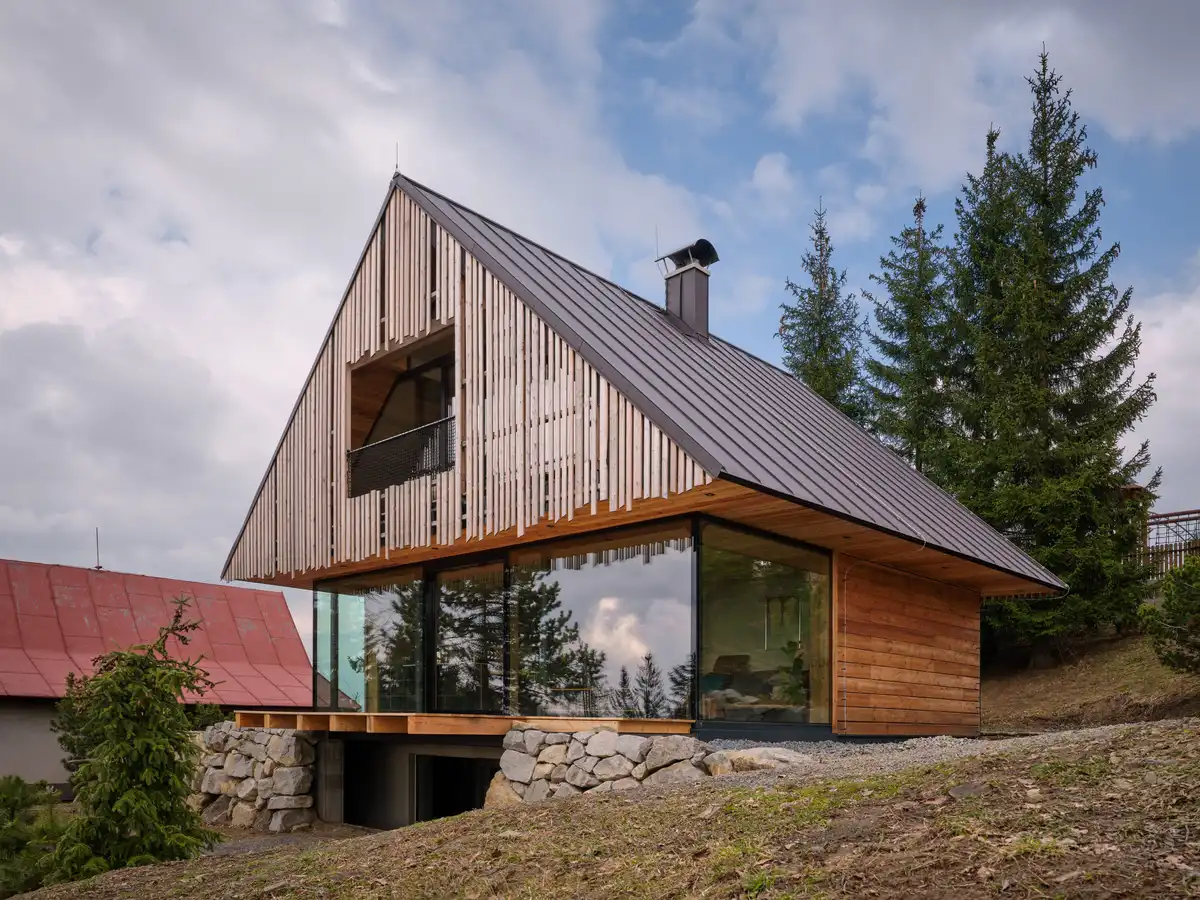
photograph : BoysPlayNice
Czech Architect Studio – CZ Design Firm Listings on e-architect
Comments / photos for the Novy Bydzov Senior Citizens’ Home, Hradec Kralove, Czech Republic design by Architektura page welcome.