Cultivating Motion: Reimagining the Drive-Through as Urban Food Infrastructure
June 23, 2026
Los Angeles may be a city defined by its car culture, but a new architectural project seeks to change that dynamic. Called Green Loops, it reimagines the traditional drive-through experience as one connected to sustainable agriculture. Instead of a sprawl of single-story buildings dispensing fries and tacos from windows across a blighted landscape, the Green Loops vertical farm offers residents access to fresh, locally grown produce without ever leaving their vehicles. Green Loops proposes a new architectural typology that combines urban agriculture, food logistics, public education, and mobility infrastructure within a single framework.
Bird’s-eye view of the Green Loops concept, a vertical farm designed to integrate food production, distribution, and community engagement into Los Angeles’ car-oriented urban fabric:
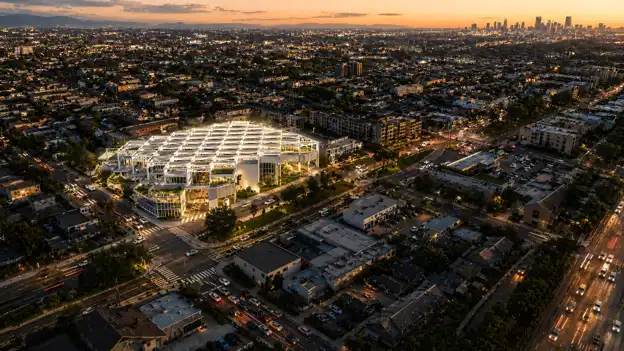
Rendering courtesy of Qingmai Ni
Central to its design is a modular truss superstructure, which makes it adaptable to different settings, and allows for vertical expansion to meet changing community needs. Within that framework, a Green Loops vertical farm contains three primary zones focused on cultivation, processing and community engagement.
Rather than treating circulation as a means of access, Ni reimagines movement itself as an educational and productive infrastructure. Vehicles, pedestrians, staff, crops, and logistics systems operate within a coordinated spatial network that makes food production visible to the public. In this system, visitors are immersed within the productive landscape itself. Elevated corridors, observation platforms, and drive-through routes transform food production into a public experience, allowing cultivation, harvesting, and distribution to become visible components of everyday urban life. It’s an idea that almost seems utopian and yet harkens back to traditional agriculture, with one foot in a better future and one in a greener past.
Green Loops was developed by a multidisciplinary design team led by Qingmai Ni, who served as Project Lead and Lead Designer. Ni was responsible for the project’s overall design vision, spatial strategy, and architectural framework.
A graduate of Savannah College of Art and Design, from which he received a BFA in 2019, and Cornell University, from which he graduated with a master of architecture in 2023, Qingmai has honed his talents with a series of positions at top urban planning and architecture design firms stretching from Shanghai to Tokyo and from New York to California. This has allowed him to learn how to navigate and lead teams as well as to use all necessary design software platforms.
“Early on, while studying interior design my focus was on how people interact with space, how layouts guide movement and how materials affect perception,” he says. “My masters gave me an understanding of building systems, construction processes, and technical documentation.”
All of his experiences have now culminated in Green Loops, which Qingmai says aligns with his general humanist outlook on architectural and interior design. “I’ve always been passionate about creating spaces that promote human well-being and sustainability,” he says. “My work focuses on exploring the relationship between built environments and the human experience, with an emphasis on how design can positively impact our physical and mental health.”
Street-level view of Green Loops, highlighting its modular truss structure and multi-level public spaces:
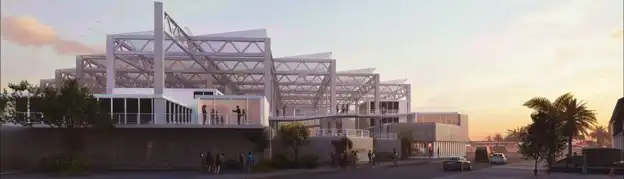
Rendering courtesy of Qingmai Ni
According to Qingmai, he began work on Green Loops to address issues affecting communities in Los Angeles, a city that is heavily dependent on automobile transportation and drive-through culture. It has resulted in a situation where communities face challenges related to food accessibility and so-called “food deserts,” where locals have limited access to nutritious food.
“Traditional food distribution systems have separated food production from urban daily life,” remarks Qingmai. “This inspired me to undertake Green Loops, which transforms the familiar drive-through experience into a productive agricultural infrastructure.”
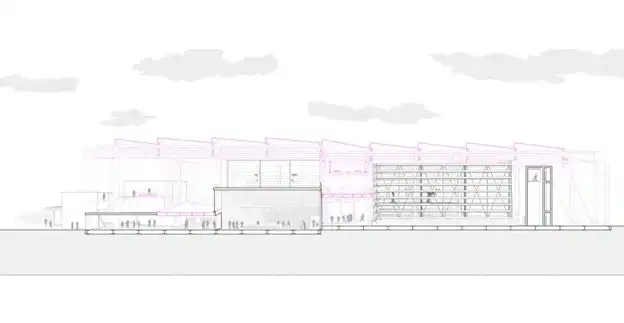
Cross-sectional view of Green Loops showing the relationship between food production, circulation routes, and public engagement spaces:
Rendering courtesy of Qingmai Ni
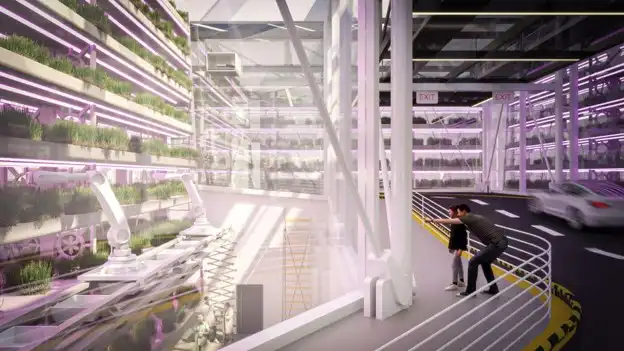
At its conceptual level, Green Loops reimagines how urban residents can access fresh food by integrating food production directly into everyday mobility patterns. It achieves this by merging agriculture, transportation, automation, and public engagement within a single architectural system. In addition to its modular truss superstructure and vertically integrated cultivation system, Green Loops envisions the use of automated harvesting and distribution systems. There is even a conveyer system that transports robotically harvested crops directly to processing units, where they make the journey from farm to table.
The Green Loops concept integrates automated harvesting systems, vertical cultivation, and a drive-through circulation route within a single facility:
Rendering courtesy of Qingmai Ni
Qingmai notes that Green Loops could also serve as an educational hub, one where community members could engage with urban agriculture, and develop a deeper connection to their food sources.
“By merging the familiarity of drive-throughs with the innovation of vertical farming, we set out to offer a scalable model for sustainable urban agriculture,” Qingmai says of the project, “one that can address food deserts and promote community well-being here in the heart of Los Angeles.”
Vertical farming is an emerging agricultural practice where crops are grown in vertically stacked layers within controlled indoor environments. Such systems can produce high yields in small footprints and enable year-round food production independent of weather or seasonal changes.
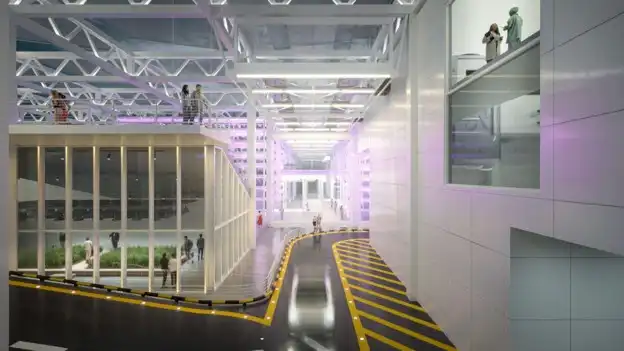
Visitors can observe food production from elevated walkways while vehicles move through the facility’s drive-through route:
Rendering courtesy of Qingmai Ni
Young Architects Competitions (YAC) and Manni Group last year organized a YAC Vertical Farms Competition, which saw Qingmai submit Green Loops as a conceptual competition proposal. The project received an honorable mention where its integration of mobility infrastructure, automated agriculture, and community engagement was recognized for its conceptual innovation and architectural vision. Qingmai was pleased with the outcome of the project, noting that it drew on his experience in different design and research methodologies, as well as his communication skills and ability to work in interdisciplinary teams.
He also said it highlights his desire to create “holistic and sustainable design solutions” that prioritize the well-being of both people and the planet. “Green Loops positions architecture as active infrastructure rather than a passive building type,” comments Qingmai. “It explores new relationships between mobility, food production, and urban life, and proposes a scalable model for future sustainable cities.”
He added that he believes the project has also introduced a “new architectural typology,” one that can combine urban farming, logistics, education, and community engagement, all in one.
More than a proposal for vertical farming, Green Loops demonstrates Qingmai Ni’s broader interest in architecture as infrastructure. By integrating cultivation, logistics, education, and public engagement within a single spatial system, Ni challenges conventional distinctions between production and consumption. The project reflects his multidisciplinary approach to design, combining urban systems thinking with human-centered spatial experiences to address contemporary social and environmental challenges.
Comments on this guide to Cultivating Motion: Reimagining the Drive-Through as Urban Food Infrastructure article are welcome.
Sustainable Architecture Design
Architectural Designs Posts
Jinhui He, Integrating technology and sustainability
Role of regional climate in architectural design
Resilient Cities Architecture Design
++
Building Articles
Comments / photos for the Reimagining drive-through as urban food infrastructure page welcome