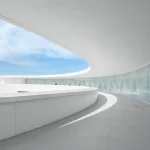
Avila Congress & Exhibitions Municipal Centre Spain
post updated 17 February 2026
MUNICIPAL CONGRESS AND EXHIBITION CENTER, ÁVILA, SPAIN
Location: Ávila, Castilla y León
Auditorio Ávila : English text
Design: Francisco Mangado
English text (scroll down for Spanish):
Avila Congress & Exhibitions Municipal Centre Building
Ávila proves to be an intense and dense city. The layout of its centered plan, defined and enclosed by the smooth surface of its walls, confirms this impression. Every corner of this enclosed interior, every building, every oblique view resulting from the winding path of its streets also illustrates this. However, there is another, more intuitive density, related to the ground itself.
A mineral, topographical density, present in the magnificent landscape punctuated by granite boulders that struggle to emerge and, finally, succeed in the artificial form of the walls. All of Ávila is, in reality, this rock amidst the harsh landscape that surrounds it.
In this density, any void acquires an added value related to the idea of contrast or boundary. In these instances, the plaza served as a liberating mechanism for the interior space, and also as an external link to the walled city. The space outside the walls, typically associated with commercial activity, is the origin of these voids that serve as a connection between the two cities.
When these spaces have remained unoccupied, they have acquired the power to structure the city over time. The presence of an open space at the foot of the city wall, formerly a valley and now a livestock market, where the new Congress Center is to be located, allows us to consider generation systems such as the one described.
The site’s topography is characterized by a steep slope. The subsoil, at least in the area occupied by buildings, is granitic. This makes excavation difficult and raises questions about the outcome of a building that does not take advantage of this feature.
Conceptual density, generosity (configured as a plaza) in the way the site is occupied, and leveraging the topographical constraints of the soil have been guiding design decisions. Formally and spatially, the landscape, dotted with granite outcrops, has provided the necessary references.
Congress Center will not be isolated and where events of all kinds can be held. The general level of this esplanade coincides with one of the highest points of the site, so that its extension creates a large interior void that will accommodate the required uses without excavation.
This means that the new buildings, despite the significant scale of the program they contain, do not project excessively. As this esplanade approaches the river, it adapts to the lower topography with large, polyhedral folds. However, on the side occupied by the building, it retains the character of a viewing platform which, being higher, allows for a visual connection with the opposite bank and with the river itself.
The building primarily occupies the northern side of the newly created public space. Alongside the city walls, it defines the “plaza of the new leisure market.” Based on the topography, the project brings together two different geometries. The more orthogonal and elongated section contains the auditoriums and main halls. The more topographic, irregular section, adapted to the terrain, houses the exhibition area.
The building is designed so that the layout of its uses results from occupying the open space between the new level of the access esplanade and the existing topography. Access to the interior of the complex is easy and straightforward. The main auditoriums are reached from the plaza and from the highest part of the seating area, allowing for an immediate understanding of the interior space.
The exhibition area has independent access from the “ravines” where the platform breaks at the eastern edge. It also has access—since all uses below the plaza level are interconnected—from within the building itself. The exhibition area on these levels is designed to be continuous with the lobby areas. All public access points are concentrated in the plaza. Conversely, on the north side, where the existing slopes are maintained, all the service areas are located.
From a formal and construction standpoint, the design is inspired by the evocative power of the landscape, by the all-encompassing granite mass. The volumes are designed to be viewed from a distance.
The building will be visible from atop the walls as a sculpted manipulation of the great rock of the site. It will never appear as flat surfaces, but rather as a volumetric conception. Therefore, the roofs will not be considered as such, but rather as a seamless continuation of the vertical planes.
It is a juxtaposition of granite volumes. The elongated, more orthogonal building is precisely milled and sculpted. The somewhat more abrupt and topographical piece that covers the exhibition space is constructed by inclining the base of the plaza itself, and extends outwards, seeking contact with the natural terrain.
It is these folds that create fissures for the passage of natural light and independent access to this area. We will build with thick granite blocks, not with thin cladding.
Inside, the volumes of the galleries will be covered with laminated glass containing fiberglass. This achieves a dense, non-transparent vision, a mineralization of the pieces consistent with the exterior treatment.
+++
Avila Building, Spain design by Francisco Mangado.
Spanish text:
Centro Municipal De Exposiciones Y Congresos De Avila
Ávila resulta ser una ciudad intensa y densa. La lectura de su planta, centrada y acotada por la tersa factura de su muralla, confirma esta visión. Cada esquina de este interior acotado, cada edificio, cada visión sesgada que resulta del trazado sinuoso de sus calles también lo ilustran. Existe sin embargo otra densidad, más intuitiva, que tiene que ver con el suelo.
Una densidad mineral, topográfica, que está presente en el magnífico paisaje jalonado por rocas de granito que luchan por emerger y que, finalmente, lo logran en el trazado artificial de las murallas. Todo Ávila es en realidad esta roca en medio del duro paisaje que la rodea.
En esta densidad, cualquier vacío adquiere un valor adicional que tiene que ver con la idea de contraste o con la de límite. La plaza sirvió en estos casos de mecanismo liberador del espacio interior, y también de articulación exterior con la ciudad amurallada. El espacio extramuros, normalmente ligado a la actividad comercial, está en el origen de esos vacíos que sirven de articulación entre las dos ciudades.
Cuando éstos han sabido permanecer desocupados han adquirido el poder de estructurar la ciudad a lo largo del tiempo. La presencia de un espacio libre a los pies de la muralla, anteriormente vaguada y hoy mercado de ganado, donde ha de ubicarse el nuevo Centro de Congresos, permite pensar en sistemas de generación como el indicado.
En la topografía del sitio destaca una acusada pendiente. El subsuelo, al menos en la parte ocupada por edificación es granítico. Ello dificulta la excavación y plantea dudas respecto a cuál sería el resultado de un edificio que no aproveche esta ventaja.
Densidad conceptual, generosidad (configurada en plaza) en la manera de ocupar el sitio y aprovechamiento del condicionante topográfico del suelo han sido criterios que han guiado las decisiones de proyecto. Formal y espacialmente, el paisaje, cuajado de piezas de granito, ha suministrado las referencias necesarias.
Se propone una gran explanada o plaza, un lugar de encuentro al borde de las murallas, donde el centro municipal de Exposiciones y Congresos no se encuentre solo y se celebren actos de todo tipo. El nivel general de esta explanada se hace coincidir con uno de los más altos de la parcela, de manera que su prolongación genera un gran vacío interior que alojará, sin excavación, los usos requeridos.
Ello implica que las nuevas construcciones, a pesar de la importancia dimensional del programa que contienen, no sobresalen desmesuradamente. Esta explanada, según se va aproximando al río, se adapta con grandes pliegues poliédricos a la topografía más baja. No obstante, en el lateral ocupado por la edificación conserva el carácter de plataforma mirador que, al estar más elevada, permite establecer una relación visual con la orilla opuesta y con el río mismo.
La edificación ocupa básicamente el lateral norte del espacio público de nueva factura. Junto a las murallas acota la “plaza del nuevo mercado lúdico”. En función de la topografía, el proyecto hace convivir dos geometrías differentes. La parte más ortogonal y alargada contiene los auditorios y salas principales. La parte más topográfica, irregular y adaptada al suelo, alberga el área de exposiciones.
La edificación se desarrolla de manera que la disposición de los usos es el resultado de ocupar el espacio libre que queda entre la nueva rasante de la explanada de acceso y la topografía existente. El acceso al interior del conjunto resulta fácil y claro. A los auditorios principales se llega desde la plaza y por la parte más alta del graderío, lo cual permite una comprensión inmediata del espacio interior.
El área de exposiciones tiene un acceso independiente desde las “quebradas” en las que se rompe la plataforma en el límite este. También lo tiene -dado que por debajo del nivel de la plaza todos los usos están comunicados-, desde el interior mismo del edificio. La zona de exposiciones en estos niveles se plantea en continuidad con las áreas de vestíbulo. Todos los accesos públicos se concentran en la plaza. Por el contrario, en el lado norte, donde se mantienen las pendientes existentes, se sitúan todos los servicios.
Desde un punto de vista formal y constructivo, la actuación se inspira en la fuerza evocadora del paisaje, en la masa granítica que todo lo invade. Los volúmenes se piensan para ser vistos desde la distancia.
El edificio podrá ser visto desde lo alto de las murallas como una manipulación cincelada de la gran roca del terreno. Nunca se verán planos sino que se tendrá una concepción volumétrica. Por ello las cubiertas no serán tales sino que se entenderán en continuidad perfecta con los planos verticales.
Se trata de una yuxtaposición de volúmenes de granito. El edificio alargado, más ortogonal, se fresa y se esculpe de una manera precisa. La pieza, algo más abrupta y topográfica, que cubre el volumen de las exposiciones, se construye inclinando la propia base de la plaza, y se desparrama buscando el contacto con el terreno natural.
Son esos pliegues los que generan grietas para el paso de la luz natural y el acceso independiente a esta zona. Construiremos con piezas gruesas de granito, no con finos aplacados.
Interiormente los volúmenes de las salas quedarán recubiertos por vidrio laminar que contendrá en su interior fibra de vidrio. Se logra así una visión densa, no transparente, una mineralización de las piezas en coherencia con el tratamiento exterior.
Avila Congress Centre : English text
obra Auditorio y Centro Municipal de Exposiciones de Ávila
situación: Ávila, España.
superficie de actuación: 18.944 m2 (CMEC) 23.157m2 (Urbanización).
presupuesto: 28.890.000 €
año de concurso: 2002. Primer Premio de concurso de Proyectos.
año de proyecto: 2003-04
año de construcción: 2005-09
entidad propietaria: Ayuntamiento de Ávila-Junta de Castilla y León.
arquitecto: Francisco José Mangado Beloqui.
dirección de obra: Francisco José Mangado Beloqui.
colaboradores:
arquitectura Jose M. Gastaldo, Francesca Fiorelli, Daniel Padrón Hernández, Daniel Marchelli, Ana Gabriela Salvador, Arina Keysers, Anjte Konrad.
ingeniería estructuras NB 35 SL (Jesús Jiménez Cañas / Alberto López) Ingenieros.
ingeniería instalaciones Grupo JG Asociados (Enrique Monreal / Víctor González) Ingenieros.
ingeniería acústica Higini Arau Estudi Acustic.
iluminación ALS Lighting arquitectos consultores de iluminación (Antón Amann).
arquitectos técnicos Angel García. PA Aparejadores (Luis Pahissa / Fernando Pahissa).
constructora Volconsa SA.
Avila Congress & Exhibitions Municipal Centre information from Francisco Mangado
Location: Avila, Spain.
Architecture in Spain
Spanish Architecture Designs – chronological list
Spanish Architecture – Selection
Madrid Civil Courts of Justice
Zaha Hadid Architects
Nou Camp Stadium
Foster + Partners
Ibiza Country House
DeBlacam & Meagher
Comments / photos for the Avila Congress & Exhibitions Municipal Centre Spain Architecture page welcome