Dancing House Prague : ‘Fred and Ginger’ Building
post updated 25 May 2026
Prague’s famous Dancing House celebrates 30 years. An exhibition in its gallery will present original works by Frank O. Gehry, hidden spaces, and other previously unseen material.
Dates built: 1996
Architecture: Frank Gehry Architect and Vlado Milunić

photos courtesy of Dancing House Praha
Contemporary Czech Architecture design by Vlado Milunic / Frank Gehry Architect
‘Fred and Ginger’ Building in Prague
Prague – The Dancing House, one of Prague’s most iconic buildings, celebrates 30 years since its opening this June. To mark the occasion, the local gallery has prepared a unique exhibition titled Dancing House: The Story of an Iconic Building, which will explore the history of the structure, its architecture, and the lesser-known stories behind its creation.

The exhibition will feature previously unpublished archival materials, original interior furnishings from the 1990s, and access to the building’s technical facilities, areas not normally open to the public. The exhibition opens to the public on April 22, 2026, and has been created with the financial support of PSN under the auspices of VIZE 97 Foundation of Dagmar and Václav Havel.
Ginger & Fred Restaurant Prague:

The exhibition will present newly discovered and previously unpublished photographs from the construction period, as well as extensive photographic documentation of the building’s transformation over the past 30 years. The Dancing House was officially opened on June 20, 1996. Visitors will also see videos tracing the history of the site at the corner of Jiráskovo Square and Rašín Embankment, including historical photographs dating back to 1860.

One of the exhibition’s greatest attractions will be the exceptional opening of the Dancing House’s technical areas to the public, including a view into the inner courtyard. The exhibition will also showcase artefacts related to the building’s architecture and interiors. On display will be original glass tables by czech architect Eva Jiřičná, as well as original doors, lighting fixtures, and office furniture from the 1990s.
Ginger & Fred Restaurant interior:

Gehry, Milunić and their treasures: a model you do not normally get to see
A special section of the exhibition – organized in cooperation with the prestigious Frank O. Gehry Foundation – will focus on the architects themselves. Visitors will see personal objects and awards belonging to Vlado Milunić and Václav Havel, original construction documentation, and period press coverage documenting the building’s creation.

A particularly remarkable exhibit will be a model of the Dancing House by Frank Gehry and Vlado Milunić, on loan from the National Gallery Prague. A new, highly detailed model of the building was also created for the anniversary, at a scale of 1:18 and standing over two metres high.

“The exhibition will feature a 3D visualization of the Dancing House on large touchscreens, a fold-out model of the building, lenticular images, and digital presentations on iPads. The accompanying programme will include guided tours. All dates will be listed on the gallery’s website,” says Robert Vůjtek, Director of the Dancing House Gallery.

The gallery is also preparing a new book on the history and architecture of the Dancing House, following on from the now completely sold-out 2003 publication by Frank Gehry, Vlado Milunić, and Irena Fialová, published by Zlatý řez.

Loved and hated alike: the story of a house that became a symbol of Prague
When the Dancing House was completed thirty years ago, it divided Prague. Some saw it as an insensitive intervention in the historic city centre, while others viewed it as a symbol of new-found freedom. According to Milunić, the concept of the two towers – one dancing, the other static – was meant to reflect the joy felt in society after the fall of communism. It was precisely this symbolism, together with its striking architecture, that quickly transformed the building into one of the most photographed houses in Prague, and to this day makes it one of the capital’s most compelling sites for international visitors.

Originally, the building, nicknamed “Ginger and Fred,” was intended to serve as Prague’s new cultural centre, complete with a view of Hradčany. In the end, however, it became an administrative building for the insurance company Nationale-Nederlanden. Only after the building was taken over by PSN, thanks to its founder Václav Skala, did Václav Havel’s original vision of opening the structure to the public begin to be fulfilled. A gallery was established there, followed later by a hotel, café, restaurant, and a bar with a view, while part of the building continues to serve as office space.

+++
Dancing House: The Story of an Iconic Building
Dancing House Gallery, Jiráskovo náměstí 6, Prague, Czech Republic
Until October 18, 2026
Open daily, 9:00 a.m.–8:00 p.m.
Admission: CZK 230 (seniors and students CZK 185, children aged 5–15 CZK 150, family ticket for five people CZK 600)
www.galerietancicidum.cz

+++
Previously on e-architect:
post updated 16 September 2022
‘Fred and Ginger’
Dates built: 1992-96
Design: Vlado Milunic with Frank Gehry Architects
Location: Tančící dům, Rašínovo nábřeží 1981/80, Praha city centre, Czech Republic
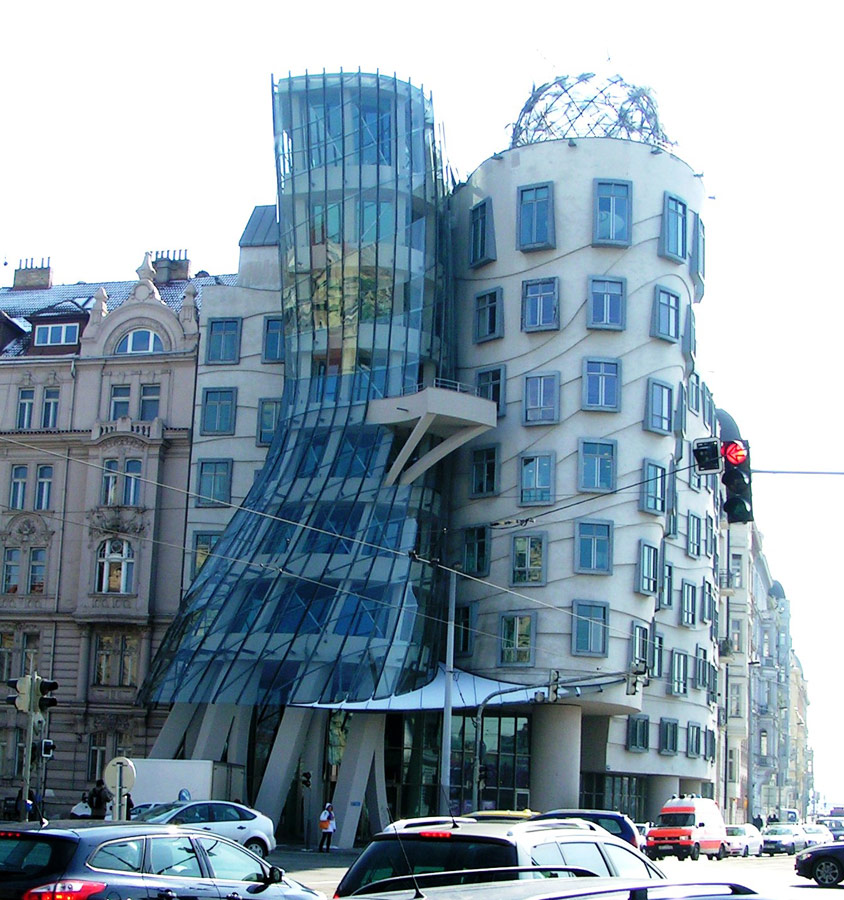
photographs © Ivan Andera
Dancing House Prague Building
Photos added 15 Mar 2013
aka The Dancing Building, officially the Rasin Building
The idea of the Dancing House was discussed first between Czech architect Vlado Milunić and the then dissident Václav Havel, who lived in the neighbouring “House 2000”, owned by the Havel family since its construction. Nationale Nederlanden insurance company agreed to invest in the project, asking Milunić to also have a partner of world prestige.
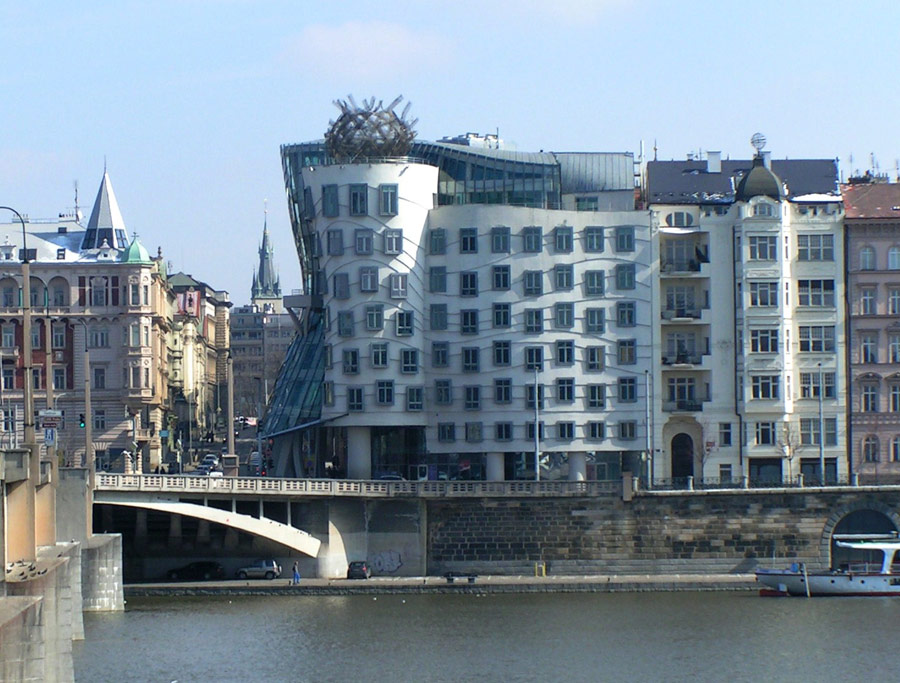
After Jean Nouvel turned down the invitation, Frank Gehry accepted. He nicknamed the project Fred and Ginger.
The principles adopted include contrast of the static and dynamic (yin & yang) “figures” of “Fred” and “Ginger”, “Fred” having the head hair ball dominant called “Medusa”.
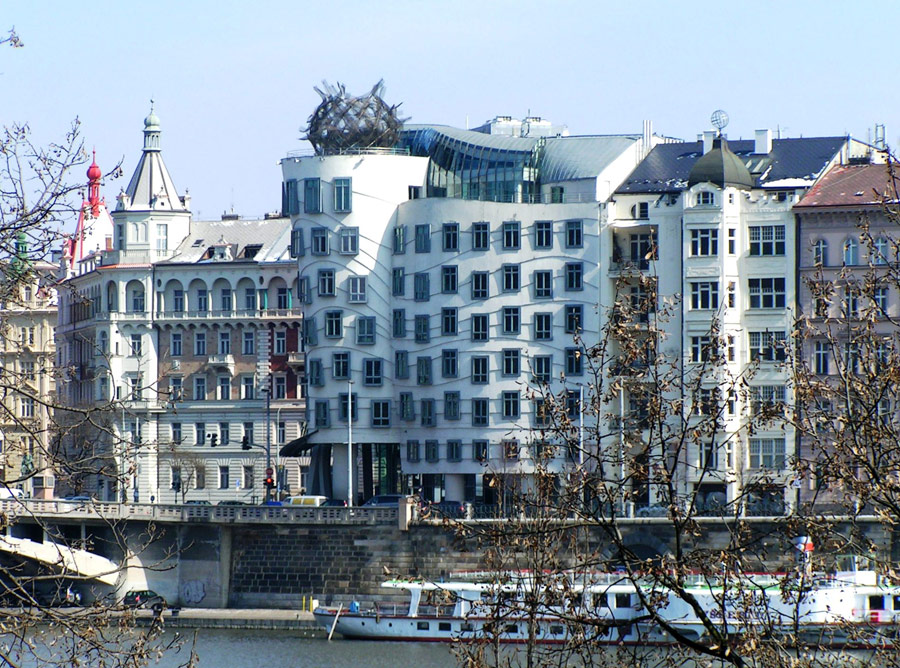
The river front shows marks of deconstructivist style. Some interiors of the investor’s offices were designed by Eva Jiricna Architects (ed, worked on by the e-architect editor, Adrian Welch, a difficult project fitting rectilinear furniture within an organic shape which changed on every floor level). Completed 1996, first very controversial for the Prague citizens, now widely acknowledged piece of art.
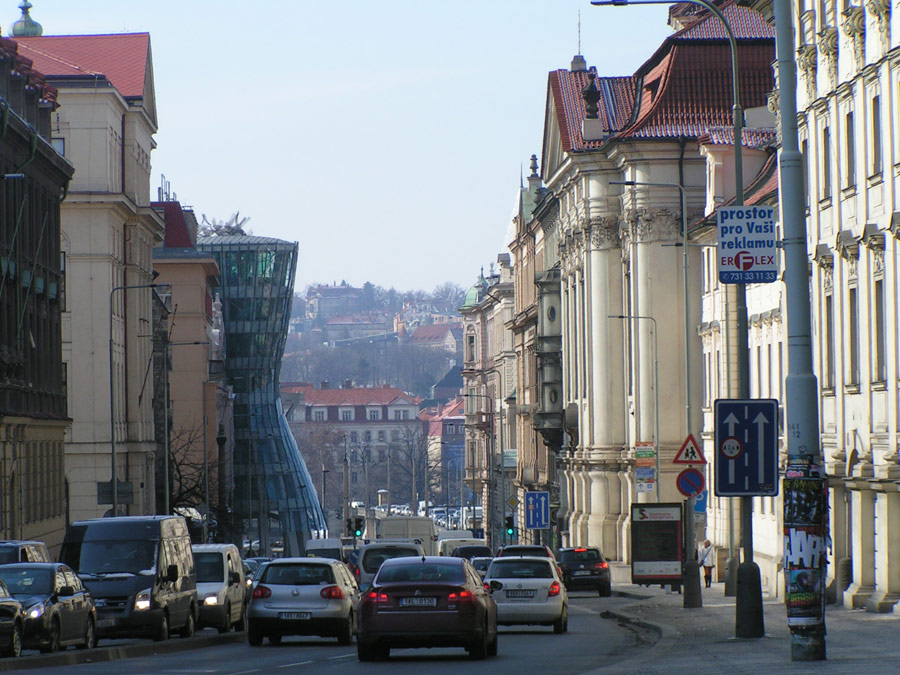
Dancing House Prague – ‘Fred and Ginger’ Building images / information from Ivan Andera
Fred & Ginger building, Jiraskuv Bridge, central Prague
1996
Architect: Frank Gehry Architects with Vlado Milunic
aka The Dancing House (Czech: Tancící dům), or The Dancing Building, or Drunk House, officially the Rasin Building
Location: by the Vltava river southwest of centre
Address: Nationale-Nederlanden building, Rašínovo nábreží 80, 120 00 Praha 2
Vlado Milunic is a Croatian-born Czech architect
Frank Gehry is Canadian and one of the most famous architects in the world
Fred and Ginger Prague design : Frank Gehry
Location: Rašínovo nábřeží 1981/80, 120 00 Praha 2-Nové Město
Prague, Czech Republic, central eastern Europe.
New Prague Architecture
Contemporary Prague Architecture
Prague Building Designs – chronological list
The 4th Quadrant of Victory Square International Architectural Competition
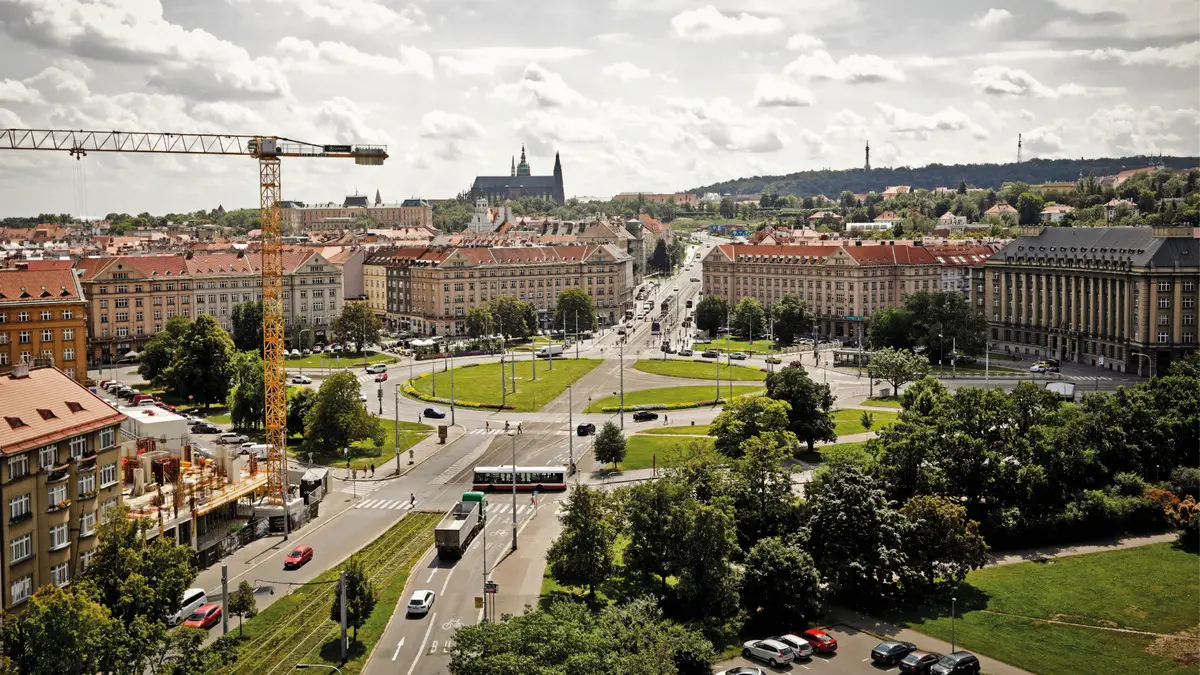
photo source: ONplan, photo: Libor Fojtík
4th Quadrant of Victory Square Prague Competition
Vltava Philharmonic Hall Design Contest Winner
Design: BIG – Bjarke Ingels Group

image courtesy of architects practice
Vltava Philharmonic Hall Prague design by BIG
Hotel Josef Prague by Eva Jiricna Architects
Czech house : Tugendhat Villa, Brno by Mies van der Rohe
++
Selected Designers with buildings in Prague
Comments / photos for the Dancing House Building – Fred and Ginger Prague page welcome