Church of Santo Tomás de Aquino, Cusco Building
November 9, 2026
Location: Church of Santo Tomás de Aquino, Cusco region, Andean highlands of Peru
Getty Announces Major Project to Conserve One of Peru’s Sacred 17th-Century Churches
Project will support seismic retrofitting and conservation of the Church of Rondocan and its collection, including a painting series by Bernardo Bitti once thought lost
Members of the local community in the Church of Rondocan:

photo : Alejandra Vélez. © 2026 J. Paul Getty Trust
LOS ANGELES — In the Andean highlands of Peru’s Cusco region, the Church of Santo Tomás de Aquino, locally known as the Church of Rondocan, is a sacred cultural heritage site and gathering place for the surrounding community. Past earthquake damage within this seismically active region and other factors have damaged the 17th-century church and threaten the survival of the structure and its collection of more than 300 cultural objects, including a major series of paintings by Bernardo Bitti.
To address these threats, Getty announces Sacred Heritage in the Andes: Conserving the Baroque Church of Rondocan Project, a multi-year initiative that will strengthen the earthen site against earthquakes and support the long-term conservation and care of the building and its collection. Experts from across Getty will work in partnership with the Dirección Desconcentrada de Cultura – Cusco (DDC-C), a regional office of the Ministry of Culture of Peru, to develop a comprehensive conservation and retrofitting project, while fostering collaboration with local professionals and the community to steward and care for the site long after the project is completed.
Earthen architecture is one of the world’s oldest building types, using natural earth materials as a sustainable building method. Built with striking Baroque design and thick adobe brick walls, the Church of Rondocan is one of many remotely located earthen sacred sites in Peru and has become increasingly vulnerable due to lack of regular maintenance and earthquake damage. Protecting the church will be a priority for the Getty Conservation Institute’s Seismic Retrofitting Project (SRP), which uses high-tech analytical techniques with locally available materials, skills, and equipment to strengthen earthen heritage sites against earthquakes and create long-term monitoring and maintenance plans.
The Church of Rondocan and its surrounding landscape:

photo : Luigi Barazzetti. © 2026 J. Paul Getty Trust
“Since 2011, the Conservation Institute has worked across Peru with local conservation professionals to conserve some of the country’s most significant earthen architectural buildings. These are the buildings in which so much of daily life in these regions takes place, but they require specialized efforts for their protection,” said Claudia Cancino, principal project specialist at the Getty Conservation Institute, and project lead for the Sacred Heritage in the Andes Project. “With this collective effort, we will be able to provide expertise and support for the Rondocan community, who have been the primary caretakers of the church and its incredible collections for generations.”
“Today marks an important step toward protecting one of Rondocan’s most cherished and meaningful places. This church is much more than a historic building; it is part of the community’s memory, identity, and everyday life. At the Ministry of Culture, we are committed to ensuring that this heritage is preserved for future generations. We want to achieve this together with the community, recognizing the dedication of those who, for so many years, have cared for this church and kept its cultural and spiritual significance alive,” said Fernando López Sánchez, Vice Minister of Cultural Heritage and Cultural Industries.
Recognizing the Rondocan community’s deep connection to the site is met with limited resources, the Conservation Institute has been working with local community members to understand its significance and to define conservation practices for the site and its church’s 17th- and 18th-century collection of cultural objects, which includes paintings, gilded wooden retablos and associated polychrome sculptures, ecclesiastical textiles and more.
These collections will be examined and treated by the DDC-C with support of specialists from across Getty. Guidelines will be developed with the DDC-C for local conservation professionals and the community, including sustainable treatment methods and recommendations for the conservation and maintenance of the church’s collection.
“What makes the church’s collection unique, beyond its richness for such an isolated church, is that no evidence suggests it has ever been restored. As such, it represents a rare opportunity to document the artifacts, generating knowledge useful to a variety of stakeholders. The study of the decorative surfaces of the lateral altarpieces, for instance, with their rarely preserved original materials, will inform the interpretation of similar decorative surfaces in other churches in Peru,” said Stéphanie Auffret, senior project specialist at the Getty Conservation Institute. “This project also provides a wonderful opportunity to interact with the local community, who care deeply about the site and all its cultural objects, such as the sculptures they carry as part of processions during the Semana Santa. Preserving a collection in use presents challenges as well as valuable exchanges with community members, something not experienced in a museum’s context.”
Wall painting in the Church of Rondocan, depicting a hermit, dating to the 18th century:

photo : Victor Zea. © 2026 J. Paul Getty Trust
One of the highlights of the collection is a series of eight paintings by the Italian Jesuit priest and painter Bernardo Bitti (1548–1610), an artist who occupies a pivotal position in the history of art in the Americas. The series, “Principales Misterios de la Vida y Muerte de Cristo Nuestro Salvador y de la Virgen Santísima” (“Principal Mysteries of the Life and Death of Christ our Savior and the Holy Virgin Mary”), thought to be lost by most art historians, was painted in Cusco, likely between 1595 and 1599. One painting from the series, “La Oración en el huerto” (“Prayer in the Garden”), will be transferred to Getty in 2027 to undergo scientific analysis and conservation treatment.
“We are honored our partners in Peru are entrusting us with this splendid work by Bernardo Bitti,” said Ulrich Birkmaier, senior conservator of paintings at the Getty Museum. “We anticipate the results of our comprehensive technical study and treatment will illuminate Bitti’s working methods and use of materials. Working closely with our Peruvian conservation partners, the Archdiocese in Cusco and the Ministry of Culture, we are thrilled to learn more about this enigmatic painter and anticipate this work will help inform the conservation of other paintings in the series.”
Conservation staff from the Dirección Desconcentrada de Cultura de Cusco carrying out grout stabilization in collaboration with Getty wall painting specialists:

photo : Victor Zea. © 2026 J. Paul Getty Trust
Environmental monitoring will also be implemented to identify ways to reduce risk and promote continued maintenance of this treasured collection.
As seismic retrofitting construction documents have been developed and approved, construction will begin on site in 2027. The DDC-C will fund and carry out the construction phase, and Getty will partner to monitor progress over the next several years.
More information on the Sacred Heritage in the Andes Project will be announced as the work continues.
The Getty Museum’s Paintings Council is a financial supporter of the Sacred Heritage in the Andes Project.
Technical examination and assessment of a painting from the series Principales Misterios de la Vida y Muerte de Cristo Nuestro Salvador y la Virgen Santísima, attributed to the Italian Jesuit priest and painter Bernardo Bitti (1548–1610):

photo © 2024 J. Paul Getty Trust
+++
Getty advances art’s meaning and impact—bringing people together to preserve the past, inspire the present, and shape the future.
The Getty Conservation Institute (GCI) works internationally to advance conservation practice in the visual arts—broadly interpreted to include objects, collections, architecture, and sites. The Institute serves the conservation community through scientific research, education and training, field projects, and the dissemination of information. In all its endeavors, the GCI creates and delivers knowledge that contributes to the conservation of the world’s cultural heritage.
The J. Paul Getty Museum collects Greek and Roman antiquities, European paintings, drawings, manuscripts, sculpture and decorative arts to 1900, as well as photographs from around the world to the present day. The Museum’s mission is to display and interpret its collections, and present important loan exhibitions and publications for the enjoyment and education of visitors locally and internationally. This is supported by an active program of research, conservation, and public programs that seek to deepen our knowledge of and connection to works of art.
+++
Getty Conservation Institute Conservation Of Earthen Architecture in Latin America
The completion of seismic retrofitting and conservation efforts at the 17th-century Church of Kuñotambo is a case study for conservation efforts in other regions of Latin America
Seismic Retrofitting Project team, Jim Cuno (President and CEO of the J. Paul Getty Trust) and local authorities:

photo Courtesy J. Paul Getty Trust
June 21, 2019
Conservation of Earthen Architecture
The Getty Conservation Institute (GCI), in partnership with the Dirección Desconcentrada de Cultura de Cusco (DDC-C), celebrated on June 19 the results of a 10-year collaboration to seismically retrofit and conserve the 17th-century Church of Kuñotambo as part of the GCI’s Seismic Retrofitting Project (SRP).
Church of Santo Tomás de Aquino, Cusco, Peru 17th Century architecture images / information received 091126 from The J. Paul Getty Trust
Location: Peru, South America
Peruvian Architecture Designs
New Peruvian Architectural Designs – chronological list
New Peruvian Buildings – selection from e-architect:
Markham Collegue Primary School, Av. La República 111, Monterrico, district of Santiago de Surco, Lima
Design: IDOM and Rosan Bosch Studio

illustration : IDOM / Rosan Bosch Studio
Casa Tejona Lima Residence
Design: Arq. Martin Dulanto Sangalli
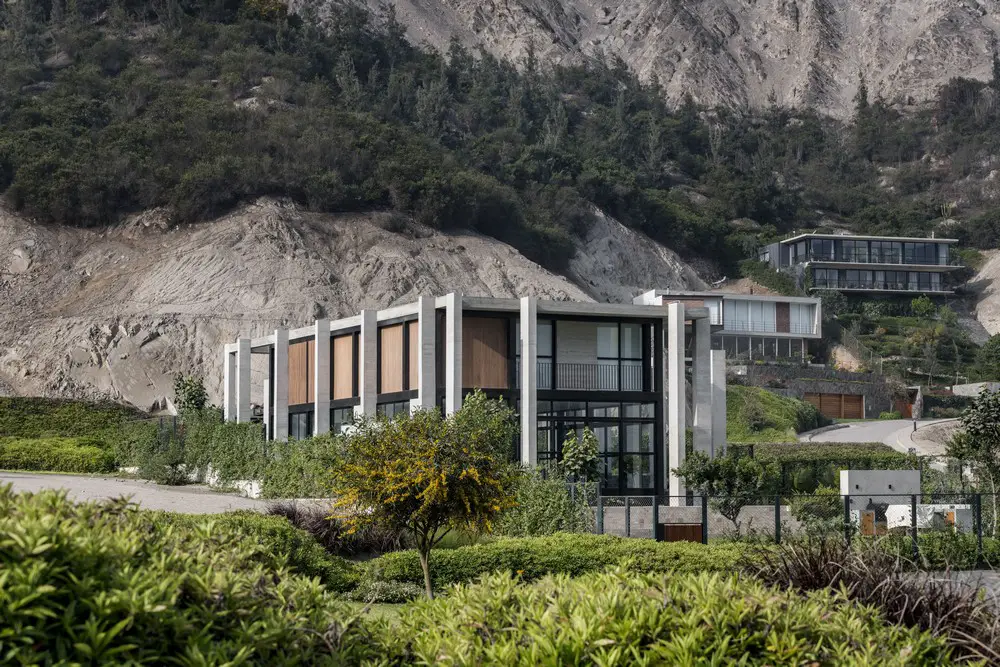
photo : Renzo Rebagliati
Lampa Cultural Center Lima
Design: Christian Verde and Carlo Gonzales

image courtesy of architects practice
Comments / photos for the Church of Santo Tomás de Aquino, Cusco, Peru 17th Century building page welcome