Tonglu Senbo Resort in Hangzhou, China
11 May 2026
Architecture design & site planning team: SpActrum
Location: Tonglu County, Zhejiang

Photos: Zhao Qiang, Wu Qingshan
Black, the colour of stealth.
The black cabins are based on pentagonal prisms, with two faces cutaway to create tension between discontinuous perceptions of one entity from each angle – a form of stealth.

By keeping a minimal footprint that preserves the original building’s position, and leaving the native forest largely intact, the elevated walkways maintain the continuity of the natural system without disturbance – ecological stealth.
The elevated walkway system, while consciously limiting human intervention, leads guests through the trees in search of the black cabin hidden among them. Stealth – returning to a verb.
The Way of Stealth: A Renewal Strategy That Respects Coexistence with the Forest
Stepping on fallen twigs and withered leaves, walking beneath the raised walkways, the grass and moss continue their undulating rhythm across the terrain – this is the ultimate call of the site.

Since 2022, this landscape in Hangzhou Tonglu’s “Grandma’s Home” resort area has undergone its largest transformation since 1990. Over more than two decades of dramatic change in China, the meaning and outward forms of retreat have evolved enormously. Yet after careful site investigation, SpActrum concluded that while the original site strategy had failed in terms of specific forms and materials, the trees that have grown alongside the buildings over the past twenty years stood out as an effective, naturally grown site strategy.

Thus, SpActrum’s first task was to persuade the client to abandon any ambition for a “radically refreshed” or completely transformed look. Instead, they replaced the specific buildings, rebuilding the cabins and walkway systems with contemporary techniques, freeing the architectural language from any fixed “style.” Borrowing a term from Valerio Olgiati, this is a return to a “non-referential” state – confronting the site’s conditions directly to generate perception.

Guests walk along the pathways. The connecting walkway, built with a new light-weight steel-and-timber structure, are lowered to reduce any sense of risk, while still keeping the guest route separate from the ground. The height of walkway align with the cabin entrances; the cabins’ service spaces are hidden within the height between the entrance and the ground below. The ground remains a continuous ecosystem. The two systems intertwine and intersect, yet remain independent – undisturbed by each other. Beyond the necessary clearing for fire-access routes, the forest is preserved to the greatest extent possible. During construction, the architects even observed that falcon still inhabit the site.

Back to 2022 and the project was first conceived, protecting native trees, building with moderation, and fostering a more playful relationship between building and nature was still a rarely taken path when the real estate frenzy was just coming to an end. We are delighted to see that, over the years from design to completion, this approach has gradually become a conscious choice for many architects, as well as a strategy that people increasingly embrace and welcome.

The Form of Stealth: A Geometric Prototype that Breaks Architectural Uniformity
Under this strategy, the new black cabins replace the former Thai-style wooden lodges in situ. One challenge the design seeks to address: is architectural continuity always necessary? Can a single form be given multiple expressions through the simplest formal operations? The triangle is a simple geometry, enclosing the smallest space for a given perimeter.

The quadrilateral, with double symmetry about both two axis and centre, is too much regulated and lacks developmental potential. The pentagon is the simplest form beyond these two, possessing one central axis of symmetry and one bilateral symmetry. From there, the design cuts into the volume – removing one corner toward the ground and another toward the sky – creating a Gömböc-like geometry that oscillates between instability and stability,giving the still form a tentency of movement. The form achieves a tense balance between motion and stillness.

On this faceted geometry, window openings are arranged in series, mainly distributed across vertical planes. The apertures aim to maximise the internal dimensions of the interior. The vertical glazing facing the double-height void appears as narrow slits, while the horizontal glazing facing the sunken seating area extends outward, transforming the forest outside into scrolls and panoramic landscapes. On the second floor, the window facing the bed separates daylight and ventilation – leaving the outward-viewing glazing pure and unobstructed, while integrating the ventilation window into a larger window system. The bathroom window aligns with the line of sight when lying in the bathtub; a protruding horizontal element outside restricts the view, allowing only outward glances from inside while preventing any view in from the outside.
The cabin has two doors. One is set into the slanted entry face, framed by an H-shaped structure that emphasises the doorway against the recessive dark body of the house. The other door opens onto a private terrace and can be swung open wide, allowing the interior to merge with the terrace in suitable weather.

Forest, Walkways, Black Cabins: A Resonant Perception Generator
The visual relationship between the walkways and the cabins become a device that reveals the cabins’ non-continuity. The orientation of each cabin is calibrated to minimise mutual sightlines with neighbouring cabins and surrounding buildings while maximising privacy.

Walking along the raised paths, the buildings seem to teleport into place – black spirits frozen in different expressions. As one moves, the cabins reveal themselves in fragments: a closed, sloping triangular face; a surface pieced together by triangles and quadrilaterals; two triangles meeting edge to edge; a purely orthogonal quadrilateral face. A small volume, seen from the perspective guided by the walkway, appears to possess an infinite number of facets.

The forest and the black cabins engage in an even more complex interplay. The forest is an inverted triangle – its branches radiate as vigorous, twisting lines; its leaves form dappled, shifting patches with the seasons; its boundaries are blurred. The black cabins, in turn, are immersed behind every natural tone. Their shapes are partially obscured by the organic forms of the trees, deepened locally by shifting shadows.
The journey orchestrated by the walkways, the interwoven silhouettes of cabins and forest – all of this coalesces into an ecological, perception-awakening dwelling system.

Tonglu Senbo Resort buildings, Hangzhou, China – Building Information
Architecture design & site planning team: SpActrum – https://www.spactrum.com/
Project name: Houses of Stealth (Tonglu Senbo Resort)
Client: Tonglu Tourism Investment, Kaiyuan Cultural Tourism
Location: Tonglu, Hangzhou
Site area: 5,740 sqm
Building area: 705 sqm
Completion date: 2026. 01
Lead architect: Yan Pan
Architecture design team members: Yijie Zhang, Ning Guo, Yue Zhang, Jinyu Wan, Zhen Li, Yimeng Tang
Preliminary design: Shanghai Zhongsen Architecture & Engineering Design Consultants Co., Ltd.
Construction drawing design: China United Engineering Corporation Limited
Landscape design: Zhejiang Andao Design
Landscape design team members: Ting Mao, Sihan Liu
Interior design: Hangzhou Pan Tianshou Environmental Art Design Co., Ltd.
Constructor: Zhejiang Third Construction Group Co., Ltd.
Photography: Su Shengliang, Yan Pan, Jinyu Wan

Photographer: Zhao Qiang, Wu Qingshan
Tonglu Senbo Resort buildings, Hangzhou, China images / information received 110526
Location: Tonglu County, Zhejiang Province, China.
Zhejiang Province Buildings
Recent Zhejiang Province Building Designs on e-architect:
Qiantang Bay Cultural District, Hangzhou City, Zhejiang Province
Architecture: Zaha Hadid Architects
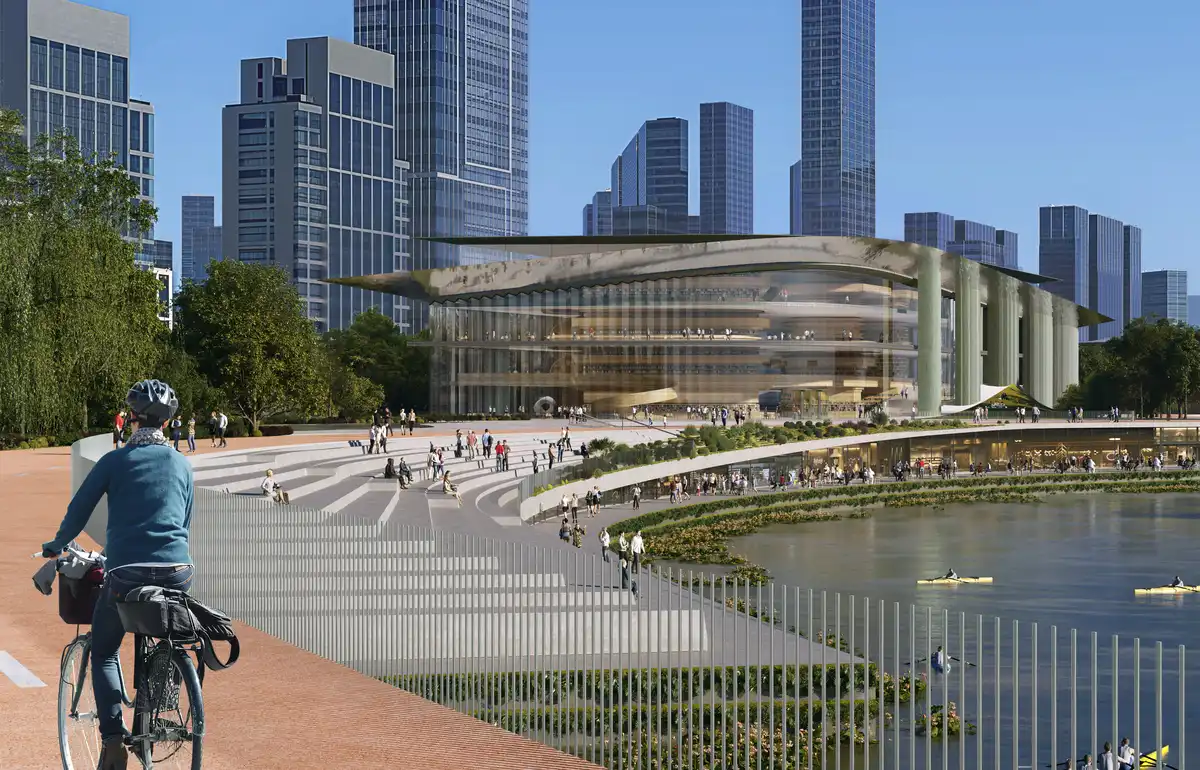
render : Atchain
Micro-renovation of Shennong Temple, Quzhou, Zhejiang
Design: y.ad studio
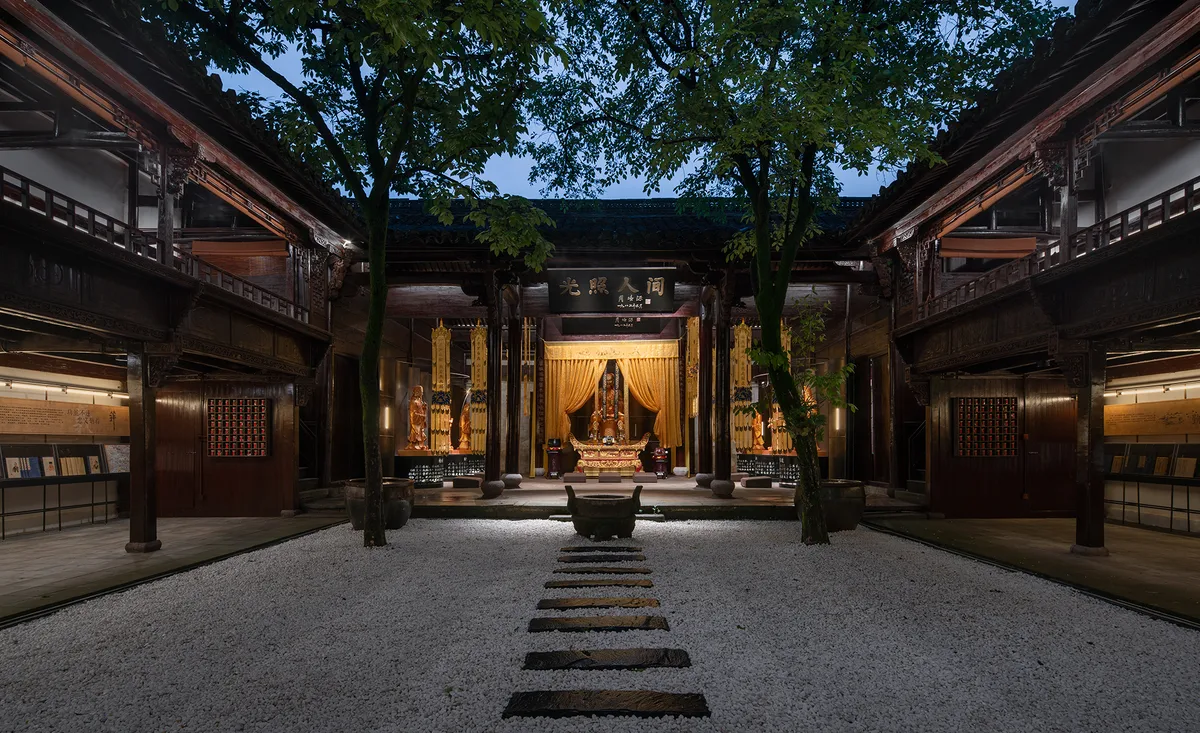
photo : SCHRAN
Lishui Airport building design, Lishui, southwest of Zhejiang province
Design: MAD Architects
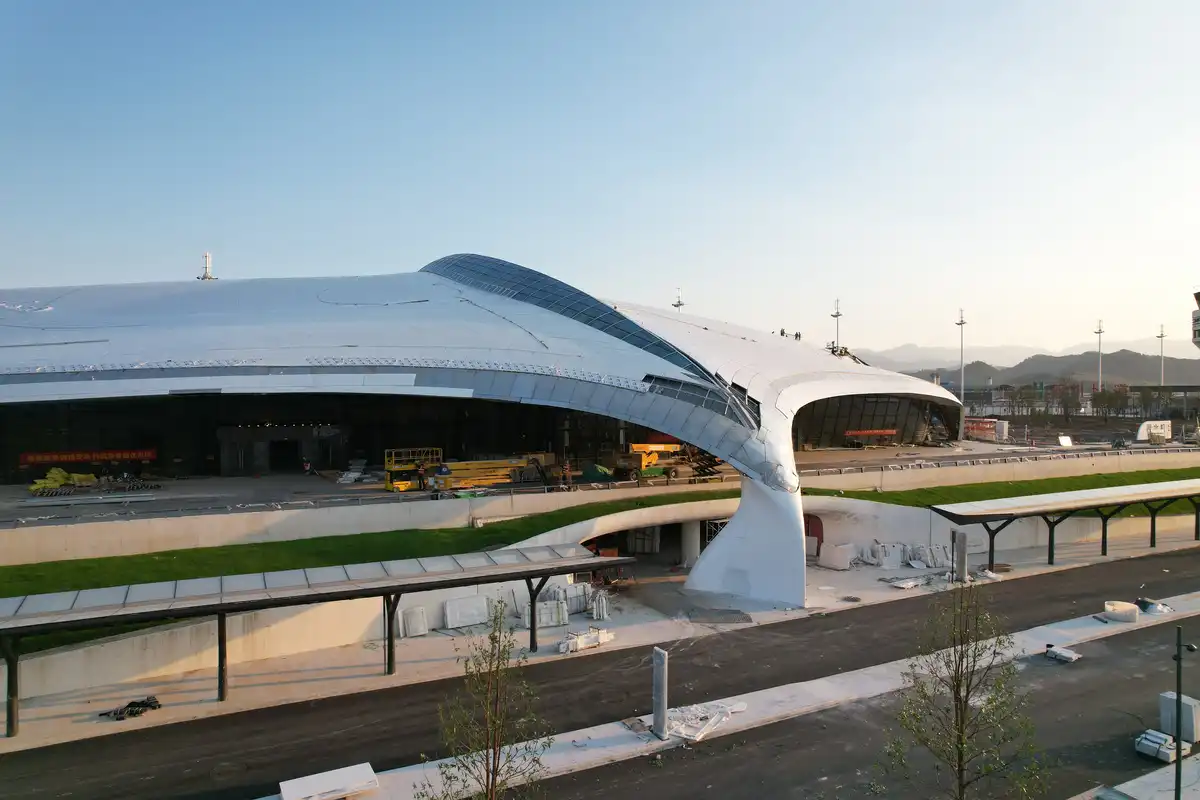
photo : MAD Architects
Xixi Wetland Estate in Hangzhou
Design: David Chipperfield Architects
+++
Architecture in China
China Architecture Designs – chronological list
Chinese Architect – Design Office Listings
Comments / photos for the Tonglu Senbo Resort buildings, Hangzhou, China designed by SpActrum page welcome