
Zihua Mo Redefining the Boundaries of Architectural Intervention
5 February 2026
From Macro-Planning to Micro-Ecologies: How Zihua Mo is Redefining the Boundaries of Architectural Intervention
With a background spanning Urban Planning in China to Advanced Architecture at UPenn, Zihua Mo merges systemic logic with spatial poetics to address contemporary crises.
In the contemporary built environment, the line between urban planning and architectural design is often rigidly drawn. Planners deal with zoning and large-scale systems, while architects focus on form and material. However, architectural designer Zihua Mo is carving out a niche practice that operates deliberately in the blur between these two disciplines.
Mo’s unique design philosophy—which he describes as acting as a “Dissolving Agent”—is deeply rooted in his cross-disciplinary academic journey. Before earning his Master of Architecture from the University of Pennsylvania (UPenn), Mo studied Urban and Rural Planning at Shenzhen University in China. This foundational training in planning provided him with a macroscopic lens, allowing him to understand cities not just as collections of buildings, but as metabolic systems of social flows, economics, and ecology.
“My background in Urban Planning taught me to look at the ‘invisible forces’—how people move, how resources circulate,” Mo explains. “At UPenn, I learned to give those forces physical form. My goal now is to apply that systemic thinking to architectural scales, creating spaces that are aesthetically compelling but performatively rigorous.”
Portrait of Zihua Mo:

image courtesy of Zihua Mo
The Architect as Urban Catalyst
This capacity to operate across scales is most visible in his proposal, “Dissolving Corbin Building.” Rather than treating the historic Lower Manhattan landmark as a static object, Mo reimagines it as a dynamic connector that stitches together the fragmented urban fabric.
“The project isn’t just about the building; it’s about re-activating the connections around it,” Mo explains. “I wanted to dissolve the hard boundaries between the historic structure, the transit hub, and the private residence.”
The intervention uses food as the primary medium for this connection, weaving it through every level of the city. Underground, Mo proposes transforming the circulation links to the adjacent Fulton Center transit hub into a bustling public food court, turning a transient corridor into a destination. Above, the design reclaims the underutilized rooftop of the Fulton Center, converting the barren surface into a vibrant roof bar that engages the skyline.
Between these public poles, the residential experience is redefined through communal rituals. The adapted façade incorporates shared planting spaces that blur the exterior edge, while interior layouts feature communal kitchens that replace the isolation of typical apartments. “By embedding spaces for growing and cooking together,” Mo notes, “we transform the building from a container of isolated individuals into a vertical neighborhood connected to the pulse of the city.”
Dissolving Corbin Building: The proposal reimagines the historic structure as a vertical neighborhood and urban connector:
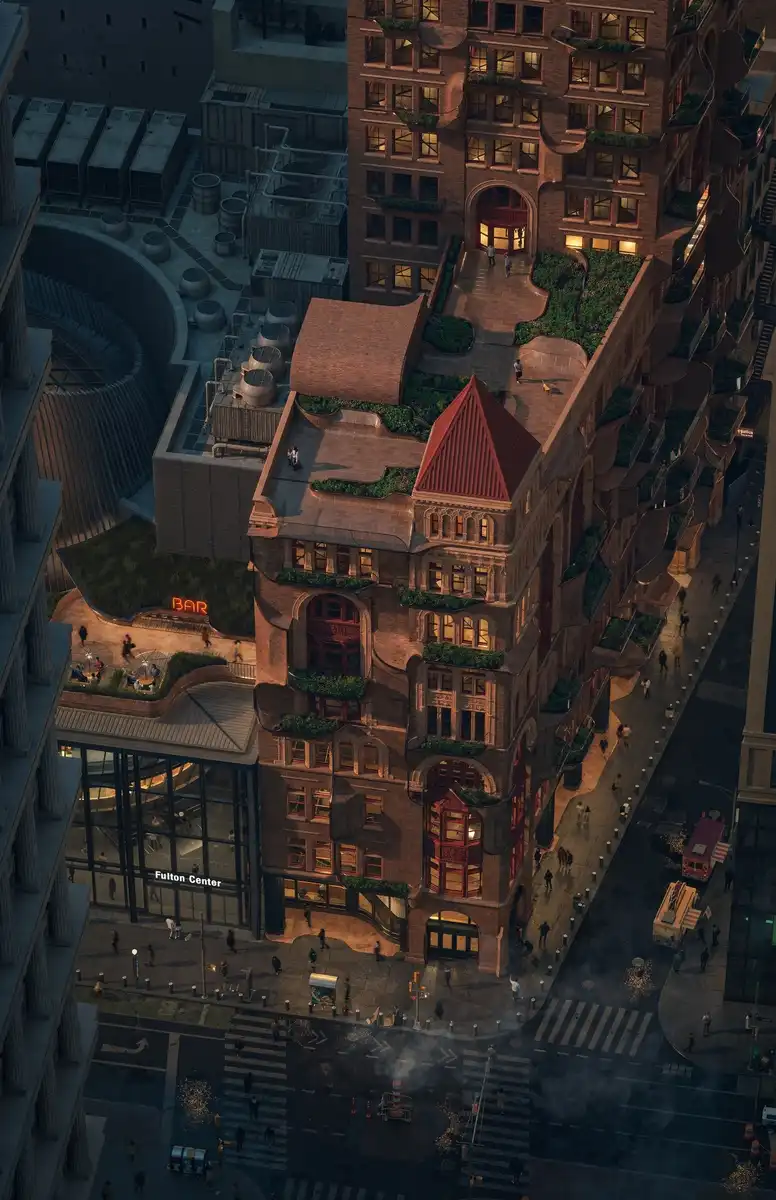
image courtesy of Zihua Mo
Synthetic Nature and Technological Mediation
Mo’s transition from planning to architecture also sparked an interest in how technology can mediate the relationship between human infrastructure and natural environments. His project “Micro Ecologies / Strange Natures,” sited at the chalk cliffs of Møns Klint in Denmark, exemplifies this research-driven approach.
Moving beyond the traditional preservationist view often taught in planning policy, Mo adopted an experimental architectural intervention. He proposed a system of “Synthetic Nature,” utilizing a chemical process where Calcium Hydroxide reacts with atmospheric CO2 to precipitate Calcium Carbonate. This allows the architecture to “grow” from the site’s own geological material, stabilizing the eroding coastline. It is a masterclass in using micro-scale chemical engineering to solve a macro-scale environmental challenge.
Micro Ecologies: Synthetic Nature: An experimental intervention at Møns Klint that uses chemical precipitation to stabilize the coastline:
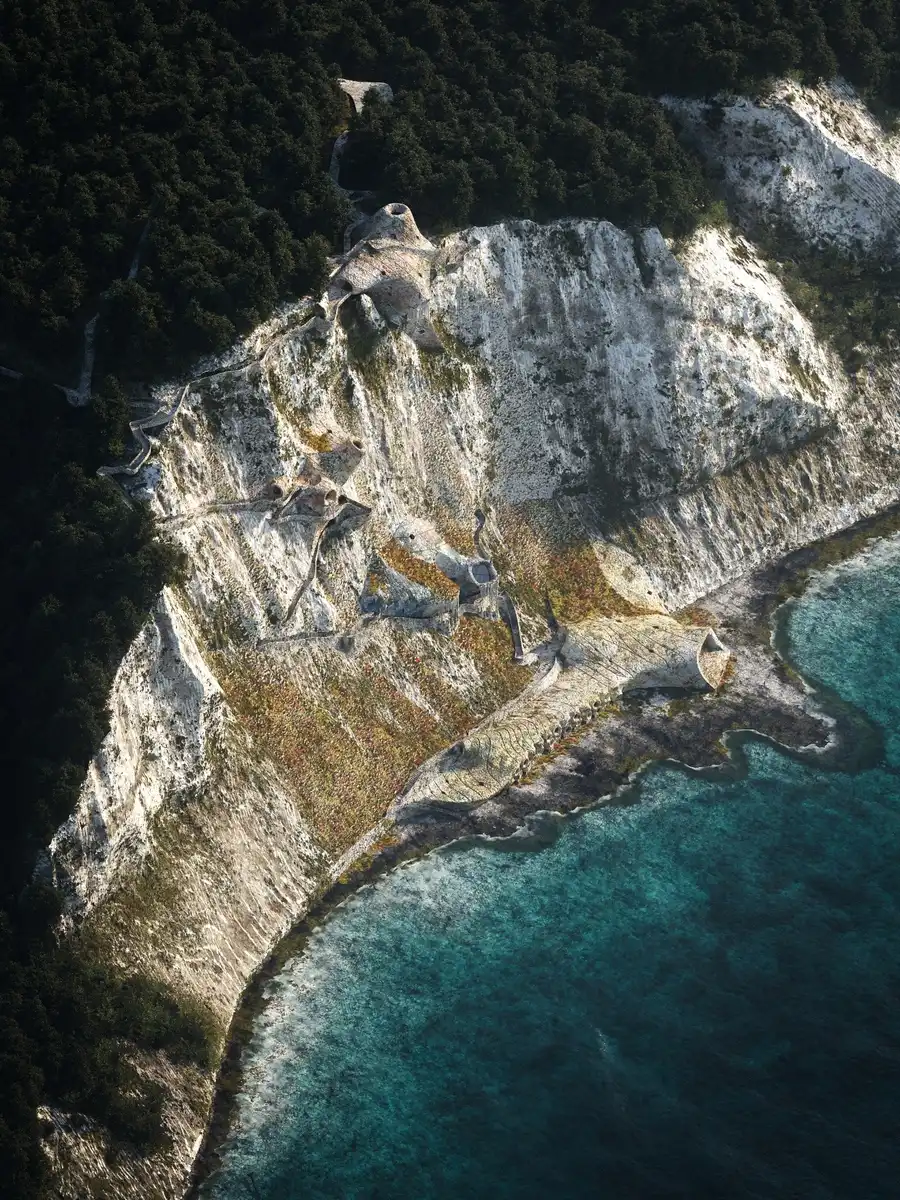
image courtesy of Zihua Mo
Human-Centric Scale
Despite his focus on large systems, Mo’s work at UPenn and in his current professional practice demonstrates a keen sensitivity to the human scale—a skill honed during his Master’s studies. In his redesign of the waiting area of the Counseling Services center at UPenn, Mo shifted from the “city scale” to the “intimate scale.”
Recognizing that traditional clinical environments can induce anxiety, he applied a fluid design language to “soften the edges” of the experience. By integrating lighting, biophilic elements, and furniture into a cohesive system, he created a therapeutic environment that balances privacy with openness. Even here, the planner’s logic is evident: he analyzed the “social flow” of students to minimize awkward eye contact while maximizing comfort.
Waiting Area of the Counseling Center: UPenn Counseling Services redesign, utilizing fluid geometry and biophilic elements to reduce clinical anxiety:
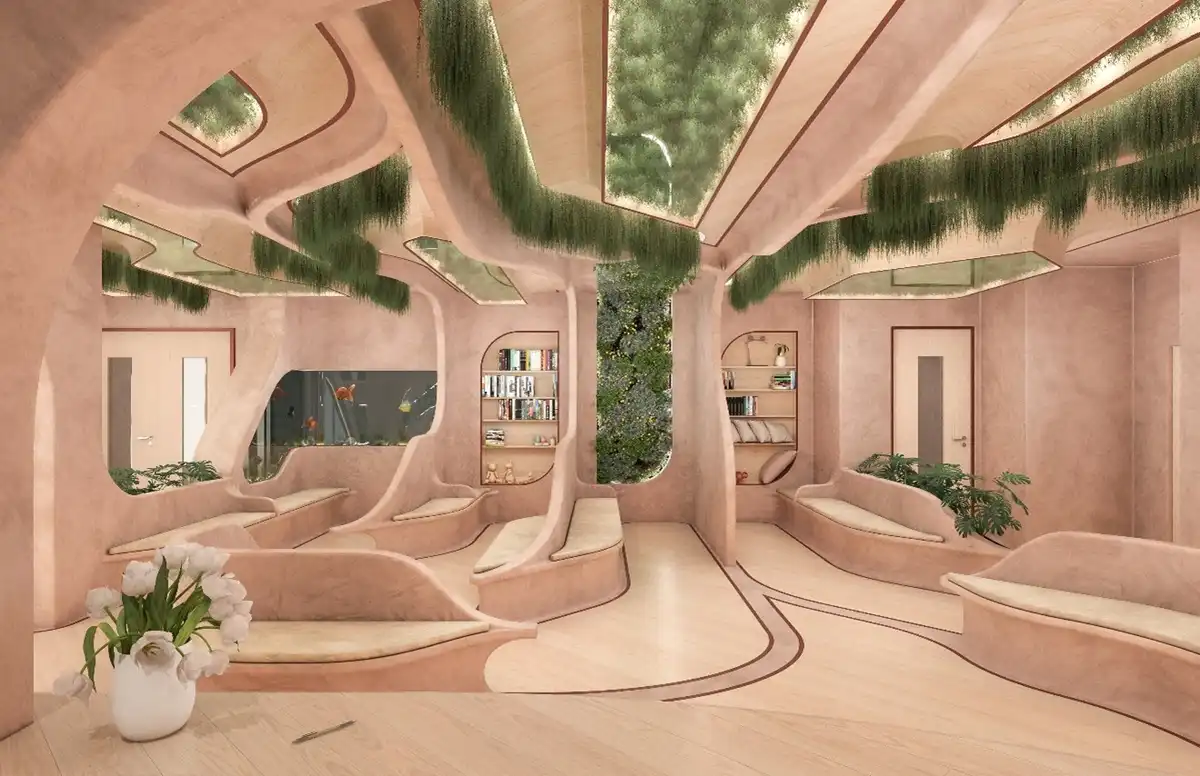
image courtesy of Zihua Mo
A New Multidisciplinary Methodology
Today, working as a designer in the healthcare sector, Zihua Mo continues to bridge the gap between the rigorous logic of planning and the innovative potential of architectural form. His work stands as a testament to the power of interdisciplinary education. By refusing to choose between the role of the planner and the architect, Mo has developed a hybrid methodology that is uniquely equipped to tackle the complex, layered challenges of the modern world.
Comments on this guide to From Macro-Planning to Micro-Ecologies – How Zihua Mo is Redefining the Boundaries of Architectural Intervention article are welcome.
Modern Architecture Design
Recently added Building posts
Hanqin Tang architecture design
image : Hanqin Tang
Space-making Algorithm in Architecture in conversation with Award-winning Architect Jingwen he
Role of regional climate in architectural design
++
Building
Residential Property
Comments / photos for the Zihua Mo architecture design approach page welcome.


