5 Top Vacation Rental Property Management Companies Guide
8 December 2025
5 Top Vacation Rental Property Management Companies (& How to Pick the Right One)
Short-term rentals are booming. U.S. guests booked 24.1 million nights on Airbnb-style platforms on July 15, 2023, and market tracker AirDNA projects demand will rise another 10.7 percent in 2024. Supply is swelling at the same time, which holds average occupancy near 55 percent and turns hosting into a 24/7 job.
Nearly half of owners now hire a vacation-rental property-management company to handle pricing, marketing, guest support, and compliance. In the pages that follow, we compare the five best national managers and give you a quick decision framework so you can choose the partner that maximizes income while minimizing stress.
How we picked the winners
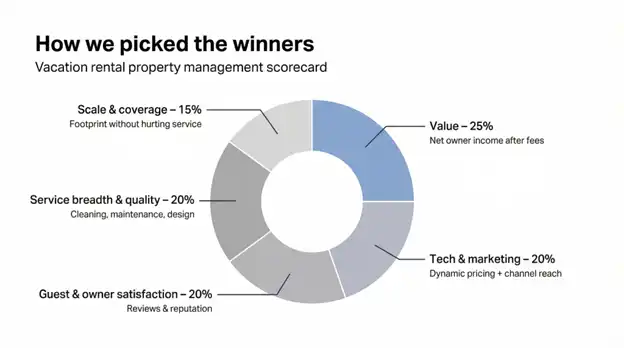
- Value (25 percent) – transparent fees plus proof that owners keep more money after costs
- Tech & marketing (20 percent) – dynamic pricing, 40-plus channel reach, and real-time owner dashboards
- Guest & owner satisfaction (20 percent) – Trustpilot ratings (Vacasa about 4.4★ on 16 000 reviews, Evolve about 3.8★) cross-checked against BBB reports and forum chatter
- Service breadth & quality (20 percent) – end-to-end coverage of cleaning, maintenance, compliance, and design extras
- Scale & coverage (15 percent) – a footprint large enough for national partnerships yet still small enough to protect service quality
Weighting value highest keeps the spotlight on what matters: your take-home cash, not vanity metrics such as gross bookings. Technology and marketing follow because pricing engines and wide distribution—think dynamic-pricing software from vacation-rental franchise networks like Skyrun—fill calendars that great photos alone can’t. Satisfaction and service quality ensure promises translate into happy guests and owners, while scale verifies the company can replicate success beyond one ZIP code.
This rubric lets us compare giants, franchises, and lean tech players on equal footing, and it’s the same scorecard you can use when interviewing managers in your market.
1. SkyRun Vacation Rentals: local heart, national muscle

Picture the best of both worlds: a neighbor who knows every shortcut to the ski lift and a national brand whose algorithm tweaks rates while you sleep. That blend is SkyRun, a franchise network that now manages about 1 200 homes across more than 40 U.S. destinations, according to a PR Newswire press release.
Founded in Colorado in 2004, each SkyRun location is owned by a local entrepreneur but powered by one booking engine, one dynamic-pricing brain, and one set of brand standards. The result is a house that feels custom-cared-for yet marketed with big-company firepower.
Owners like the math. Full-service management runs 20–25 percent of gross rent, while a hybrid plan drops to about 15 percent if you handle some tasks. There’s no onboarding fee and a 30-day walk-away clause, so the franchise must perform or lose your listing.
Performance backs up the pitch. Company data show an average 4.8-star guest rating across Airbnb and Vrbo, a level usually reserved for boutique managers. One Breckenridge owner cleared $800 000 in bookings within 18 months after switching, thanks in part to lightning-fast price tweaks when a snowstorm pops.
Technology does the heavy lifting. Listings syndicate to 40-plus channels, including Marriott Homes & Villas, and a yield engine recalibrates prices several times a day. Owners watch every move inside a live dashboard that tracks bookings, revenue, and even checkout photos from the cleaner.
Because the franchise owner lives nearby, guests reach a real person, not a call center, and you get one point of contact who has skin in the game.
SkyRun shines for second-home owners who crave personal attention but refuse to leave money on the table. If you want someone who can text you a porch photo after a hailstorm and launch the listing on Marriott that same afternoon, put SkyRun at the top of your short list.
2. Vacasa: scale that sells
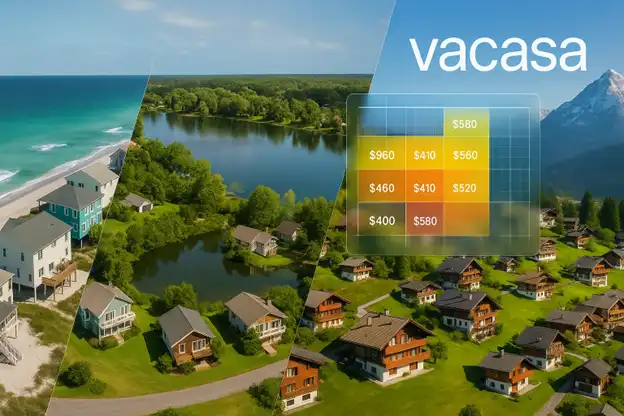
Think of Vacasa as the department store that anchors the mall. After merging with Casago in May 2025, the combined brand now manages about 43 000 vacation homes across North America, Belize, and Costa Rica, according to a company news release—far more than any other company on this list.
That scale pays dividends. Vacasa’s pricing engine recalibrates rates several times a day, factoring in flights, events, and even weather fronts. Listings appear on 40-plus channels (including Marriott Homes & Villas), so shoulder-season gaps shrink fast.
The promise is simple: hand over the keys and enjoy direct deposit. Vacasa covers photography, 24/7 guest messaging, housekeeping, maintenance, tax remittance, and compliance. Cleaning fees go to the guest, and field teams stock starter toiletries and linens. Owners mainly approve the occasional repair and block personal dates.
Convenience costs. Full-service fees run 25–30 percent of gross rent. For owners who prefer to arrange cleans themselves, the Guestworks program charges a flat 10 percent. Contracts are typically one year with a 90-day exit window, balancing stability with flexibility.
Guest satisfaction stays high. Trustpilot shows a 4.4-star average from more than 16 000 reviews. Service can vary by market, so interview the local general manager and ask about staff-to-property ratios before you sign.
Vacasa suits owners who want maximum reach and a truly hands-off experience, and who are comfortable paying a premium for big-tech peace of mind.
3. Grand Welcome: guarantees with a human touch

Picture Grand Welcome as SkyRun’s beach-town cousin. The company expanded from 750 homes in 2022 to about 2 200 properties across more than 60 U.S. markets by late 2025, according to a Franserve announcement. Each territory is run by a local owner who still knows which plumber answers the phone at 6 a.m, making Grand Welcome one of the more approachable vacation-rental franchise opportunities worth exploring.
The hook is confidence: many franchisees offer a revenue guarantee. In Lake Tahoe, for instance, the office promises homeowners at least $5 000 more than last year or writes a check for the difference. That skin in the game keeps everyone focused on earnings, not excuses.
Fees stay competitive. Full-service commission averages 20 percent, a hair below SkyRun and well under Vacasa. Onboarding is free, contracts run one year, and most franchisees allow an early exit with notice. Bulk deals on linens, smart locks, and design refreshes cut costs for owners.
Technology matches the big players: listings feed to Airbnb, Vrbo, Expedia, and 30-plus niche sites, while a national revenue team adjusts rates daily. Your local general manager oversees cleaners and inspectors, and an owner dashboard ties bookings to maintenance tickets so you can see revenue and repair spend in one glance.
Consistency is the wildcard. The Tahoe office runs like a Swiss watch, while a brand-new Gulf Coast branch may still be hiring cleaners. Trustpilot shows a 2.6-star average from 12 reviews—evidence that some locations shine and others need polish. Interview the local franchisee, ask for references, and confirm their staff-to-home ratio before signing.
Choose Grand Welcome if you want the warmth of a local handshake plus the safety net of a revenue floor, all powered by a national marketing engine that can keep your calendar full year-round.
4. Evolve: low fee, high control

Evolve flips the traditional model. Instead of a 25 percent cut for cradle-to-grave service, it charges 10 percent on its basic plan (15 percent for “Evolve Plus”) and focuses on marketing, dynamic pricing, and 24/7 guest communication. Owners arrange cleaning and maintenance themselves or through local help.
That trade keeps more money in your pocket. On $80 000 in annual bookings, a 25 percent manager leaves you $60 000 before expenses, while Evolve’s 10 percent fee bumps that to $72 000, often still ahead even after paying reliable cleaners.
Scale is solid. Evolve markets more than 30 000 homes across 500-plus North American destinations and pushes listings to Airbnb, Vrbo, Booking.com, and its own site. The SmartRates engine recalibrates prices daily, and pro photos plus optimized copy come standard.
Support covers the essentials: payment processing, $1 000 in damage protection per stay, and round-the-clock guest messaging, while you keep full control of on-site standards, from eco-friendly supplies to your favorite handyman.
Freedom cuts both ways. If a cleaner cancels or a water heater fails, you solve it. Owners who live nearby or have a trusted co-host thrive, while far-flung investors may prefer full service.
The no-penalty exit helps. Evolve offers a Risk-Free Guarantee that refunds its fees if you leave within six months. With a 4.1-star Trustpilot average on more than 5 000 reviews, Evolve is a compelling middle path for hands-on hosts who love the business side but hate the marketing grind.
5. Awning: Wall Street brains for Main Street homes
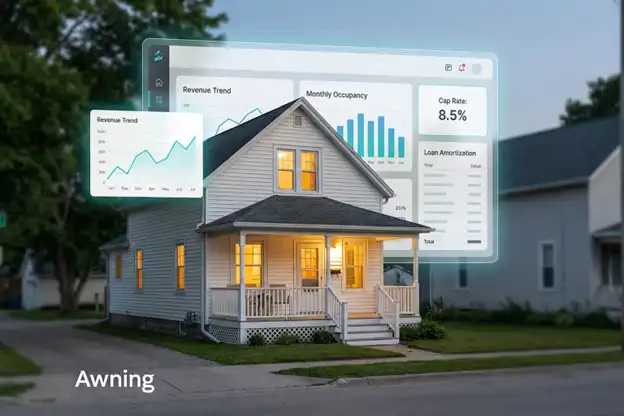
Awning began as an analytics platform that guided investors to high-yield Airbnb markets. Clients soon asked, “Can you run the place, too?” and Awning obliged. Today it manages hundreds of listings nationwide while continuing to model cap rates and financing scenarios.
The offer is straightforward: full-service management starting at 10 percent of booking revenue. Most homes fall in the 10 to 15 percent band. That fee covers pro photography, multi-channel marketing, dynamic pricing, 24/7 guest support, and coordination of local cleaners and handymen. Cleaning and repair costs flow through at cost, keeping margins transparent.
Investors rave about the dashboard, which pairs nightly performance with loan amortization, refinance calculators, and neighborhood appreciation curves. Think of it as a Bloomberg Terminal for vacation homes.
Service quality is maturing. Trustpilot shows a 2.8-star average across 31 reviews, reflecting a young firm scaling faster than its vendor network in some cities. Awning now assigns each owner a dedicated manager and pays top-rated contractors more, yet due diligence is smart: ask how many homes they already run in your market and who handles housekeeping.
Awning excels at end-to-end convenience. You can shop, close, furnish, and launch without switching providers. For first-time investors chasing yield, or portfolio owners who want one pane of glass across states, few rivals offer the same cradle-to-cash-flow experience.
Conclusion
Hiring a professional manager can turn a demanding side hustle into a truly passive investment—but only if you pick a partner whose fees, technology, and service model fit your goals. Use the scorecard above to interview candidates, compare offers, and choose the company that will maximize your profit while giving you the level of control—or freedom—you prefer.
Comments on this guide to 5 top vacation rental property management companies article are welcome.
Building Designs
House Designs – contemporary property additions on e-architect:
Mulholland Drive Annex, eastern Santa Monica Mountains of Southern California
Bundy Drive Residence, Los Angeles
Quality planning matters in property renovation projects
++
Home Articles
Residential Architecture
Comments / photos for the 5 top vacation rental property management companies page welcome.