How Dingdong Tang Turns Complexity into Deliverable Architecture
9 February 2026
Author: Morgan Hayes
Dingdong Tang, award-winning architectural designer specializing in complex delivery and heritage revitalization:

In contemporary architecture, the most precarious territory is not the blank page—it is the space between intent and delivery. Many teams can produce compelling renderings; far fewer can preserve the logic behind them once budgets tighten, consultants collide, jurisdictions weigh in, and the field introduces conditions no drawing set can fully predict. It is inside that volatile gap that Dingdong Tang works.
Dingdong Tang is an award-winning architectural designer, the Founder and Design Principal of LYT-X Studio, and formerly part of Yazdani Studio of CannonDesign. His practice spans two worlds that often appear unrelated: heritage revitalization and high-performance research environments. Yet both arenas share the same hard problem—complexity—and Tang has built his reputation not simply on shaping space, but on governing the decision systems that make complex architecture buildable, defensible, and durable.
He frames design as a discipline of integration: turning constraints into an explicit governing structure, closing decisions with evidence, and protecting intent through delivery. Across adaptive reuse proposals and high-stakes building workflows, his defining strength is consistent: he converts complexity into built order that can be executed, verified, and maintained.
Beyond Coordination: Integration as Governance
To understand Tang’s approach, it is helpful to identify the industry default it replaces. In many complex projects, “coordination” remains reactive. Conflicts stay invisible until late—when drawings collide, bids surface ambiguities, or site conditions reveal what no one clearly owned. By the time misalignment becomes visible, the project has already absorbed weeks of latent risk.
Design intent rarely collapses in a single moment; it erodes over time. Scope drift hides inside “minor” clarifications. Details become negotiable by default. Late-stage alignment turns into redesign under deadline, and coherence is traded away in RFIs, change orders, and on-site compromises. The cost is not only financial; it is architectural—clarity is replaced by patchwork.
Tang works from a different premise: complexity is inevitable; ambiguity is optional. Where reactive coordination treats problems as events to manage after they appear, he treats integration as governance—a proactive structure that makes tradeoffs explicit, locks decisions before they fracture across teams, and keeps intent enforceable when pressure rises. “Architecture isn’t an image,” he says. “It’s a system of verifiable decisions.”
Tang defines complexity in operational terms. Interfaces are where systems meet. Constraints are the fixed coordinates—code triggers, preservation limits, environmental forces, and operational requirements. Unknowns are what sharpen late—field conditions, procurement shifts, stakeholder priorities. Governance begins by naming these realities early, then assigning decision rights so teams stop renegotiating the same problem in different rooms.
Tang establishes review gates that function as verification thresholds rather than calendar milestones. A project does not advance simply because time passes; it advances when the logic holds—when life-safety and circulation remain coherent and critical transitions are detailed to an executable level. He surfaces non-negotiables at the front—code triggers, preservation boundaries, operational limits—so tradeoffs happen with full visibility, not in the field under duress. He assigns ownership at high-risk interfaces, defines what “closed” means, and demands a record that survives handoffs. Risk is not managed through diffuse agreement; it is retired through accountable closure.
The Evidence Loop: Why Verbal Decisions Fail
Governance only matters if it holds under stress. Tang therefore runs an evidence loop he treats as non-negotiable: analysis leads to a decision; the decision is recorded and translated into documentation; documentation is verified against reality; and change is managed through traceable control rather than drift.
When projects skip this discipline, decisions remain verbal—and verbal decisions do not survive handoffs. Consultants interpret intent differently. The same interface gets “resolved” multiple times under different assumptions. Details drift until the field becomes the first place where conflicts are truly closed. By then, closure is expensive, and the “solution” often becomes a compromise that quietly rewrites the project.
Tang counters this failure by anchoring decisions to documented triggers and reviewable artifacts. He formalizes constraints as a hierarchy rather than a background list. If a team cannot articulate what is truly non-negotiable—preservation boundaries, life-safety triggers, access requirements, operational limits—it creates waste. Designers invest energy in moves that will inevitably be rejected by the jurisdiction or constructability later. By making frictions visible early and binding them to a traceable record, he keeps integration legible, auditable, and repeatable.
The Heritage Test: Innovating Within Non-Negotiables
UNESCO Ancient Theatre Revitalization proposal, courtesy of LYT-X Studio:

At LYT-X Studio, Tang tests this governance framework most intensely in heritage contexts. In the proposal for the UNESCO Ancient Theatre Revitalization, preservation boundaries are not a backdrop—they are active constraints that shape every decision. The work must satisfy preservation scrutiny, code expectations, and contemporary civic operability without converting the place into a stage set.
The difficulty is physical. Inserting modern HVAC runs into centuries-old masonry without scarring the visual fabric requires more than geometry; it requires a negotiated truce between preservation ethos and mechanical reality. Life-safety and accessibility requirements collide with historic geometry, tight clearances, and protected fabric that cannot simply be “opened up.” Tang treats integration as that negotiation: clarifying what must remain untouched, what can adapt, and what must be newly introduced—without letting any single discipline dominate the whole. The goal is not to “add circulation,” but to choreograph how the public reads the place, where arrival becomes orientation, and movement becomes a legible civic sequence without overpowering the historic fabric. Here, governance becomes cultural: it protects memory while enabling contemporary use.
Scaling the Method: High-Performance Research Environments
The same governance logic scales into advanced research environments—and during his time at Yazdani Studio of CannonDesign, Tang applied it where technical precision and documentation discipline become primary constraints, and late-stage misalignment translates directly into cost, delay, and performance risk.
Caltech Resnick Sustainability Center Exterior View:
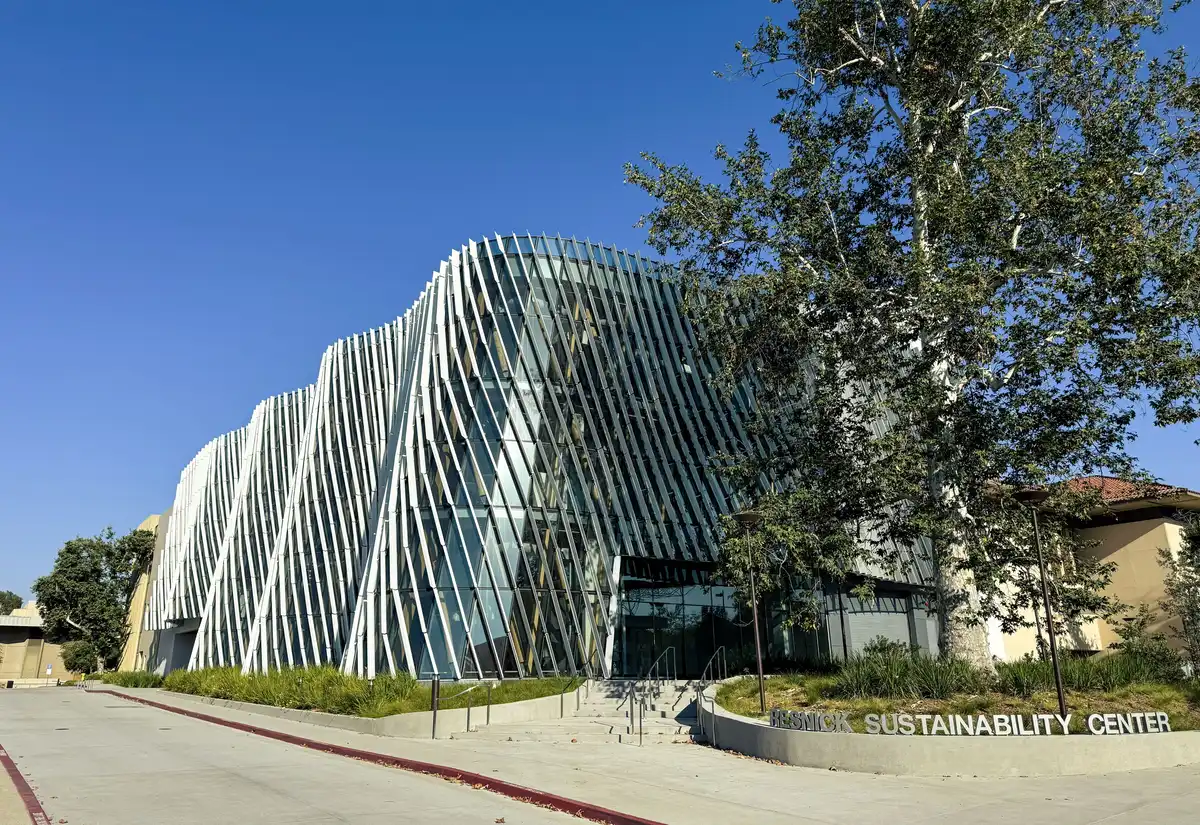
At the California Institute of Technology’s Resnick Sustainability Center, a LEED Platinum facility conceived as a campus hub for energy and sustainability research, architecture performs in multiple registers at once: as research infrastructure, as public-facing institutional space, and as a highly coordinated technical environment. Often described through a transparent, light-filled framework that puts “science on display,” the project pairs a mass-timber-forward expression with a high-performance enclosure—an assembly that leaves little tolerance for late-stage rework. The building’s spatial clarity relies on integration discipline at every interface, because even small gaps between intent, documentation, and field conditions can propagate quickly.
Caltech Resnick Sustainability Center Interior View:

Within this environment, Tang held critical responsibility in construction-phase decision workflows. As a construction-phase gatekeeper, he translated field conditions into controlled documentation—protecting design intent while keeping decisions buildable. When seemingly minor interface gaps threatened to cascade into redesign and delay, he drove closure through traceable records rather than informal agreements. He treated construction administration not as reactive paperwork, but as a verification framework—closing decisions with clear records, controlled revisions, and accountability where misalignment becomes cost.
Resnick Center for Agricultural Innovation at UC Davis, courtesy of Yazdani Studio of CannonDesign:

At the Lynda and Stewart Resnick Center for Agricultural Innovation at UC Davis, Tang applied the same principle earlier in the process: treat lab coordination as a front-loaded risk problem, not a late-stage clean-up task. Laboratory environments amplify interface complexity; mechanical distribution, piping, power, and data must coexist within constrained zones while supporting demanding performance requirements. Tang reduced ambiguity by locking interface assumptions early and enforcing drawing precision as documentation advanced. By pushing alignment upstream, he limited downstream reversals and reduced the kind of late conflicts that typically fracture lab projects—between performance intent, consultant inputs, and deliverable reality.
Across both research facilities and heritage work, Tang’s through-line is consistent: integration is not an administrative task. It is a governing framework that turns constraints into decisions—and decisions into durable architecture. In a profession that often celebrates ideas, his work insists on something harder: the discipline required to make those ideas survive reality.
Comments on this guide to Dingdong Tang architecture design article are welcome.
Modern Architecture Design
Recently added Building posts
Hanqin Tang architecture design

image : Hanqin Tang
Space-making Algorithm in Architecture in conversation with Award-winning Architect Jingwen he
Role of regional climate in architectural design
++
Building
Residential Property
Comments / photos for the Dingdong Tang architecture design approach page welcome.