
Designing Buildings That Work With Infrastructure, Not Against It
2 February 20266
Architects are trained to think in elevations, sections, daylight angles, human flow, material palettes, and the emotional weight of space. Yet the lived success of a building is often decided by systems most people never see: power reliability, water pressure, storm drainage, fiber routes, district energy tie-ins, roadway capacity, and the resilience of the surrounding network when something breaks.
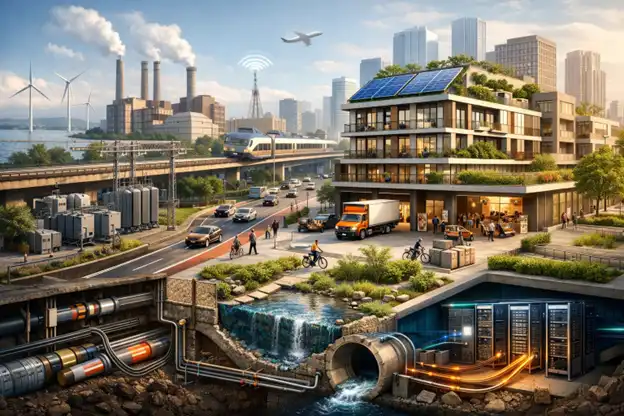
In an era defined by climate volatility, grid stress, rapid urbanization, and a renewed focus on public investment, architecture can’t be separated from infrastructure. The most future-proof buildings are the ones that “plug in” intelligently—reducing strain on shared systems, adapting to disruption, and, ideally, making the neighborhood work better because they exist.
This article looks at how architects, developers, and city stakeholders can design projects that align with infrastructure realities. It’s not about turning architects into civil engineers. It’s about making infrastructure part of the design language from the start—so form, function, and resilience reinforce each other rather than colliding in late-stage value engineering.
The Hidden Brief: Infrastructure Is Already Shaping Your Design
Every project begins with a brief: program, budget, site constraints, codes, planning policy, client goals. But there’s another brief that arrives quietly and becomes unavoidable later: utility capacity and network constraints.
A project can be beautifully resolved on paper and still fail in execution if:
- The electrical supply can’t support peak demand without costly upgrades.
- The water main can’t meet fire flow requirements.
- The drainage system can’t accept additional runoff without attenuation.
- The road network can’t handle construction logistics or new traffic patterns.
- Telecommunications routing is limited, delayed, or expensive to extend.
These issues don’t just affect schedules and costs; they shape massing, plant room sizing, basement layouts, podium depths, landscape strategies, and even façade decisions (especially where shading and thermal loads influence plant capacity).
The practical shift is this: treat infrastructure like an early design partner. Bring it into concept design, not the post-planning scramble.
Power, Heat, and the New Logic of Energy-Ready Buildings
Energy strategy is no longer a tick-box sustainability section at the end of a report. It’s becoming a core driver of spatial planning.
1) Electrification changes building anatomy
As buildings move away from gas (or reduce dependency), electrical demand rises. Heat pumps, induction cooking, EV charging, and all-electric plant create a different peak profile. This has implications for:
- Substation space and routing
- Riser sizing
- Plantroom footprint
- Roof and façade allocations for PV and ventilation
- Acoustic strategy (heat pumps often add external noise challenges)
The architectural opportunity is to treat energy systems as intentional, not hidden compromises. When plant is integrated early, you avoid awkward rooftop “afterthought” enclosures or oversized risers that destroy valuable area.
2) District energy and hybrid networks
In many urban areas, district heating/cooling, ambient loops, or shared energy networks are either emerging or being expanded. Buildings that can connect—or at least be “district-ready”—gain optionality. That may mean:
- Reserving plant interface zones
- Designing thermal storage options
- Allowing for future pipe corridors
- Structuring basements for later tie-ins
Even if a district system isn’t available today, making space for future connection can be a strategic hedge.
Water: The System That Fails Quietly—Until It Doesn’t
Architects often think about water in terms of fixtures, aesthetics, and landscape. Infrastructure thinking asks a different set of questions: where does water come from, where does it go, what happens during extreme events, and what is the building doing to local hydrology?
1) Stormwater as spatial design
Runoff management is increasingly a determining factor in site planning. Instead of treating attenuation as underground tanks that appear late in the process, many projects now benefit from visible, spatial strategies:
- Bioswales and rain gardens as circulation edges
- Permeable paving that supports public realm quality
- Courtyards designed as water landscapes, not just “leftover” space
- Green roofs that reduce peak discharge and improve microclimate
These aren’t merely ecological gestures. Done well, they become place-making tools.
2) Water resilience is a climate issue
Flooding is no longer a once-in-a-century anomaly. For many regions, it’s a recurring design condition. That shifts the logic of ground floors, basements, entrances, and critical systems:
- Keep critical plant above likely flood levels
- Consider sacrificial ground-floor zones in high-risk sites
- Provide safe egress during inundation
- Use materials and assemblies that tolerate wetting and quick recovery
This is where architecture can express resilience without looking defensive.
Mobility Infrastructure: Beyond Parking Ratios
Mobility decisions shape a building’s relationship to the city. Parking ratios used to be a dominant planning metric. Now the emphasis is broader: multi-modal access, micromobility, public transport integration, and logistics.
1) Designing for the delivery economy
Even residential projects now have complex loading needs: deliveries, returns, food drop-offs, waste management, and service access. Ignoring this pushes chaos into public streets.
Better outcomes come from planning:
- Clear service routes that don’t collide with pedestrians
- Discreet, well-lit delivery zones
- Waste systems that reduce public realm clutter
- Storage for parcel lockers without destroying lobby experience
2) Micromobility is architectural space
Bike rooms, e-scooter storage, charging points, and safe access routes are no longer “nice-to-haves.” If you design them as part of the building’s spatial identity—rather than a leftover corner—you improve usability and reduce conflict at entrances.
Digital Infrastructure: The Quiet Demand That’s Exploding
Buildings are now data-dependent. Tenants expect resilient connectivity the way they expect potable water.
Designing with digital infrastructure in mind can prevent expensive retrofits:
- Plan diverse telecom entry routes where possible
- Provide secure, accessible comms rooms
- Allow for rooftop equipment zones (where permitted)
- Consider future capacity for smart building systems and sensors
This matters for commercial buildings, hospitality, mixed-use, and increasingly for residential developments where remote work is permanent.
Designing for Disruption: Resilience as a Core Architectural Quality
Resilience isn’t just about stronger materials. It’s about graceful performance under stress: heatwaves, outages, storms, supply interruptions.
Some practical design moves that integrate infrastructure resilience:
- Thermal performance first: high-performance envelopes reduce reliance on mechanical systems.
- Passive survivability: buildings that remain safe during power loss earn long-term trust.
- Redundancy where it counts: not everything needs backup, but critical systems often do.
- Maintenance access: resilience fails if systems can’t be serviced quickly and safely.
- Modularity and adaptability: design risers, plant zones, and service corridors for future change.
The goal isn’t to build a bunker. It’s to build something that stays functional and recoverable.
The Process Shift: Treat Infrastructure as Early Design Intelligence
The biggest improvements often come from changing when you make decisions. If infrastructure constraints surface after planning, you’ll pay for them in redesign and delay.
A better workflow looks like this:
- Early capacity checks: utilities, drainage, transport, comms
- Scenario planning: what changes if capacity is constrained?
- Spatial allowances: plant zones, corridors, future-ready interfaces
- Stakeholder alignment: engineers, planners, utilities, and design team in the same room early
- Iterative testing: don’t wait for “final” designs to validate systems
If you want a deeper stream of analysis on how infrastructure decisions influence the built environment—especially around resilience, networks, and planning logic—see infrastructure strategy insights.

Architecture That Belongs to the System
The most admired architecture doesn’t just look good; it works. It supports life at scale. It performs during heatwaves, keeps water out when storms hit, and doesn’t collapse into dysfunction when a supply chain hiccup delays a part.
Designing with infrastructure in mind doesn’t dilute architectural intent. It strengthens it. It forces clarity: what is essential, what is optional, and how does this building participate in the city’s metabolism?
Buildings are not isolated objects. They are nodes in a network—energy, water, mobility, digital connectivity, ecology, and social life. When architects design with that reality upfront, projects become more durable, more elegant, and more truly “of their place.”
If you want, I can also adapt this to e-architect’s typical editorial style (shorter paragraphs, more subheads, and image-caption placeholders) while keeping it over 1,000 words and preserving the single anchor link.
Comments on this guide to Safelinc CO detectors: carbon monoxide protection for homeowners article are welcome.
Home Floor Plan
House Floor Plans and Designs
++
Home Articles
Residential Architecture
Comments / photos for the Designing Buildings That Work With Infrastructure, Not Against It page welcome.


