GEM – Grand Egyptian Museum in Giza
Architecture development in Egypt architecture by heneghan peng architects, exhibition design by ATELIER BRÜCKNER
post updated 2 November 2025
Architecture Design: Heneghan Peng Architects
Photos: Iwan Baan
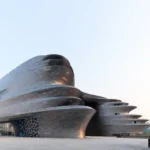
Internationally renowned architecture firm heneghan peng architects celebrates the official completion of its design of the Grand Egyptian Museum. Located just over one mile away from the Pyramids of Giza, the Museum is a testament to the longevity and scale of ancient Egyptian civilization and its enduring influences.
Address: Cairo – Alexandria Desert Rd, Kafr Nassar, Al Haram, Giza Governorate 3513204, Egypt
Phone: +20 2 35317344
Public transit access: Cairo Metro Line 4, Pyramids Station (under construction) List of Cairo Metro stations
22 October 2025
Grand Egyptian Museum Building in Giza
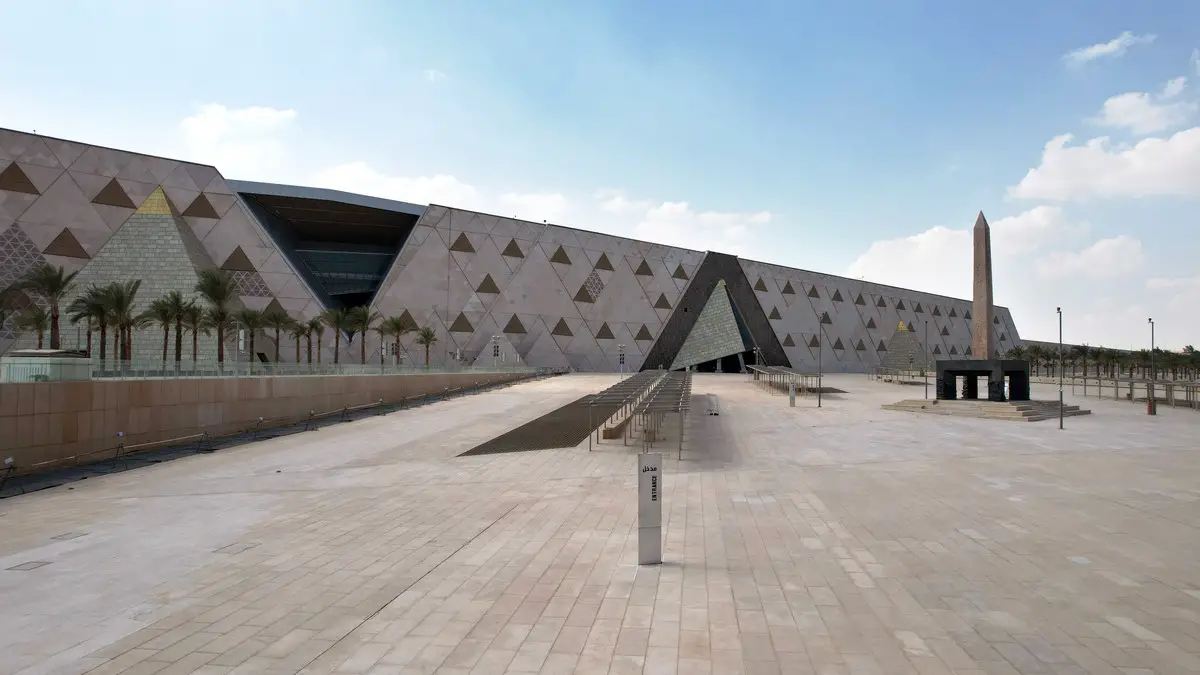
Designed to house 100,000 artifacts, the Museum is the largest in the world dedicated to a single civilization. The full completion is marked by the opening of the Tutankhamen gallery, which will display the entire collection of over 5,000 artifacts to the public for the first time. heneghan peng designed the Museum in direct relation to the positioning of the pyramids, thoughtfully bridging the gap between history and modernity.
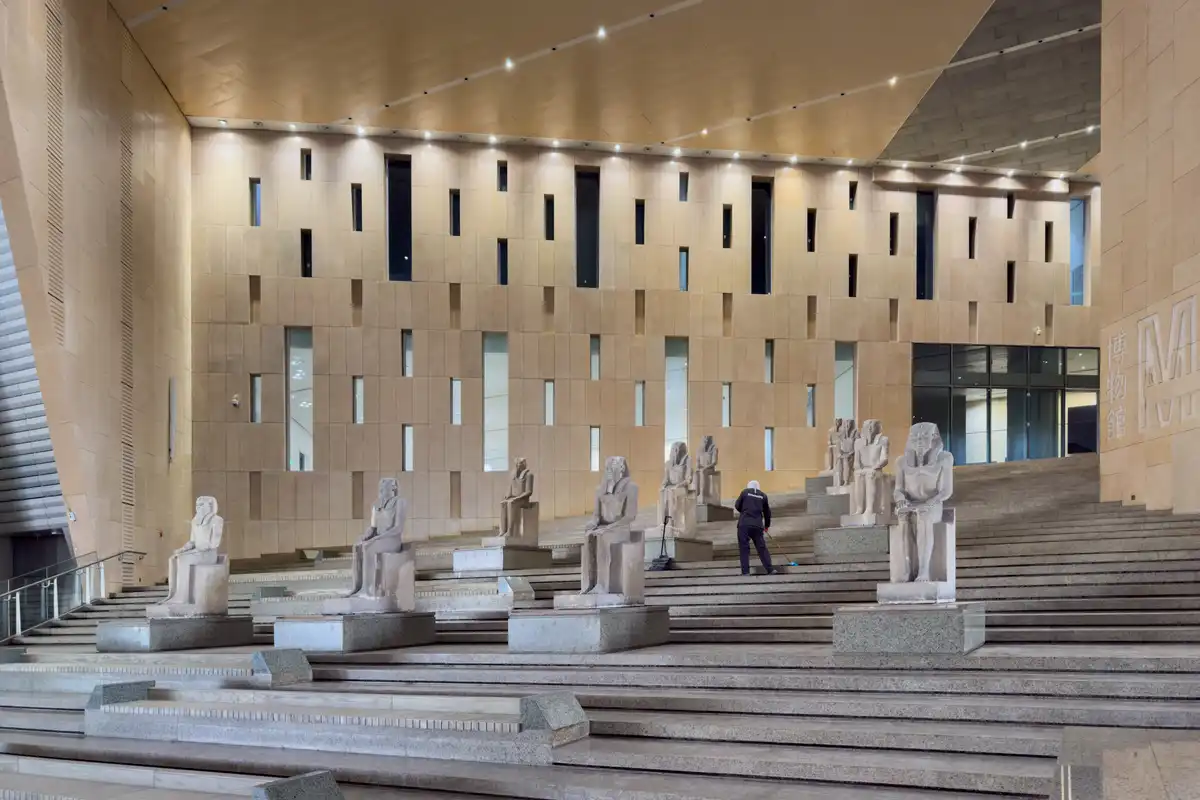
heneghan peng was awarded the project in 2003 after the Egyptian Ministry of Culture launched the largest architectural competition in the world for a completed building to date, calling for submissions to design a world-class museum on a prestigious site overlooking the pyramids. heneghan peng’s design triumphed over 1,556 other entries from 82 different countries, marking a significant achievement for the Ireland-based firm. heneghan peng worked in joint venture with Arup and Buro Happold to create a global team of architects and engineers that brought the project to life. Full credits can be found below.
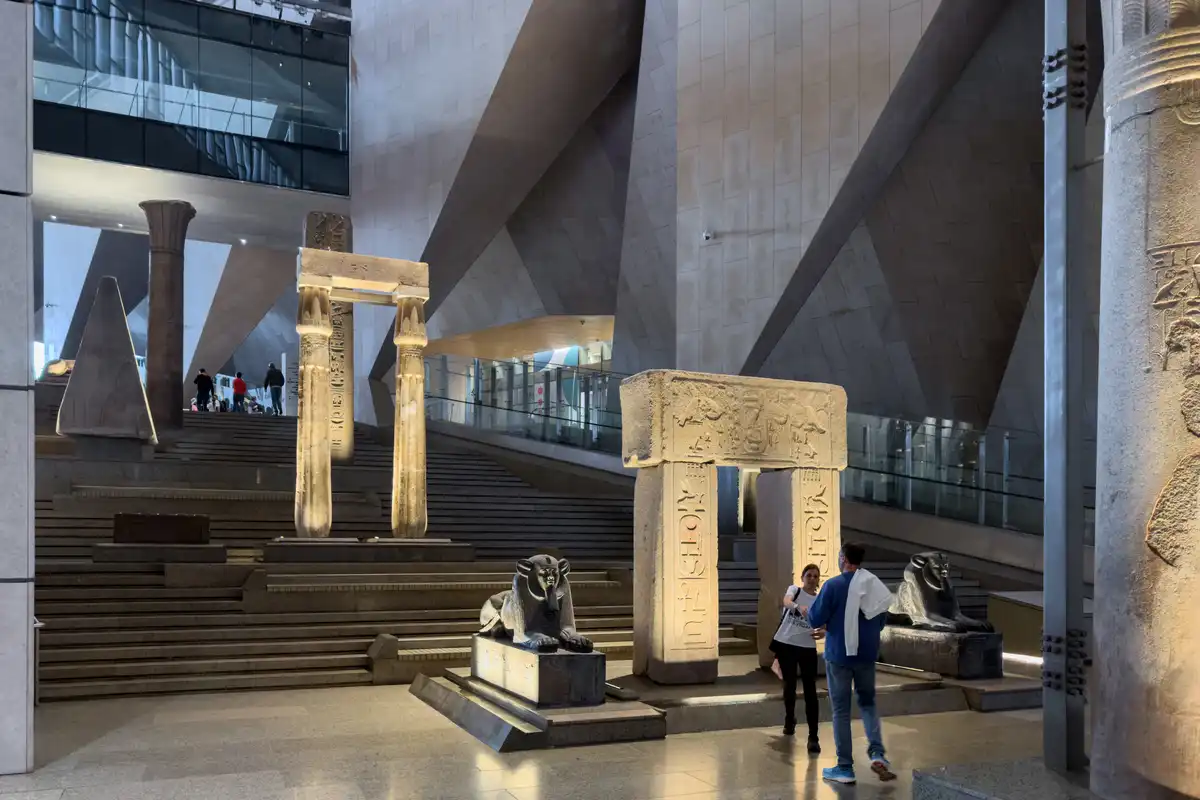
“Designing a museum of this caliber, in such close proximity to a landmark as monumental and symbolic as the pyramids, is a once-in-a-lifetime opportunity,” said Róisín Heneghan, Founding Partner at heneghan peng architects. “Our design works to strengthen that connection to history and place, providing a home for some never-before-seen artifacts that rests upon the very land from which they were created. The result is an experience that evokes a sense of awe at the breadth and depth of ancient Egypt’s fascinating history in a way that feels both modern and timeless.”
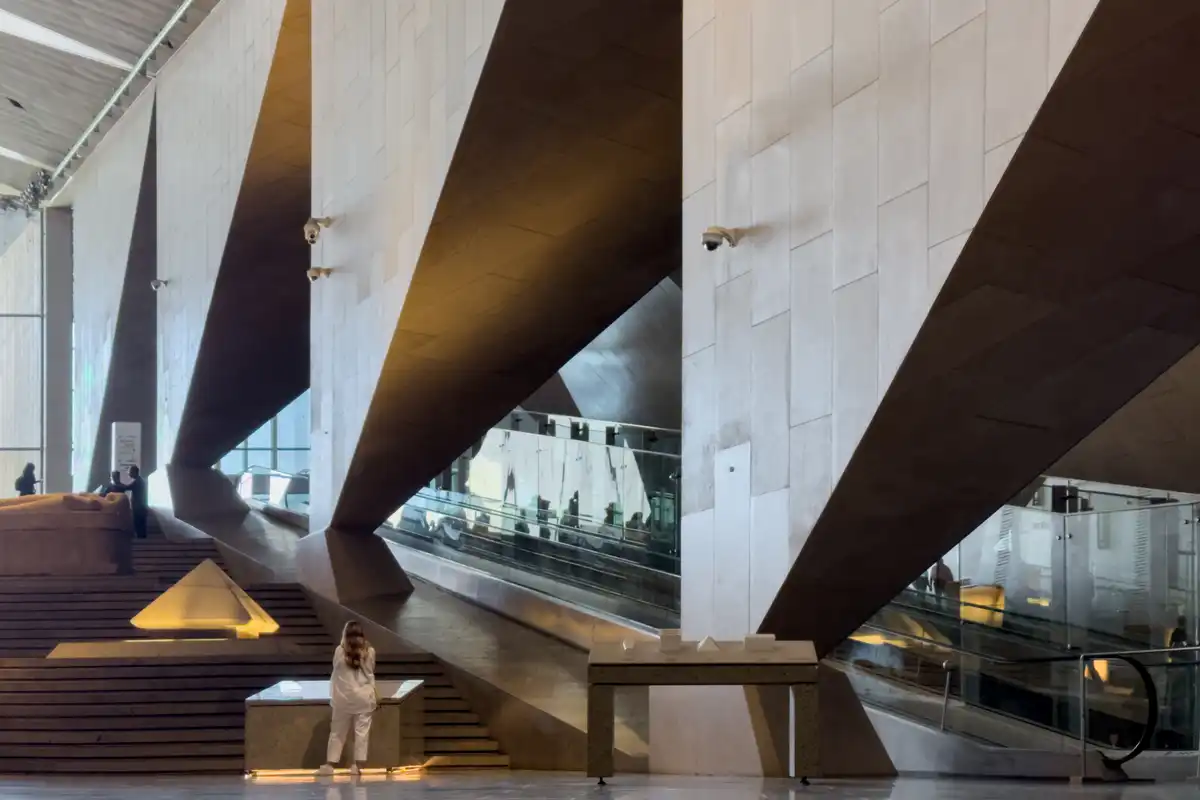
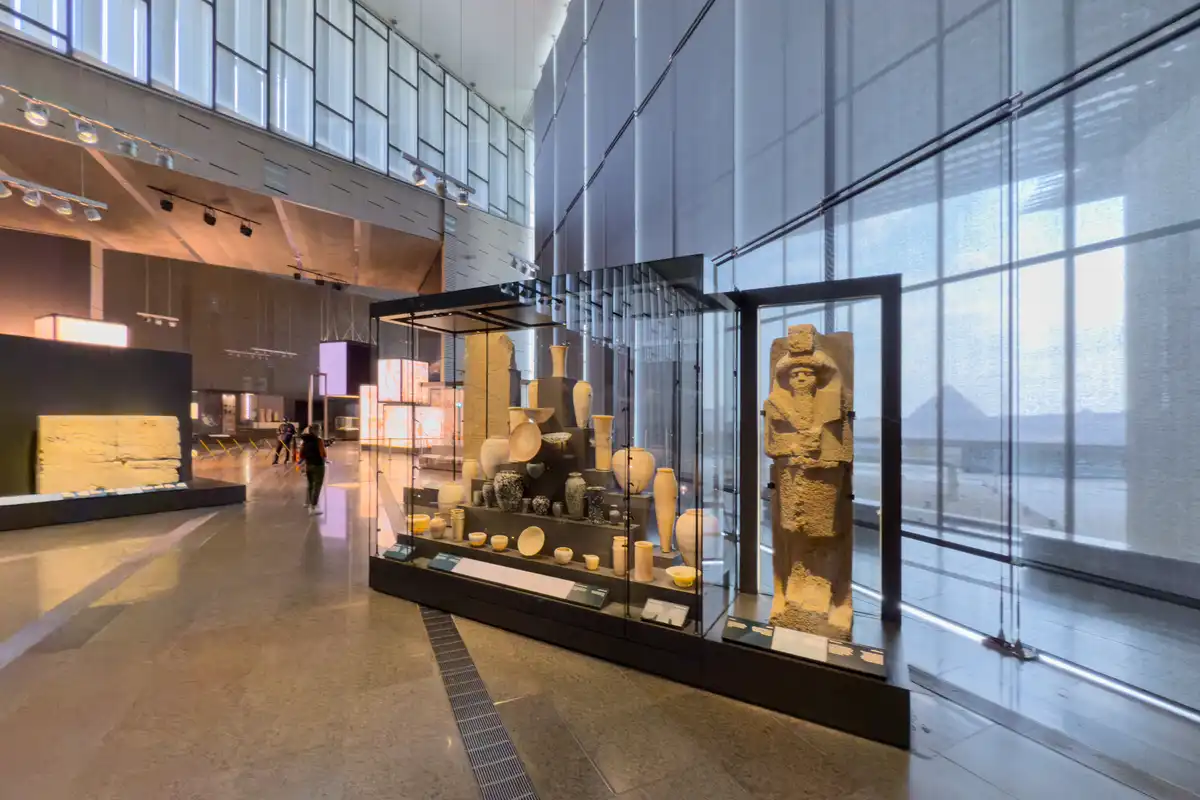
Located on a desert plateau formed by the Nile thousands of years ago, the Museum’s geological setting was integral to the design. Beginning at a focal point outside of the entrance, the Museum structure radiates outward toward the pyramids along a visual axis that aligns directly with the positioning of the three pyramids. The interior walls follow these radial lines to create a fanning shape, with the roof sloping upward along a similar visual line to meet the highest point of the pyramids but never surpass them. This direct dialogue between the Museum and the pyramids strengthens the connection to place and creates an unparalleled view that makes the pyramids feel like a part of the Museum itself.
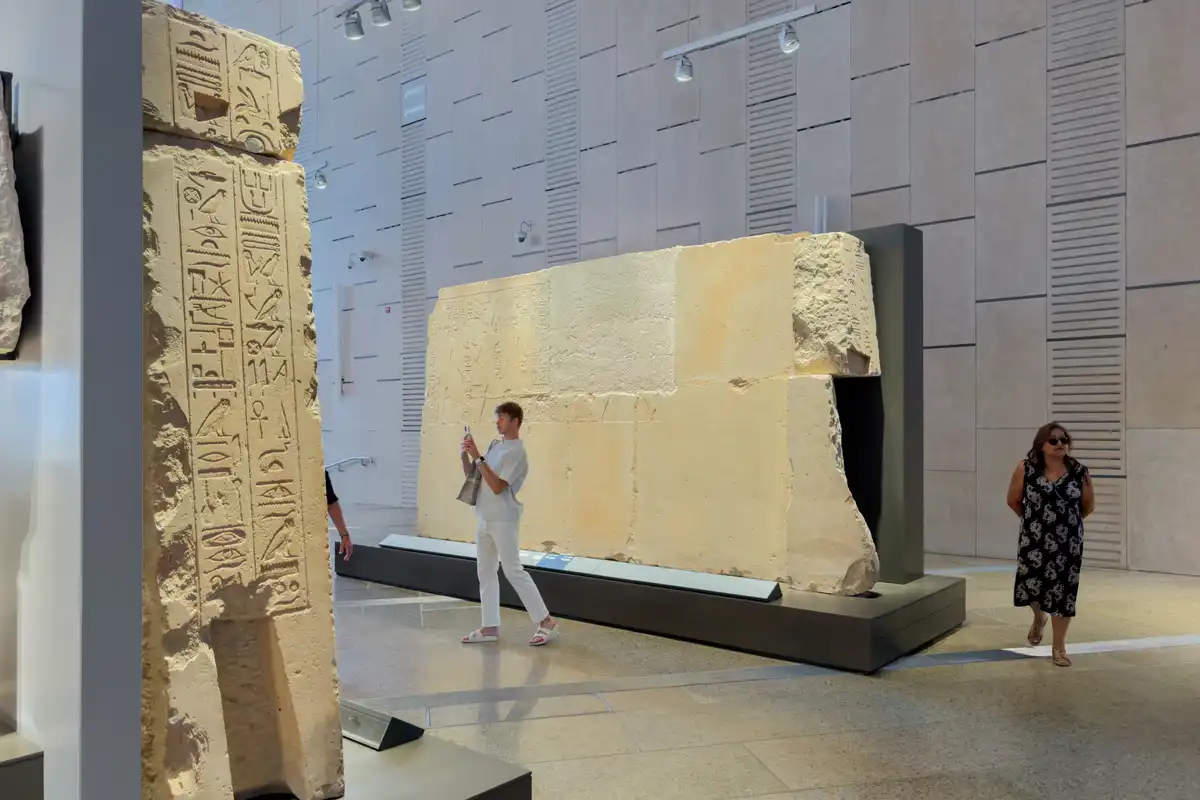
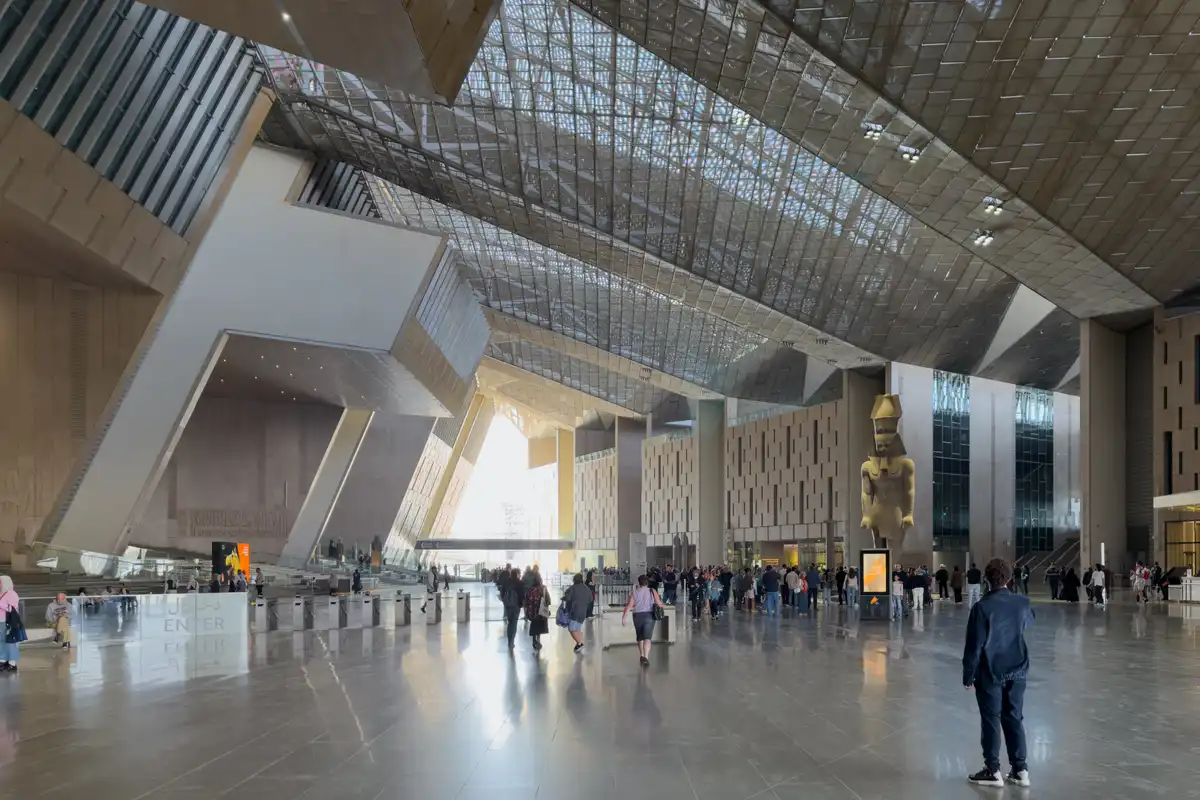
The Permanent Exhibition gallery, situated along the line demonstrated above, points directly toward the tallest pyramid
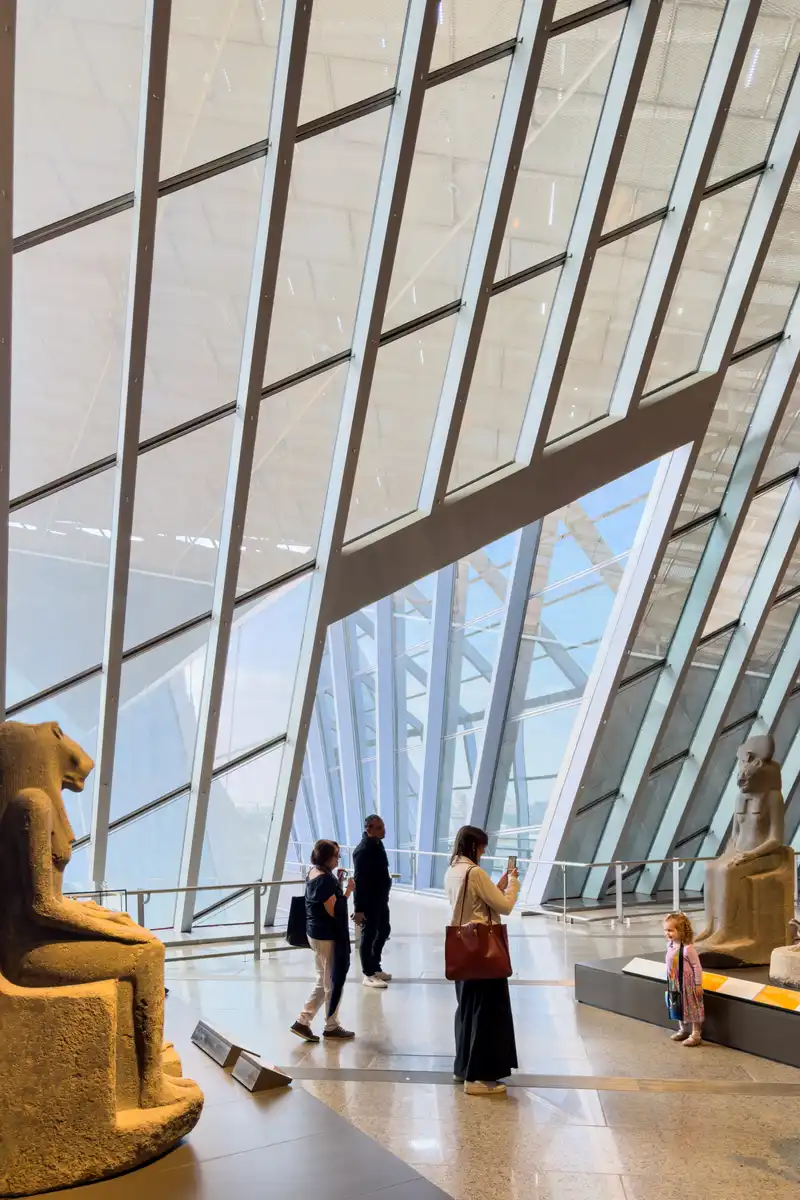
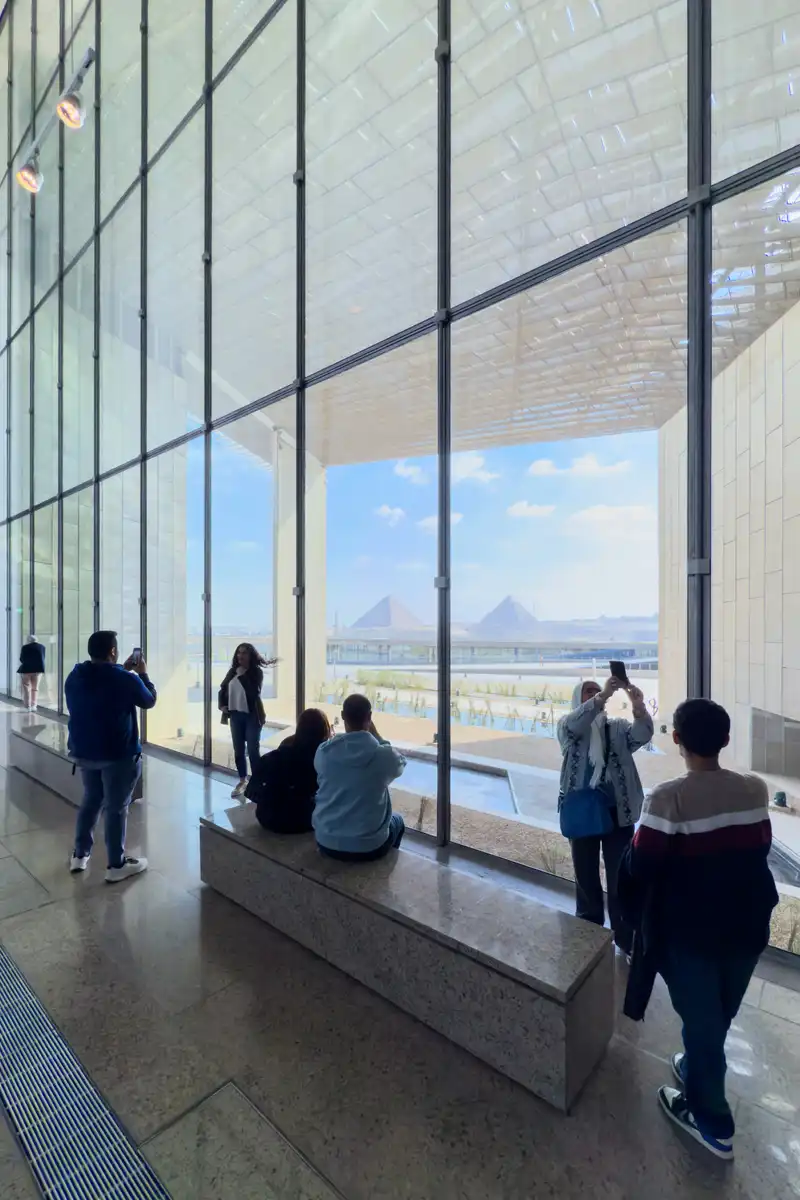
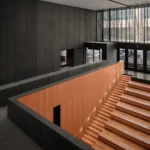
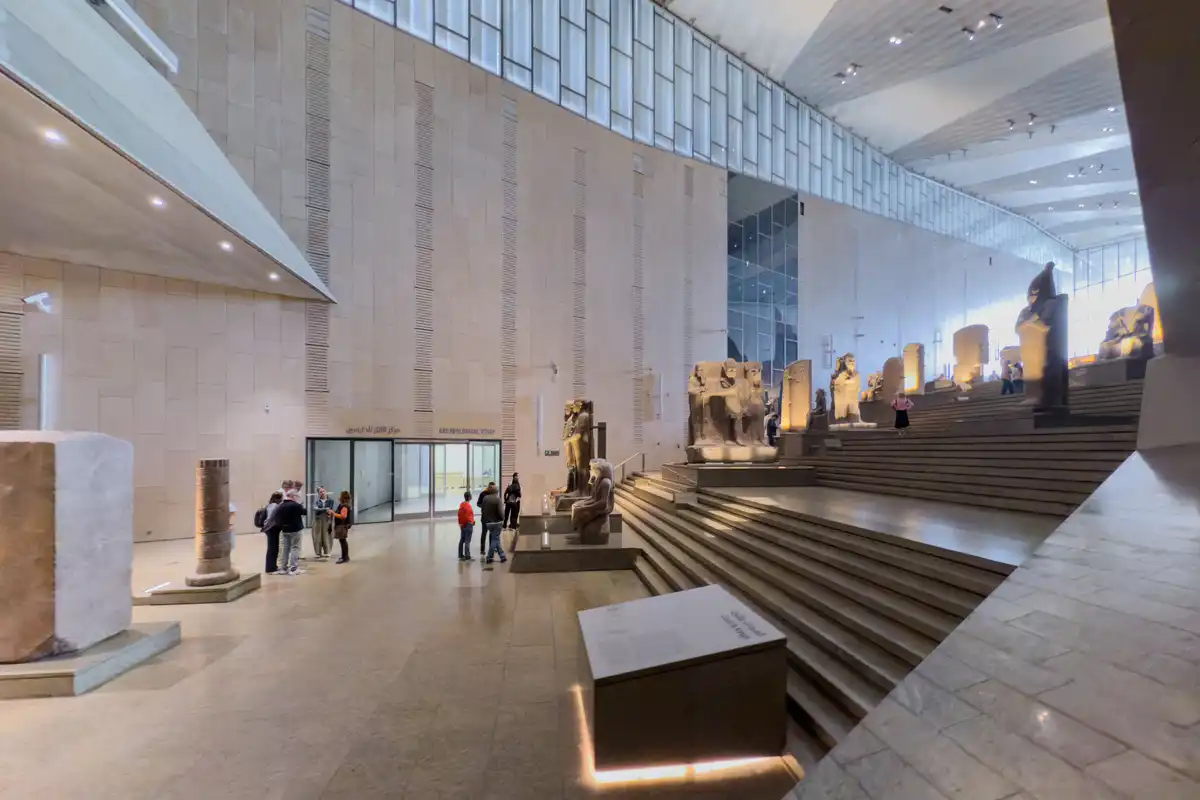
The grand six-story staircase serves as a chronological route to guide visitors through the different galleries, beginning with the Predynastic Period through the Coptic era. The permanent exhibitions, including the new Tutankhamen Gallery, are placed at the top of the staircase, encouraging visitors to immerse themselves in each period before completing the experience with the iconic view of the pyramids. Many of the largest and heaviest artifacts, including the 10 statues of King Senusret I, are also placed upon the staircase at varying levels.
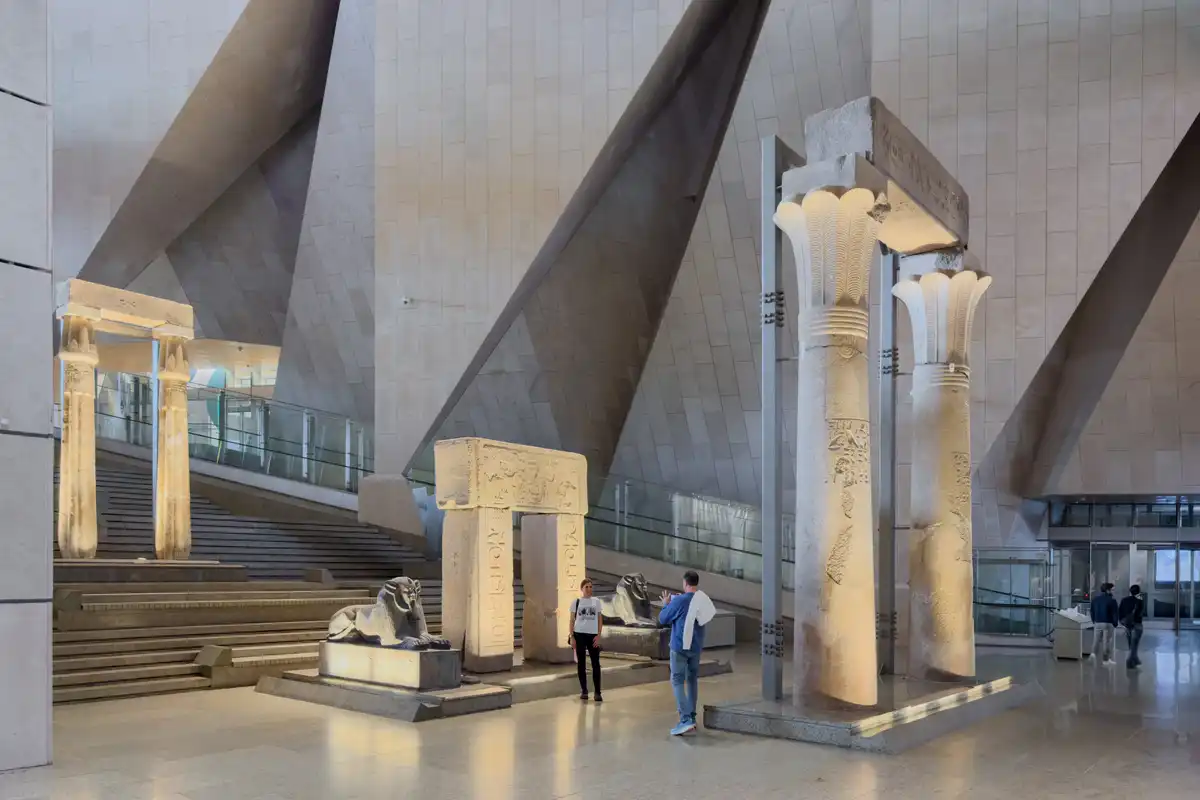
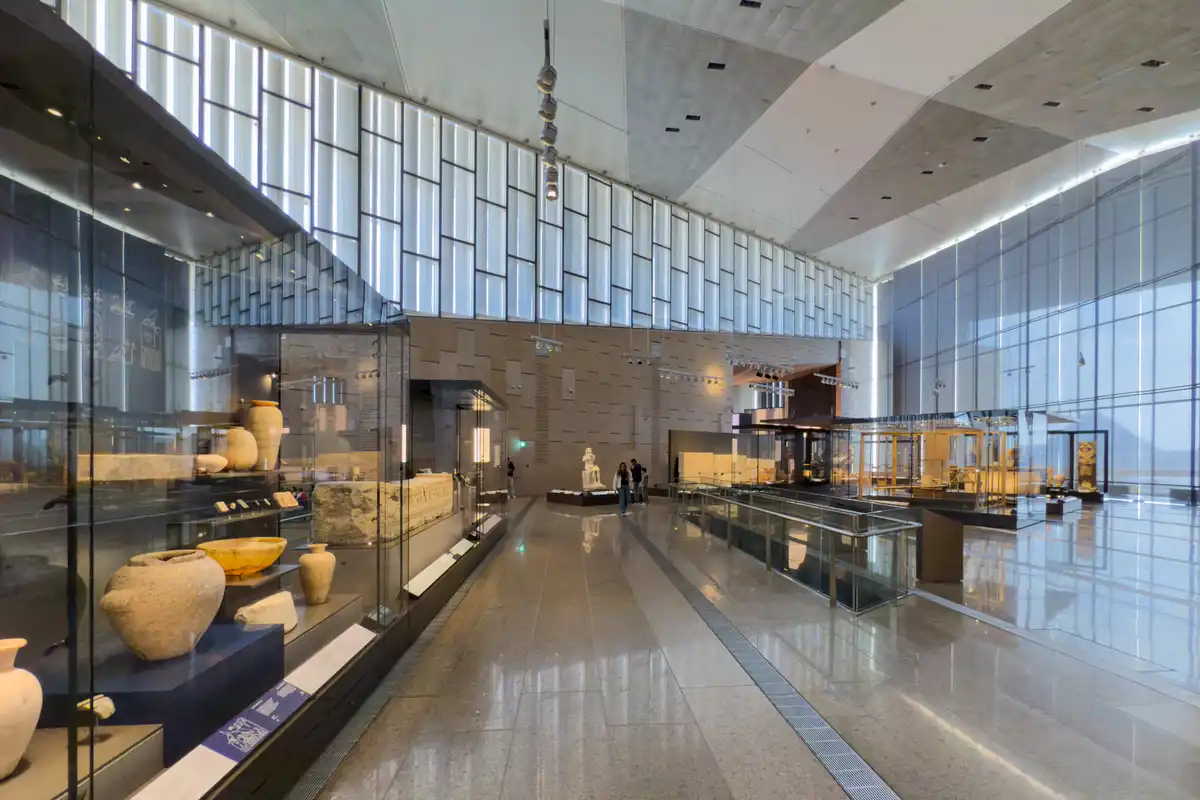
The incorporation of natural lighting is a key element of heneghan peng’s approach to the Museum experience and connection to the region’s historic context. While natural lighting is typically minimized in museums for conservation reasons, many of the artifacts are stone, creating a unique opportunity to introduce natural lighting wherever possible, particularly in the Museum’s main spaces. To help the building perform as passively as possible, the structure is largely made of concrete to reduce variation in temperature and minimize the need for air conditioning in such a vast space.
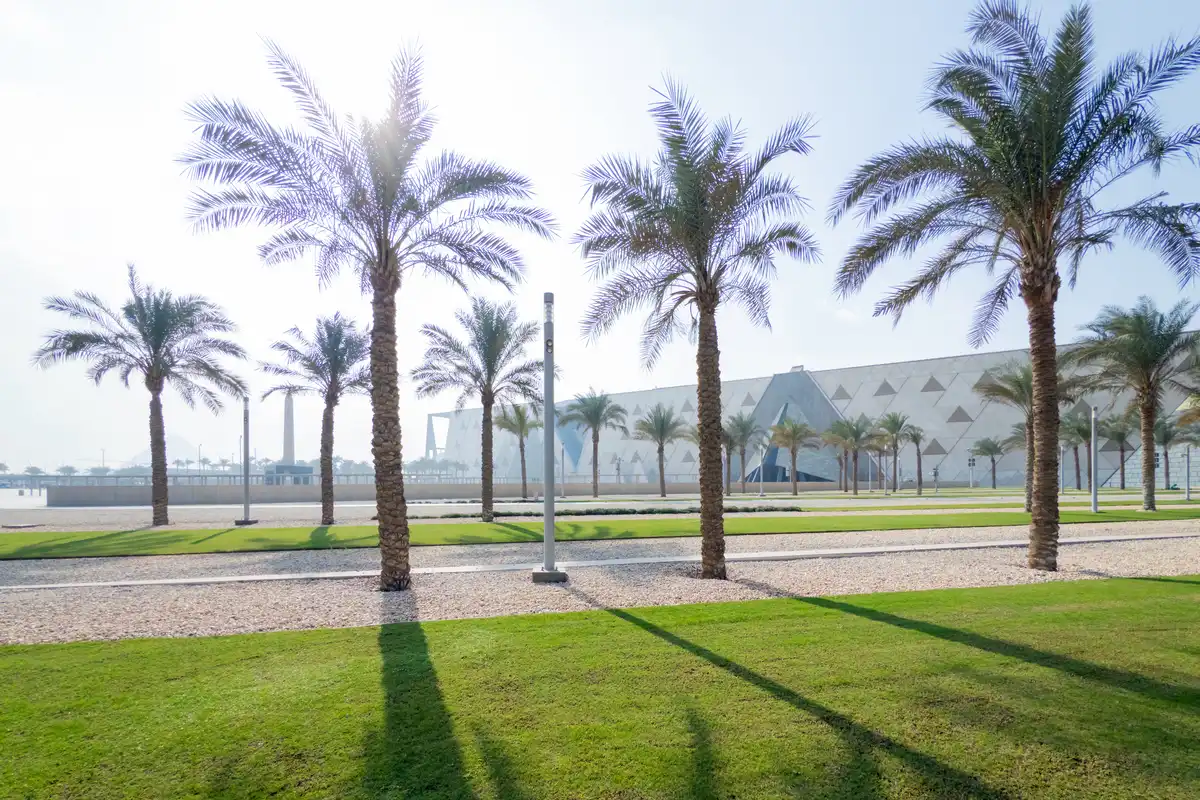
The Museum was designed to be a resource for Cairo in more ways than one. The site also includes extensive gardens that provide public green space for the local community. Developed in collaboration with landscape architecture firm West 8, the gardens speak to the juxtaposition of the surrounding landscape, harking back to the beginnings of Egyptian civilization in the lush Nile valley.
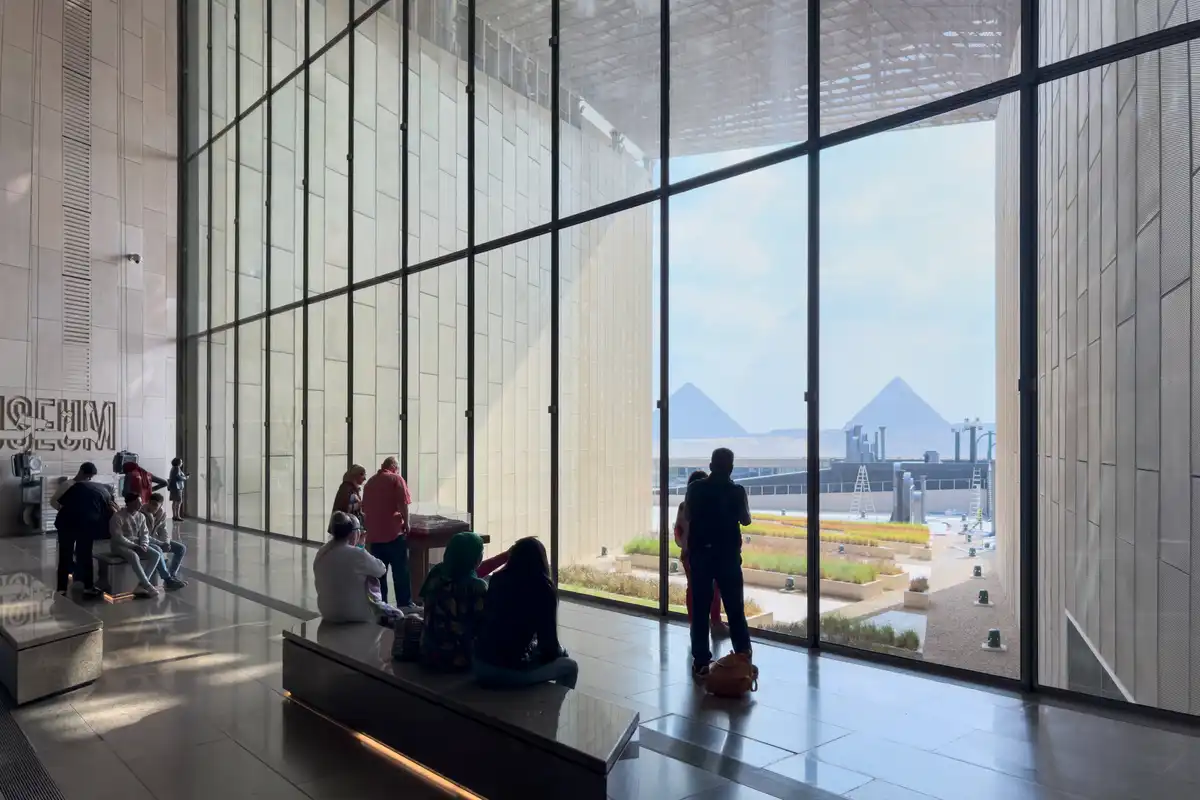
In addition to the public-facing galleries, it was also imperative that the Museum had the capability to conserve and prepare artifacts for display. The conservation laboratory and storage facility, connected to the main building via tunnel, is one of the largest in the world with 17 different labs dedicated to preserving the Museum’s priceless artifacts. Given the diversity of materials that make up the Museum’s collection, the design needed to cater to artifacts ranging from papyrus and textiles to pottery, sculptures, and human remains which all require unique measures.
Photography: Iwan Baan
heneghan peng + ATELIER BRÜCKNER
++
Previously on e-architect:
More photos added on 27 February 2024
post updated 22 February 2024
Grand Egyptian Museum Building Design
IFC Recognizes the Grand Egyptian Museum as the First EDGE Advanced Green Museum in Africa and the Middle East
Cairo, Egypt, February 19, 2024 – IFC today awarded the Grand Egyptian Museum (GEM) with the EDGE Advanced Green Building Certification, making the museum the first in Africa and the Middle East, and one of a handful worldwide, to receive the certification.
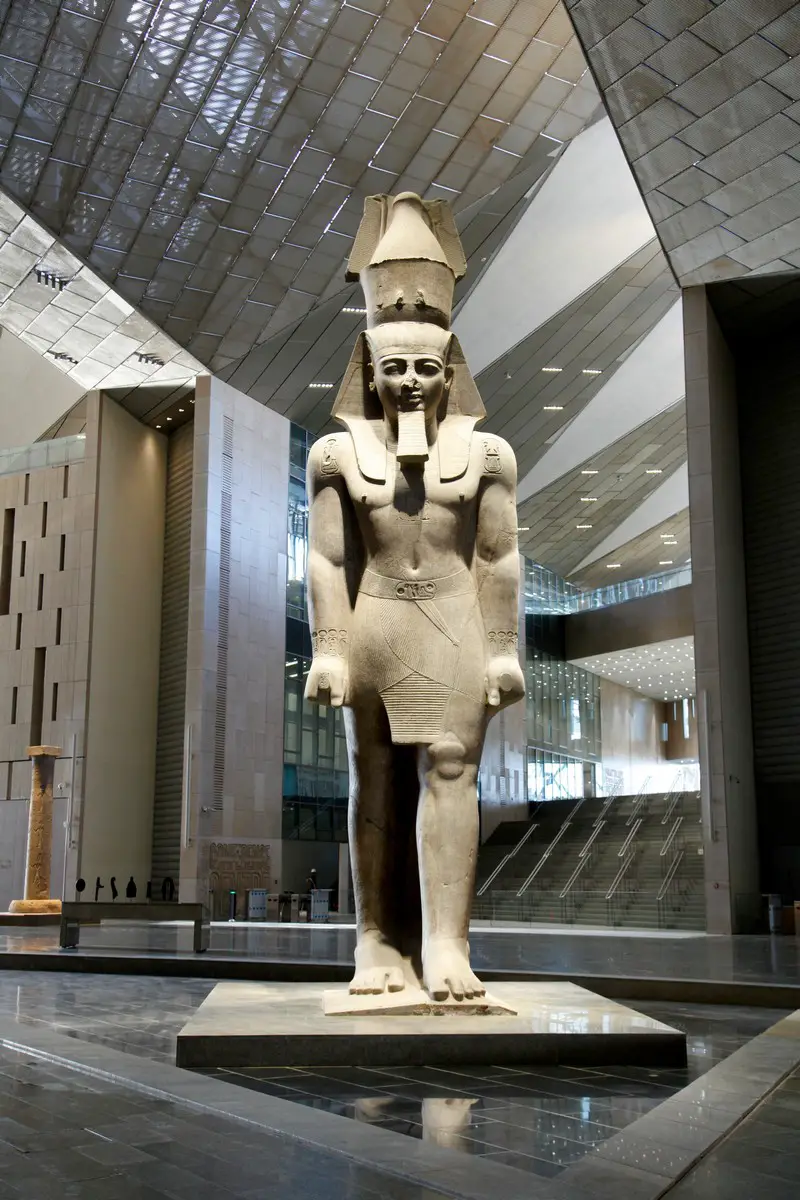
A large sculpture inside the GEM Grand Egyptian Museum Giza building:
Supported by Switzerland’s State Secretariat for Economic Affairs (SECO) and the UK Government, the EDGE Advanced certification recognizes the GEM’s resource efficient and climate-smart design and construction, which is helping the museum save more than 60% in energy costs and reduce water use by 34% compared to a conventional building of its type and size.
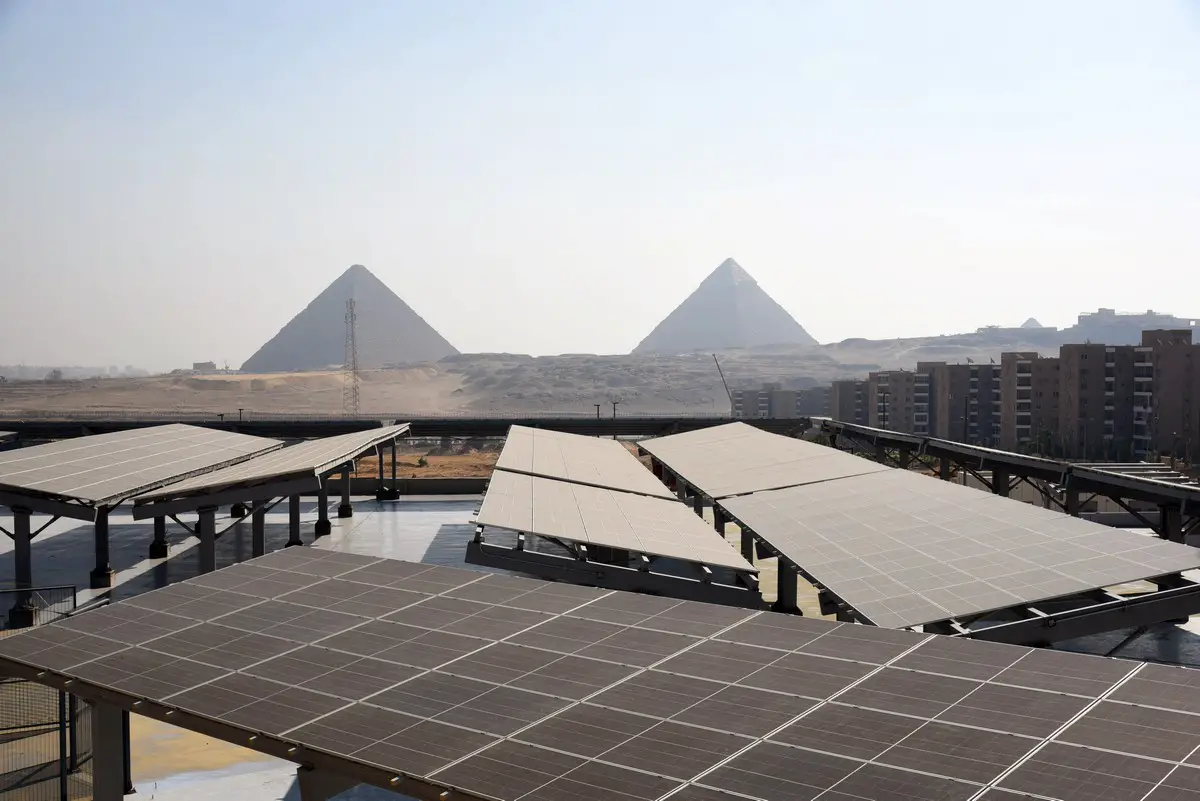
The museum, which has a site area of half a million square meters, has taken sustainability measures including a reflective roof, external shading for thermal comfort, resource-efficient lighting, and water fixtures, in addition to the use of smart meters for energy consumption.
GEM Grand Egyptian Museum Giza Building, Egypt:
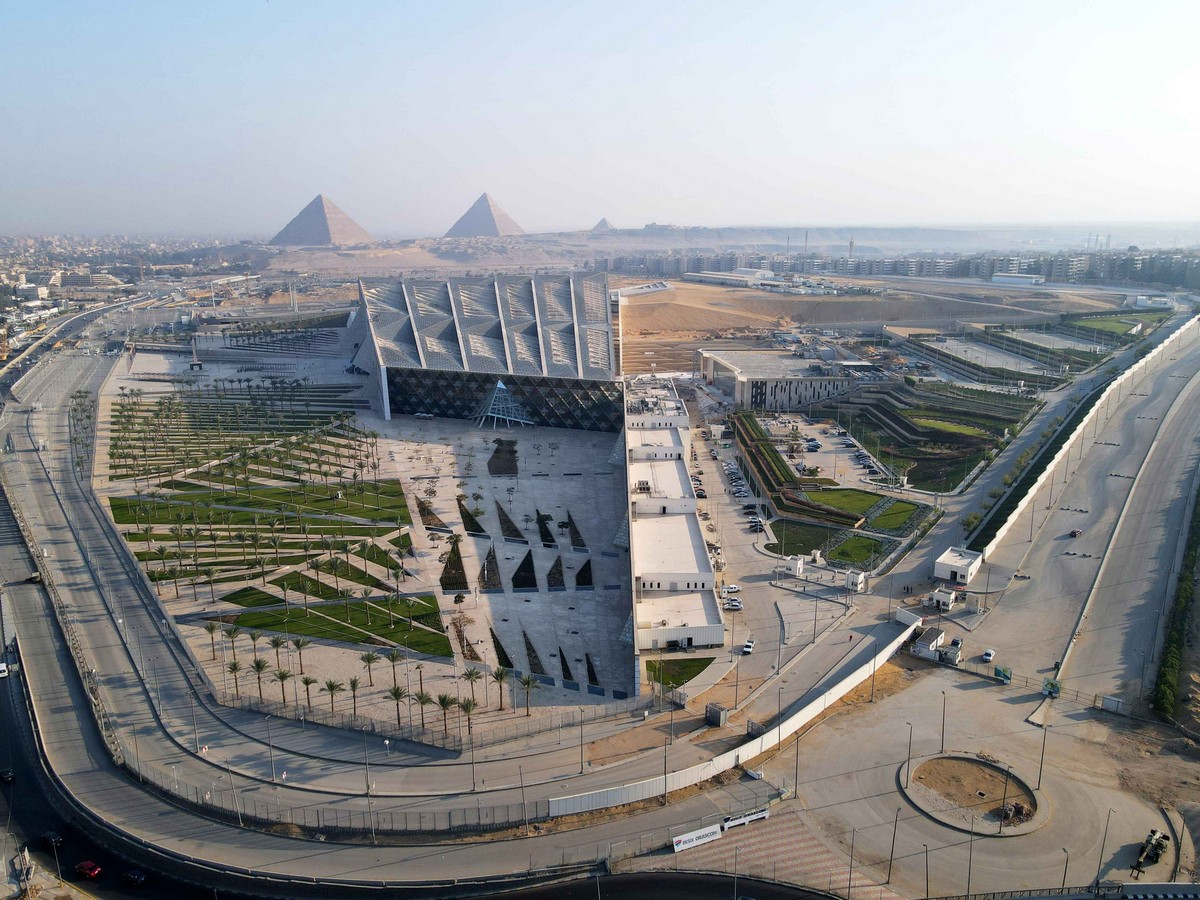
photo courtesy of architects office
These measures translate into energy savings equivalent to removing over 400 gasoline-powered vehicles from the streets of Cairo for one year, and water savings equivalent to 63.4 million liters of Nile River water annually.
“Today, the Grand Egyptian Museum stands to be a shining example of innovation and environmental stewardship as ‘an EDGE-certified green building’, an award highlighting the successful ongoing partnership between Egypt and the IFC in the Green Buildings Enhancement program. This is in line with the country’s commitment to promoting sustainable and green infrastructure and reflects the strategic partnership between Egypt and the IFC across diverse sectors within the Egypt – World Bank Group Country Partnership Framework 2023–2027,” said H.E. Dr. Rania A. Al-Mashat, Minister of International Cooperation, Egypt.
“The Grand Egyptian Museum going green – and becoming the first EDGE Advanced certified museum in Africa and the Middle East – is a powerful testament to Egypt’s growing commitment to sustainability,” said Cheick-Oumar Sylla, IFC’s Regional Director for North Africa and the Horn of Africa. “Building green is both resource-efficient and cost-effective. Now is the time to build more responsibly and support Egypt in its journey toward a lower-carbon future.”
GEM EDGE Advance Certification handover:
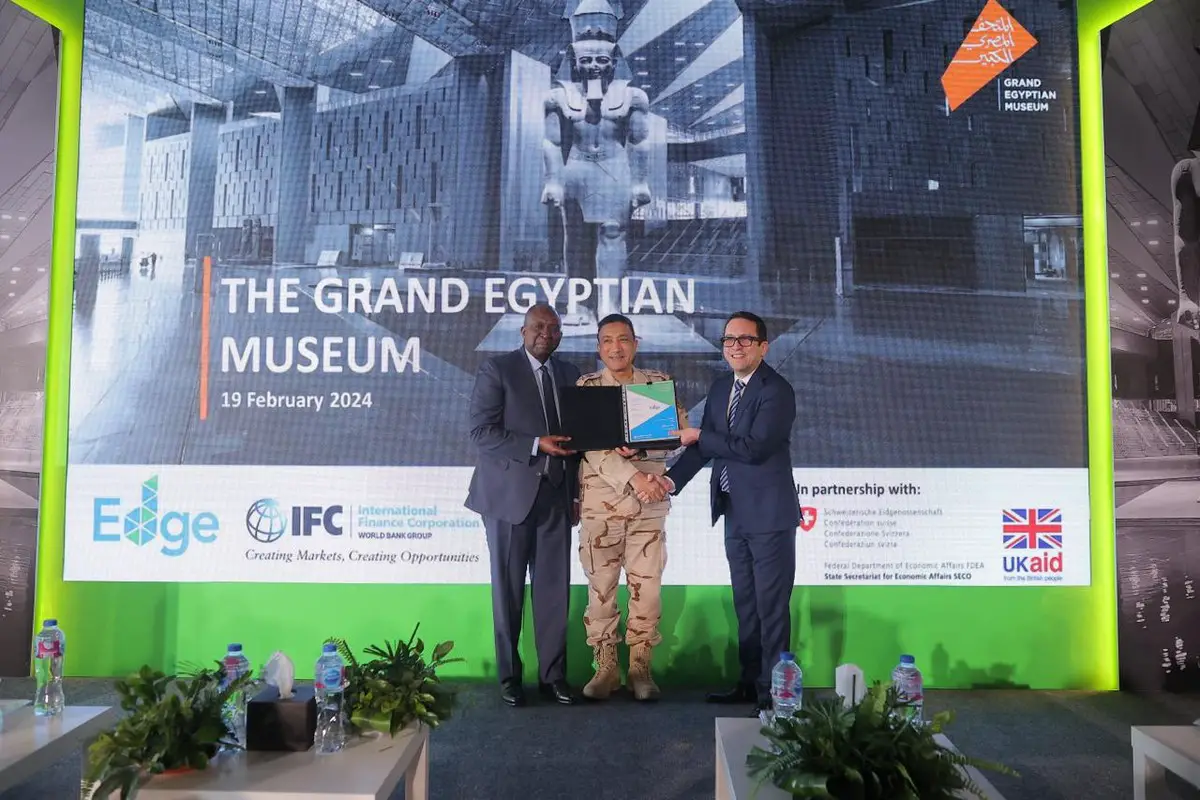
image courtesy of EDGE
“The Grand Egyptian Museum received this prestigious award by IFC based on the building’s energy and water efficiency measures and its reduced carbon footprint,” said Major General Atef Moftah, the Grand Egyptian Museum’s General Manager. “These measures – and this certificate – reaffirms the museum’s commitment to sustainability, in alignment with Egypt’s Vision 2030 for clean energy.”
GEM’s EDGE Advanced certification is part of IFC’s Green Building project, developed in partnership with the Government of Egypt’s Housing and Building National Research Center (HBRC), to enhance the green buildings ecosystem in Egypt and promote the certification of construction projects that foster cost-effective, resource-efficient design choices. The partnership focuses on increasing the public sector’s awareness of the economic case for certified green buildings, developing skills to implement green incentive schemes, and supporting the local development of green building stock.
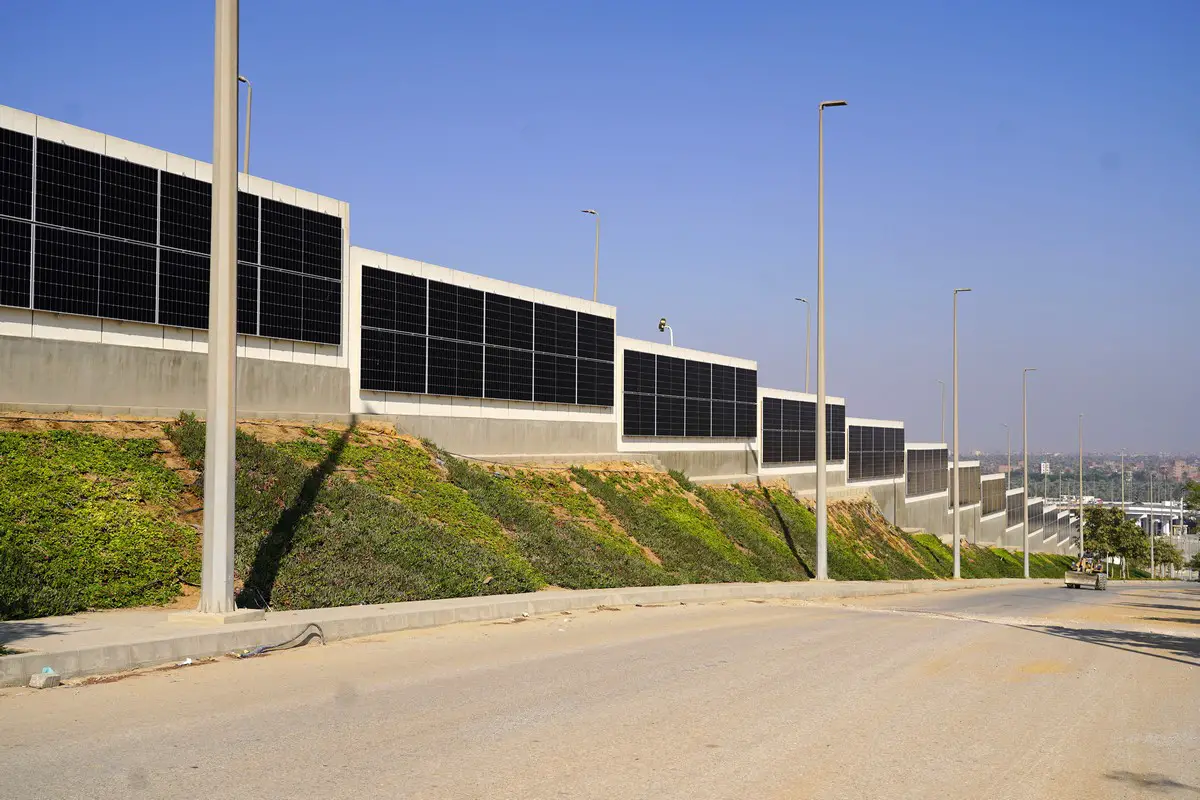
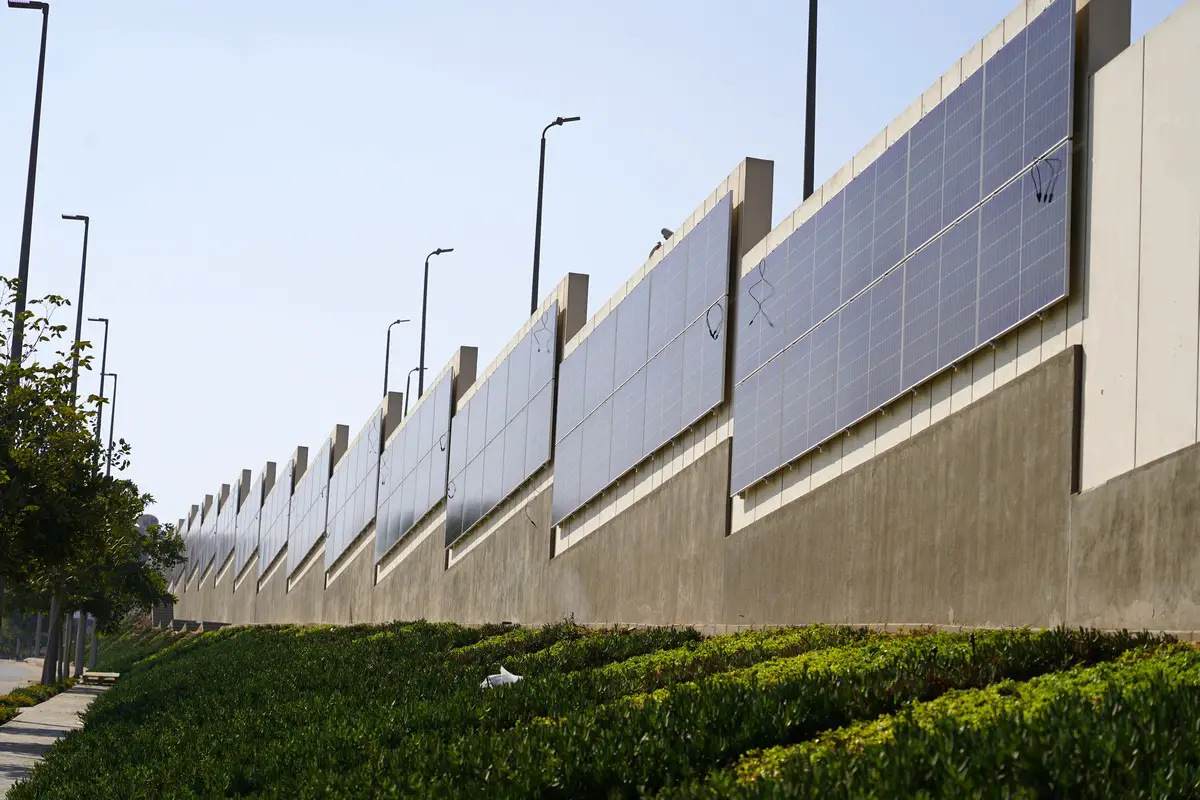
GEM Giza solar panels along the road:
“The Grand Egyptian Museum sets a new standard for sustainable construction in Africa, demonstrating Egypt’s leadership in embracing environmentally responsible practices,” said Dr. Mohamed Massoud, Chairman of the Housing and Building National Research Center. “This project showcases the power of collaboration between government, international organizations, and the private sector to advance sustainable building practices that benefit both the environment and the economy.”
Since beginning its operations in Egypt, IFC has invested and mobilized approximately $8 billion in investment projects and has an advisory portfolio amounting to $26.8 million. IFC’s private sector support in Egypt focuses on the fintech, climate finance, manufacturing, infrastructure, renewable energy, healthcare, gender, and other sectors.
About IFC
IFC — a member of the World Bank Group — is the largest global development institution focused on the private sector in emerging markets. We work in more than 100 countries, using our capital, expertise, and influence to create markets and opportunities in developing countries.
In fiscal year 2023, IFC committed a record $43.7 billion to private companies and financial institutions in developing countries, leveraging the power of the private sector to end extreme poverty and boost shared prosperity as economies grapple with the impacts of global compounding crises. For more information, visit www.ifc.org.
Stay Connected with IFC on social media at www.ifc.org.
GEM solar panels:
About EDGE
An innovation of IFC, EDGE helps property developers to build and brand green in a fast, easy and affordable way. EDGE is supported by free software that offers up solutions to reduce energy, water, and the energy embodied in building materials by at least 20 percent.
EDGE certification is recognized by the major green finance standards and streamlines green debt reporting requirements. The simplicity and low cost of EDGE, plus its focus on quantifying emission reductions makes it invaluable to map and track a path to zero carbon. The program has been generously supported by the following donors: The United Kingdom, Austria, Canada, Denmark, ESMAP, EU, Finland, GEF, Hungary, Japan, the Netherlands, and Switzerland. For more information, visit www.edgebuildings.com
About HBRC
The Housing and Building National Research Center (HBRC) is a leading research institution in Egypt, dedicated to advancing knowledge and innovation in the fields of housing, building, and construction. For more information, visit www.hbrc.edu.eg.
About Grand Egyptian Museum (GEM)
The Grand Egyptian Museum is a scientific, cultural, and educational institution that is keen to preserve the ancient Egyptian heritage and civilization, and promote scientific research for the sake of humanity, by providing a unique and accessible integrated tourism experience for its visitors based on modern technological means of display. The museum is one of the most important and greatest achievements of modern Egypt, as the largest museum in the world that tells the story of the ancient Egyptian civilization history.
It consists of a large number of distinctive and unique artifacts, including the treasures of the golden king Tutankhamun, which are displayed for the first time in full since the discovery of his tomb in November 1922, the collection of Queen Hetepheres, mother of King Khufo (Cheops) who commissioned the construction of the Great Pyramid in Giza, the Museum of King Khufu’s boats, in addition to various archaeological holdings from the predynastic era to the Greek and Roman eras.
The GEM architects: Heneghan Peng, Dublin, Ireland
Previously on e-architect:
15 May 2017
Design: heneghan peng architects
Location: Giza, Egypt
GEM – Grand Egyptian Museum
images courtesy of architects practice
GEM Giza Building
The world’s largest museum of Egyptian art and culture is being designed by ATELIER BRÜCKNER. The Stuttgart scenographers won the architecture competition for the design of the exhibition. The Grand Egyptian Museum (GEM) has a total floor space of more than 90,000 square metres, including about 40,000 square metres of space specifically for exhibitions. The complex is currently being built near the pyramids of Giza and is intended to accommodate up to 15,000 visitors a day.
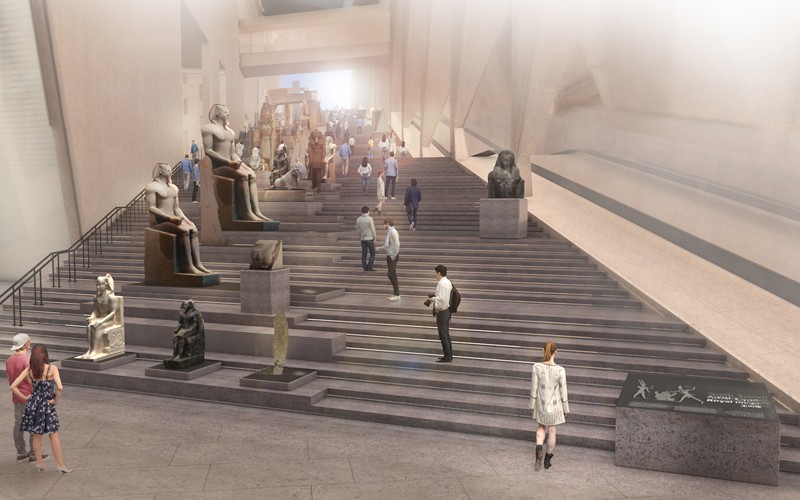
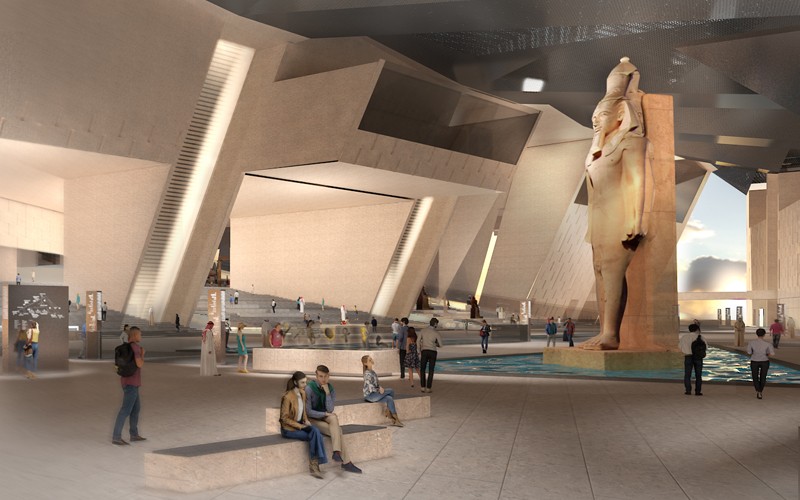
A statue of King Ramses II, which is over 11 metres high, welcomes visitors in the atrium of the new building by heneghan peng architects. From there, a spectacular staircase with the Royal Image, presenting more than 90 large sculptures, leads upwards to the exhibition area. On arriving at the top, visitors are offered a breath-taking view of the pyramids.
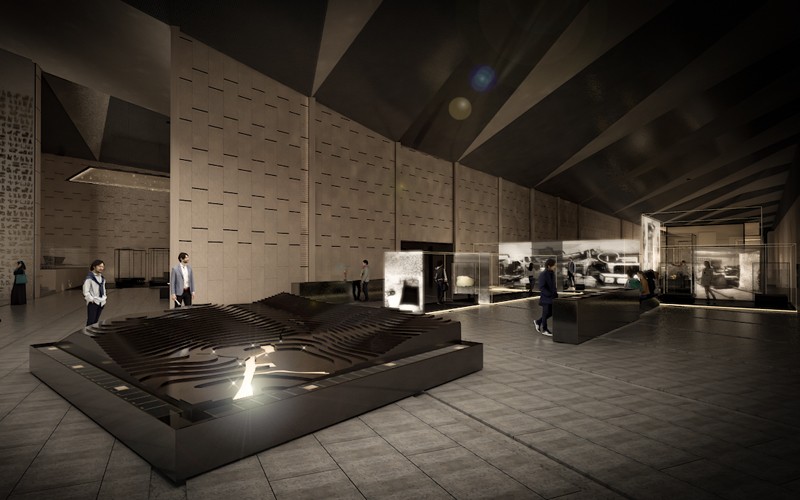
The spacious galleries allow visitors to immerse themselves in the history of the pharaohs and the time of Egypt’s high culture. More than 50,000 exhibits convey the fascination of Egyptian archaeology – including important artefacts from the beginning of the old-Egyptian period to the Greco-Roman era, including the legendary burial hoard of Tutankhamun from the Valley of the Kings. The latter will be exhibited in its entirety for the first time: In a space of 7,500 square meters over 5,000 artefacts will be shown in appropriate settings, whereby 3,000 of these objects will be on show actually for the very first time.
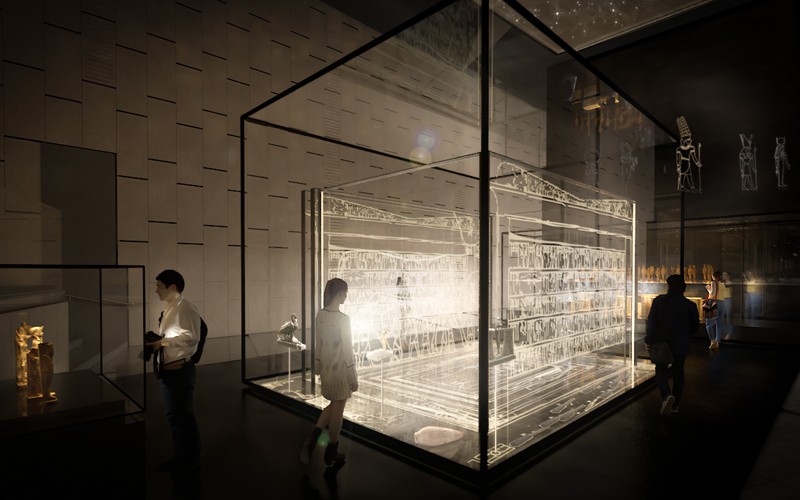
In order to find a competent design team for this ambitious project, the Ministry of Antiquities organised a selection procedure, in which ten internationally renowned agencies took part. From a total of four finalists, a committee of experts chose ATELIER BRÜCKNER from Stuttgart as the winner. “We are very honoured by the trust placed in our expertise and are highly motivated to design one of the world’s most important museums with a unique and fascinating scenography,” said Prof. Uwe R. Brückner when the result was announced in Cairo.
GEM – Grand Egyptian Museum in Giza images / information received 150517
Website: ATELIER BRÜCKNER
Location: Giza, Egypt, Northeast Africa.
Egypt Architecture
Contemporary Northeast Africa Architectural Projects
Egypt Architecture Designs – chronological list
Grand Egyptian Museum Cairo entry design by albert abut architecture:
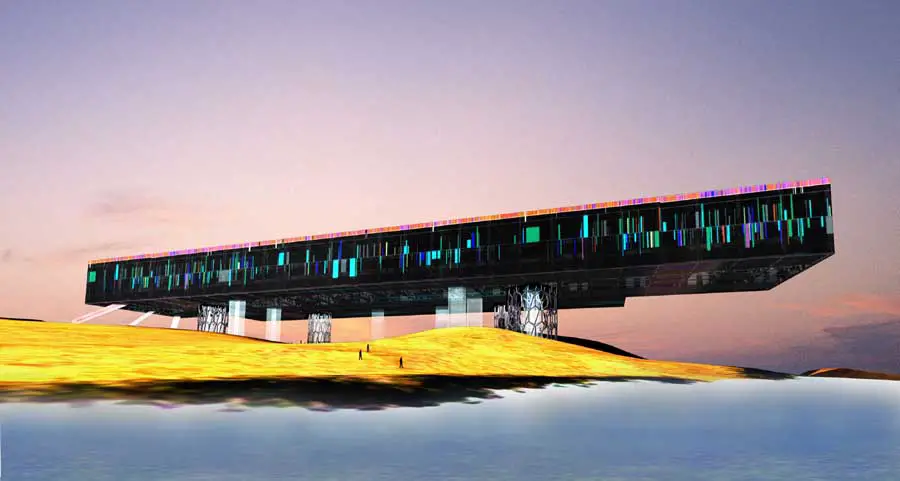
image from architecture office
Grand Egyptian Museum entry design by Potiropoulos D+L Architects, Greece
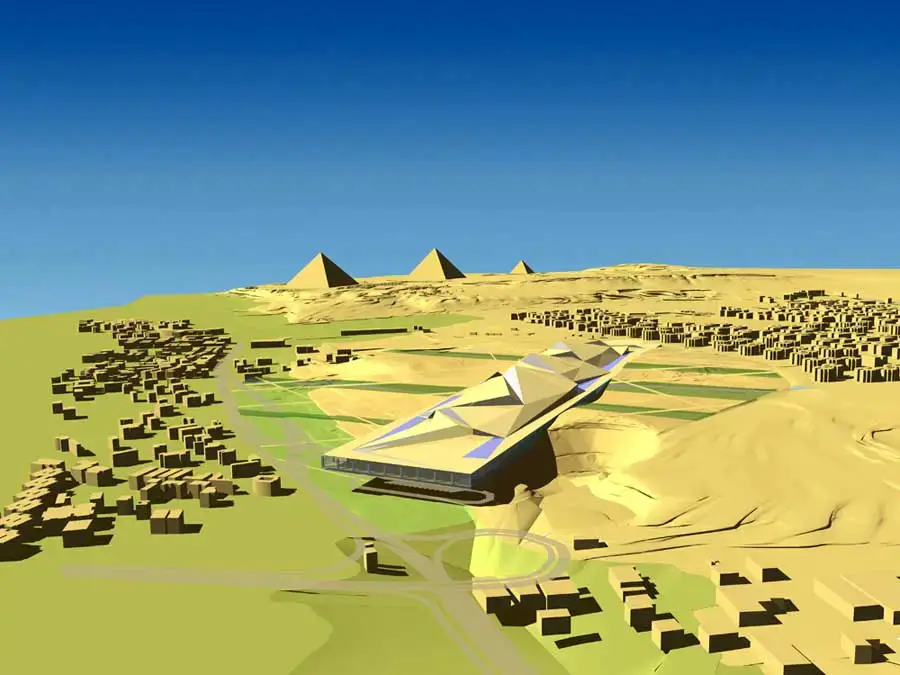
image courtesy of architects practice
Zooba – Grand Egyptian Museum, Giza Governorate
+++
Architecture Design
Contemporary Building Designs – recent architectural selection from e-architect below:
Comments / photos for the GEM – Grand Egyptian Museum in Giza building design by heneghan peng architects and ATELIER BRÜCKNER page welcome.