Meitu Cube Visual Arts Center, Xiamen
4 May 2026
Design: OPEN Architecture
Location: Xiamen, China
OPEN Architecture’s Meitu Cube Visual Arts Center Breaks Ground
OPEN’s new project, Cube of Change: Meitu Cube Visual Arts Center, broke ground on April 25, 2026.
The Cube of Change overlooks Xiamen’s East Rim coastal area:

images © OPEN
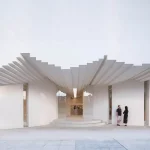
Perched along the coastline of Xiamen in southern China, the Cube of Change overlooks the East Rim coastal area unfolding across meandering beaches, lush vegetation, and a major sightseeing route. Conceived as an art center for Meitu Inc., the building takes on a deceptively simple form: a cube. Yet this is a cube capable of continuous change. The façade can open and close, filter light, enable ventilation, and glow at dusk; the interior can accommodate myriad transformations, shifting between exhibitions, screenings, performances, gatherings, and public events. The building’s relationship to the coastal city changes from day to night.
An ever-changing journey from the ground level culminates in a panoramic ocean view from the roof:

Responding to our time of accelerating cultural, technological, and social changes, the building crystallizes OPEN’s reflection on flexibility—not merely as a functional strategy, but as an architectural ethos. The result is a highly adaptable cultural building that offers a multisensory experience while remaining open to evolving forms of use, encounter, and public participation.
Designed to accommodate a wide spectrum of exhibitions, events, and public activities, the building’s circulation unfolds as a journey of intrigue and discovery. Galleries, circulation paths, terraces, and gathering spaces flow into one another, allowing multiple routes and modes of occupation. This spatial openness encourages free exploration and blurs distinctions between exhibition, movement, and social space. Visitors are no longer passive observers; they become part of the building’s visual and experiential field.
Inside the Cube, a series of interlocking spatial components is designed to transform in scale, atmosphere, and function:

The translucent double-skin façade can open and close, adding a sense of drama to the coastal scene:

The ground level remains open and porous. Drawing inspiration from the archipelago off Xiamen’s coastline, the landscape design echoes natural geological formations while offering a diversity of spatial experiences. Rising from this terrain, a dramatic waterdrop-shaped spiral staircase—rendered in Meitu’s signature red—guides visitors upward through all levels to a large ocean-view terrace. From there, another spiral staircase leads to the rooftop, where performances, events, or quiet appreciation of the surrounding landscape can take place.
From the ground level, an open-air grand staircase descends to a sunken plaza animated by a café and public seating. This plaza connects to an indoor open area that can be easily transformed into an exhibition hall, screening room, or performance venue. Regardless of the chosen path, visitors eventually return to the ground level, having traversed a kaleidoscope of visual, auditory, spatial, and atmospheric experiences.
The breathable and operable PTFE façade gives the building a presence that’s both light and mysterious:

While the building presents itself as a simple cubic volume, it is in fact composed of interlocking spatial components: a nine-meter-high black-box gallery, a white-box gallery with ocean views, a series of configurable exhibition and gathering spaces, a library, and rooftop terraces overlooking the sea. Rather than prescribing fixed uses, the galleries and public spaces are designed to transform in scale, atmosphere, and function, supporting everything from conventional exhibitions to digital installations, performances, lectures, screenings, and public events. At the rooftop, a theater with wide stepped seating opens toward the ocean, accompanied by a bar; an ocean-view elevator offers direct access to this level.
The Cube of Change glows at dusk along the city’s coast:

A double-layer façade wrapped in a perforated PTFE outer skin gives the building a light, permeable presence. By day, the diaphanous surface preserves visual continuity between interior and exterior; by night, it becomes a luminous projection canvas, extending the building’s program into the public realm and allowing art to speak directly to the city.
Sustainability strategies are integrated throughout the building:

Sustainability is woven into the project as a quiet yet essential layer. The double-skin façade reduces thermal load while bringing ample diffused daylight into the building. Openings in the outer layer of the façade and windows on the inner layer are strategically placed to take advantage of the prevailing wind, enabling effective natural ventilation. A zoned air-conditioning system provides operational flexibility while reducing overall energy consumption. Rain gardens, permeable pavement, and water retention tanks form an integrated stormwater management system that captures rainwater and surface runoff for reuse in landscape irrigation. Solar photovoltaic panels on the rooftop power the outdoor lighting. Landscaped areas are stacked throughout the building, reinforcing a continuous dialogue between architecture, ecology, and the coastal environment.
Through its emphasis on flexibility, openness, and environmental responsiveness, the Cube of Change functions not merely as an exhibition venue, but as an evolving public platform. It invites participation, adapts to shifting cultural needs, and actively contributes to the urban social life. OPEN believes that in a time defined by change, architecture must also remain capable of changing.
OPEN, China
OPEN is an architecture practice unbounded by typologies, locations, or stylistic conventions. Guided by a deep commitment to confronting the urgent challenges facing our environment and society, we design built environments that foster more humane, sustainable, and healthy ways of living. Our work spans architecture, urbanism, landscape, and interiors, and we research and develop design strategies for the unprecedented conditions of our time and beyond.
www.openarch.com
OPEN · Building A103, No. 46 Fangjia Hutong, Dongcheng District · Beijing, · 100007 · China
Meitu Cube Visual Arts Center, Xiamen, China images / information received 180424
Location: Xiamen City, Fujian Province, China.
Xiamen Buildings
Xiamen Architectural Designs – recent selection below:
Red Dot Design Museum
Design: STEPS Architecture, Network Party
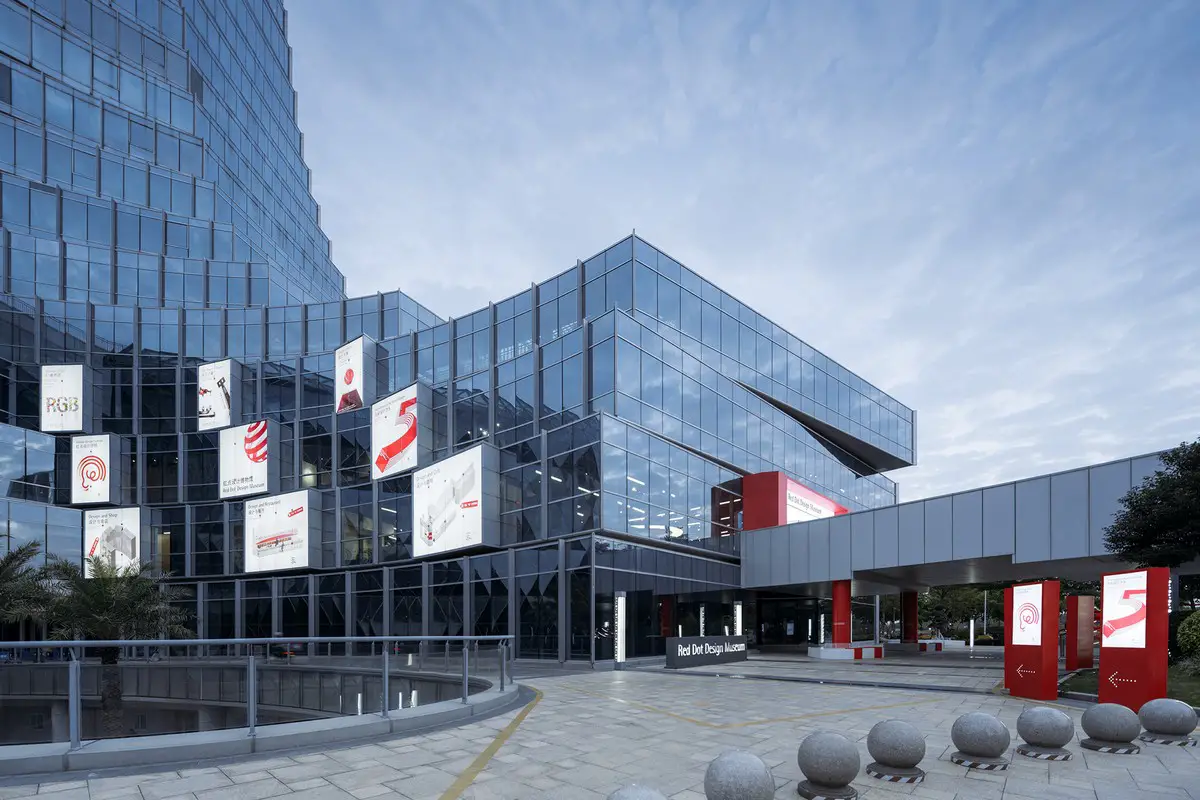
photo : CreatAR Images (Ai Qing)
Buduo Teahouse, Xinmin Town, Xiamen
Design: Wanmu Shazi
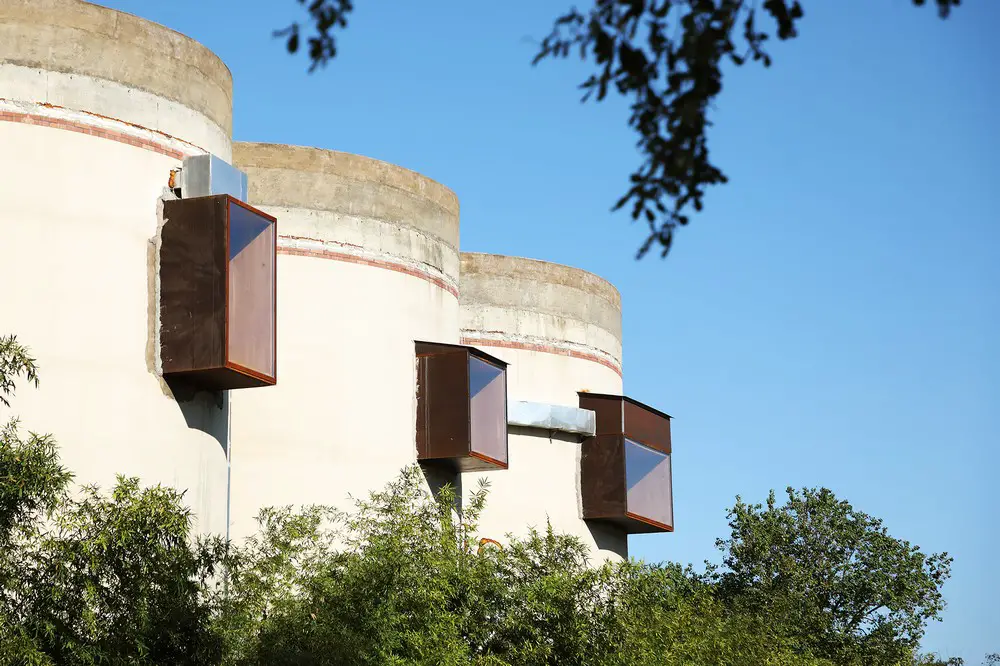
photo : 1988 Photography Studio / A Qi
Hotel WIND in Fujian Province Hotel
Design: TEAM_BLDG
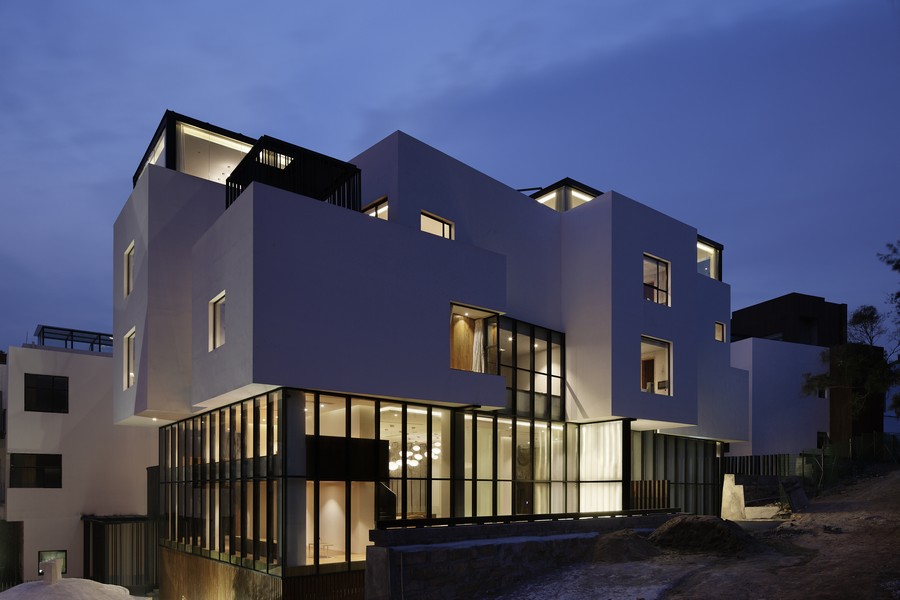
building image from architects
Xinhee Design Center Offices in Xiamen by MAD architects
++
Architecture in China
China Architecture Designs – chronological list
Black Soul, Fuzhou, Fujian, southeastern China
Architects: JST Micro-design Laboratory
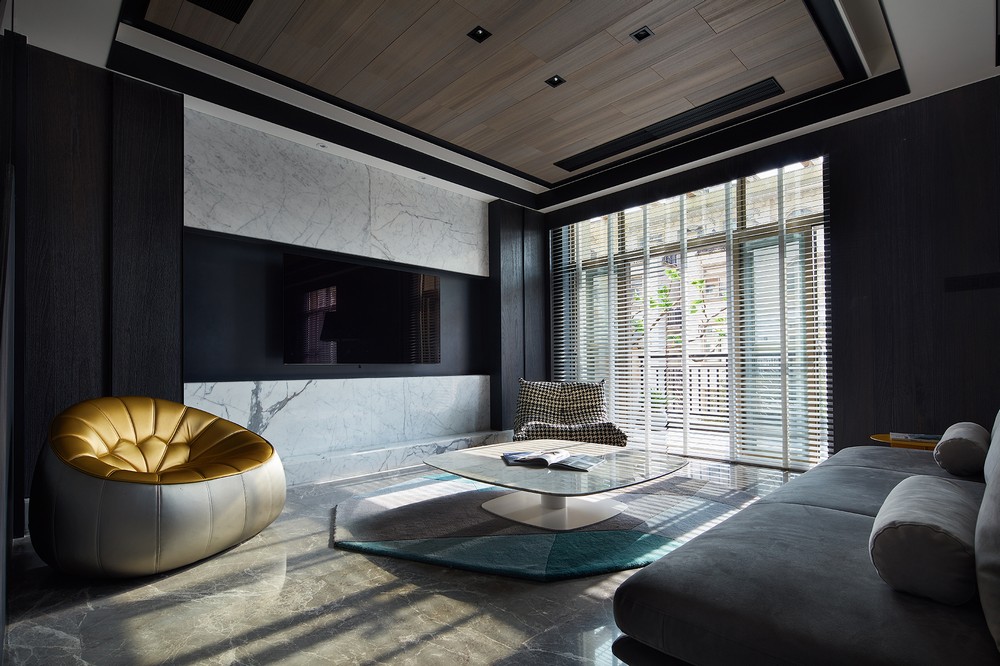
photograph : Li Di
Fuzhou Building
Comments / photos for the Meitu Cube Visual Arts Center, Xiamen, China design by STEPS Architecture, Network Party page welcome.