
Social Media Is Ruining Your Sleep Without You Realising
7 May 2026
There’s a specific kind of tired that comes from scrolling Instagram for forty-five minutes in bed and then trying to sleep. It’s not ordinary tiredness. Your eyes feel gritty, your brain feels simultaneously wired and exhausted, and when you close your eyes you can still see the afterimage of the feed moving. You meant to check one thing. It’s now 12:47 am, you’ve seen seventy-three Reels, and you’ve retained basically none of them.

This isn’t a minor inconvenience. Social media is disrupting sleep in at least four distinct ways, and most of them aren’t the ones the headlines focus on.
The blue light story is the least important part
For years, the headline concern has been blue light from screens suppressing melatonin. The effect is real but smaller than commonly reported. Studies have found meaningful melatonin suppression from evening screen use, but the effect size is modest for ordinary device brightness, and blue-light filters reduce it further. The blue light angle has become something of a scapegoat because it’s a simple, fixable-seeming problem.
The actual sleep damage from social media has much more to do with what you’re doing on the phone than the light coming out of it. Which is a harder problem to solve, because the content itself is doing the work.
Cognitive arousal is the real culprit
Social media platforms are optimised for engagement, which means they’re optimised to keep you interested, reactive, and emotionally activated. Outrage, envy, novelty, amusement, anxiety, and mild dopamine spikes from likes and messages all get delivered in a rapid sequence designed to prevent you from stopping. That’s the product. It’s doing what it was built to do.
The problem for sleep is that your nervous system doesn’t have an off switch that engages the moment you put the phone down. Emotional arousal produced by the scroll takes time to dissipate, and if you’re putting the phone down at midnight, your nervous system is still in “alert” mode for the first part of what should be sleep. This delays sleep onset, shortens deep sleep windows, and leaves people reporting that they “can’t switch off” even though they’re physically in bed.
Is social media actually bad for sleep?
The research is increasingly clear, and it’s fairly damning. Studies across adolescents and adults have found that heavy social media use, particularly in the hour before bed, correlates with shorter sleep duration, poorer sleep quality, and higher rates of insomnia. The effect is strongest in teenagers, whose sleep architecture is already changing during puberty, but it shows up in adults too.
Importantly, the correlation holds even after controlling for total screen time. It’s not just about hours on devices. It’s specifically about the type of content and the way social platforms are built. Reading a book on an iPad disrupts sleep less than scrolling TikTok on the same iPad.
The FOMO component
Social media trades in the sense that something is happening somewhere else that you might be missing. That sensation, chronic and low-level, is a mild but persistent stressor. It’s also the emotional state least compatible with sleep, which requires a kind of willingness to stop paying attention to the world for a while.
People who use social media heavily before bed often describe a sense that they want to stay up “just in case”, even when they can’t articulate what they’re waiting for. That low-grade vigilance keeps the sympathetic nervous system engaged past the point it should be winding down.
The interruption problem
The other piece is notification architecture. Even when your phone is silenced, the pattern of having your attention pulled toward the device dozens of times during the day trains the brain into a state of expected interruption. That expectation doesn’t fully switch off when you go to bed. People who sleep with their phones within reach wake more often during the night, whether or not the phone actually notifies them. The brain is listening for something.
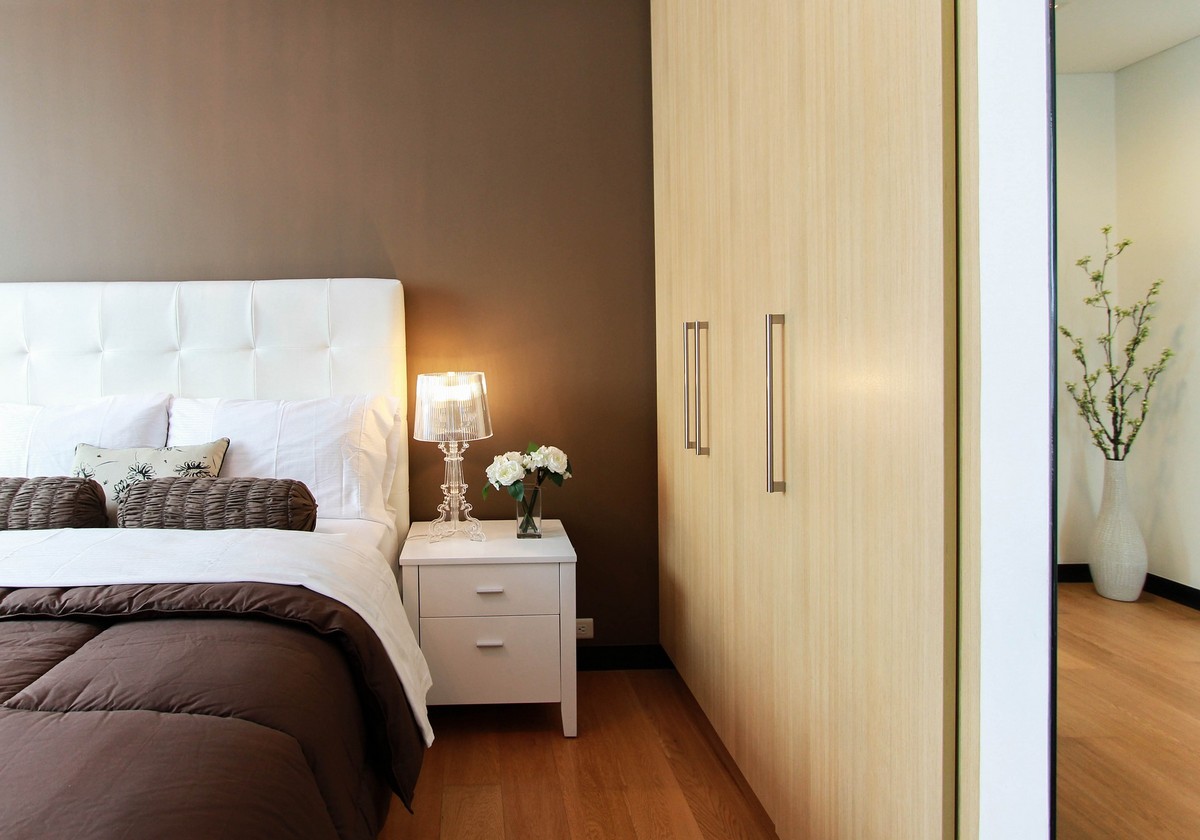
A bedroom equipped with furniture designed for restful sleep, comfortable in temperature, and minimal in digital intrusion gives the nervous system a stronger signal that it’s safe to stand down. A bedroom that includes the phone as an active presence sends the opposite signal.
How does social media affect your sleep hormones?
The simplest mechanism is delayed melatonin onset. Evening screen use, combined with cognitive arousal from content, shifts the production of melatonin later into the night. This is compounded by cortisol, which rises in response to emotionally activating content. You can end up with the hormone profile of mid-afternoon at 11 pm.
Over time, this chronic misalignment produces what sleep researchers call social jet lag, where your biological clock is out of sync with the schedule you’re trying to keep. You’re sleepy when you shouldn’t be and alert when you should be sleeping. The phone is one of the largest contributors to this effect in people who otherwise have stable schedules.
The subtle compounding effect
Each individual night of poor post-scroll sleep is minor. The cumulative effect across months and years is not. Chronic partial sleep restriction, which is what most habitual late-night scrollers end up with, correlates with increased rates of depression, anxiety, weight gain, and cardiovascular risk. The mechanism is well-documented; the cumulative cost is often invisible because it arrives slowly.
People notice the bad nights. They don’t notice the months of slightly worse sleep than they’d otherwise have had. That invisibility is part of why social media use at bedtime is so hard to change. The feedback loop is too slow to register as a warning.
What actually helps
The honest answer is that the intervention that works best is the one you’ll actually do. Leaving the phone in another room is dramatically more effective than any app-based screen-time limit, because it removes the option entirely. A cheap analogue alarm clock makes this feasible even if you’ve been using your phone’s alarm for a decade.
If full removal is too drastic, a thirty-minute gap between the last scroll and sleep onset is the minimum evidence-based recommendation. This isn’t about being virtuous. It’s about giving your nervous system time to come down from the state the feed left it in, so that the sleep that follows is something closer to sleep and not a continuation of the scroll with your eyes closed.
Comments on this How Social Media Is Ruining Your Sleep Without You Realising article are welcome.
Bedroom Design
Bedroom Articles
Modern versus contemporary bedroom designs
Essentials things for a perfect master bedroom
Make Your Bedroom More Comfortable
Touches Of Glamour for your Bedroom
Property Articles
Residential Architecture
Comments / photos for the How Social Media Is Ruining Your Sleep Without You Realising page welcome


