Off-Grid vs Grid-Tied Solar Inverters: Which Offers More Reliable Home Backup Power?
6 December 2025
As homeowners struggle with rising electricity costs, increasing grid stability, and the growing need for solar power, choosing the right inverter is more important than ever. Your inverter determines how your solar system performs, how efficiently you use your energy, and most importantly, whether your home stays powered during a power outage.
This article simplifies the differences between off-grid and grid-tied solar inverters and helps you understand which system provides the most reliable home backup power.
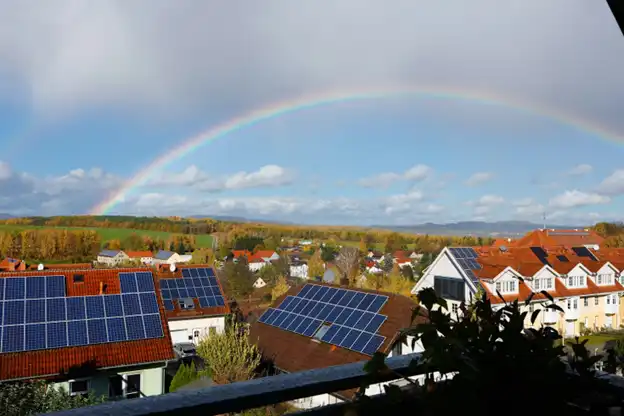
Figure 1. Residential homes with rooftop solar panels. Image source: unsplash.com
What Do Solar Inverters Do, and Why Are They Important?
The purpose of a solar inverter is to convert the solar energy generated in the form of DC into the Alternating current known as AC. Without the inverter, there is no use of solar energy. Without an inverter, your solar energy cannot power your devices. It is the heart of any solar setup – controlling power flow, managing charging, ensuring safety, and keeping the entire system stable.
How Off-Grid Solar Inverters Work
The utility grid is not necessary for the operation of off-grid solar inverters. It essentially works as a self-contained power system consisting of:
- Solar panels
- A bank of batteries
- A charge controller
- The off-grid inverter
- Optional backup generator
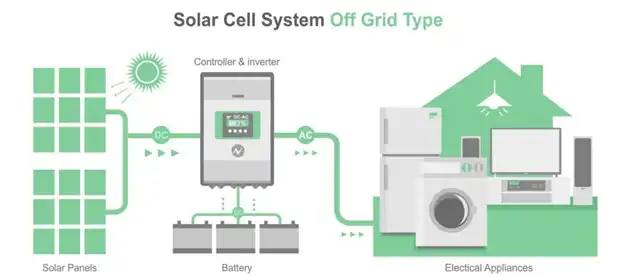
Figure 2. Simplified diagram of a typical off-grid solar power system showing PV input, battery storage, inverter, and household loads.
The house may be directly powered by solar energy, or the batteries can be charged. The house only uses battery power when the sun sets or when there is cloud cover. These inverters are among the most dependable backup choices since they don’t rely on the grid and continue to function during power disruptions. Based on our experience designing and installing both these systems, these performance differences are commonly seen in real home applications.
Advantages of Off-Grid Solar Inverters for Backup Power
- Uninterrupted Power During Outages
Off-grid solar inverters keep your home running even when the grid fails, making them ideal for regions with unstable power. - True Energy Independence
You generate, store, and use your own electricity—no utility bills, no price hikes, and no dependence on the grid. - Ideal for Remote or Rural Homes
In locations where grid access is unreliable, expensive, or unavailable, these inverters provide a practical and often the only solution. - Highly Customizable Storage Capacity
Battery storage can be sized according to your household needs, ensuring reliable backup power for short or extended outages.
Off-Grid Inverter Limitations
Off-grid solar inverters are great for backup, but they have drawbacks.
- Higher Initial Investment
Off-grid systems cost more upfront mainly because they require batteries—but those batteries are also what make true backup power possible. You’ll need extra batteries if your backup demands are bigger. - Maintenance of Batteries
Over time, batteries deteriorate and eventually require replacement (usually every 7–12 years, depending on the kind and usage). - Risk of Power Depletion During Extended Bad Weather
If the system doesn’t include a backup generator, protracted gloomy days might drastically lower battery charge. - More Complex System Design
Careful planning and appropriate system sizing are necessary to balance solar production, storage capacity, and family use.
Off-Grid Inverter Examples
Off-grid solar inverters for residential use are produced by a range of manufacturers. This includes brands such as PowerHome, whose 1–4 kW models are commonly found in small homes, cabins, and remote backup systems.
These inverters come in a wide range of capacities, from compact 1 kW units for small applications to powerful 6 kW systems suitable for full-household backup. Common features include:
- Integrated MPPT charge controllers for efficient solar charging
- Compatibility with lithium and lead-acid batteries
- High conversion efficiency (up to 93–99%)
- Pure sine wave AC output for safe operation of sensitive appliances
- Multiple built-in protections, such as overload, over-temperature, and short-circuit protection
These design characteristics make these inverters a reliable solution for both daily energy use and long-term backup power. These design characteristics are also consistent with common engineering guidelines used across the residential solar industry.
Architectural Considerations
When integrating off-grid systems into a new home or renovation, architects typically account for battery placement, ventilation needs, electrical room sizing, and safety clearances required by local electrical codes.
How Grid-Tied Inverters Work
These operate by synchronizing with the utility grid. They convert DC electricity from solar panels into usable AC power for the home, while any excess energy is exported back to the grid through net metering.
A typical grid-tied system includes:
- Solar panels
- A grid-tied inverter
- A net-metering connection
- Optional monitoring tools
During daytime, the home uses solar power first, and surplus energy is sent to the grid for credits. When solar production is insufficient, the home draws electricity from the utility grid. These inverters are mandated by electrical codes and safety standards to shut down immediately during an outage. This ‘anti-islanding’ feature prevents solar power from feeding back into the grid, which could endanger utility repair crews.
Advantages of Grid-Tied Inverters
Despite their inability to provide backup power alone, they offer several benefits that make them the most common choice for residential solar systems.
- Lower Initial Cost
These systems do not require batteries, making them significantly cheaper and easier to install. - Higher Energy Efficiency
Fewer components mean lower energy loss and higher solar-to-AC conversion efficiency. - Maximized Savings Through Net Metering
Excess solar power can be exported to the grid, reducing electricity bills through credit programs. - Simple System Design
With no batteries, the system is easy to maintain and has fewer failure points.
Grid-Tied Inverters’ Drawbacks for Backup
- No Backup Power During Outages
The largest disadvantage: the system shuts down automatically when the power network fails. - Requires Additional Equipment for Backup
To get backup capability, you would need:- A hybrid inverter
- A bank of batteries
- A smart breaker panel or switch
- Dependent on Utility Policies
Long-term financial returns may be affected by declining net-metering incentives.
Hybrid Inverters: The Middle Ground
Hybrid inverters combine the functions of grid-tied and off-grid systems. They can operate with both the grid and batteries, export extra power, and provide backup during outages. However, backup duration is usually shorter than a full off-grid system, and hybrids still rely partly on the grid.
For homeowners who prioritize maximum backup reliability, a true off-grid solar inverter remains the better choice. Similar performance trends are also documented by well-known manufacturers such as Victron, SMA, Sol-Ark, and PowerHome in their technical specifications.
Comparison
Here’s a simple comparison based on reliability during power outages:
| Feature | Off-Grid Inverter | Grid-Tied Inverter |
| Works During Outage | ✔ Yes | ✘ No |
| Depends on Utility Grid | ✘ No | ✔ Yes |
| Requires Batteries | ✔ Yes | Optional |
| Backup Power Reliability | Very High | Very Low (unless upgraded) |
| System Complexity | Medium–High | Low |
| Long-Term Savings | High | Moderate |
If your area experiences frequent outages, an off-grid inverter with battery storage is the most reliable choice; if grid power is stable and cost is the priority, a grid-tied system is more suitable.
Off-Grid vs Grid-Tied Inverters: Which System Is More Reliable
Off-grid solar inverters deliver the most reliable home backup power because they operate entirely independently from the utility grid. Even during blackouts, storms, or unstable power network conditions, an off-grid system continues supplying electricity as long as the batteries are charged. This makes off-grid setups ideal for rural homes, remote locations, or areas with frequent outages.
Grid-tied inverters, on the other hand, are designed for efficiency and low cost—not backup. They automatically shut down during power outages due to anti-islanding protections, and cannot power your home unless upgraded with additional equipment such as batteries, a hybrid inverter, and a transfer switch.
While they perform well in normal conditions, they are not suited for dependable emergency backup power. For homeowners who want uninterrupted electricity during outages, a fully off-grid system remains the most reliable and self-sufficient solution.
From an architectural standpoint, off-grid inverter systems typically require early coordination for equipment placement, ventilation, and electrical room sizing. Even small residential systems need dedicated space for batteries and clearances defined by local electrical codes. Considering these requirements during the design phase helps ensure seamless integration and long-term performance.
All performance descriptions in this article are based on publicly available technical datasheets and widely accepted industry standards.
Final Verdict
If your priority is dependable home backup power—especially in remote areas, regions with unstable grids, or homes prone to frequent outages—off-grid solar inverters are the most reliable choice. They provide true energy independence, uninterrupted operation during blackouts, and customizable battery storage.
A grid-tied solar inverter can still be a cost-effective option for homes with stable utility service, but it cannot function as a backup system on its own. A hybrid inverter paired with batteries offers a balanced approach—but for maximum reliability, a dedicated off-grid system remains unmatched.
Comments on this guide to modern solar inverters: home backup power article are welcome.
Solar Panels Articles
Solar Panels Posts
Before Installing Solar Panels
Types of roofing for solar panel installation
++
Building Articles
Residential Architecture
Comments / photos for the Off-Grid vs Grid-Tied Solar Inverters: Which Offers More Reliable Home Backup Power? page welcome.