What Palm Springs Mid-Century Homes Teach Us About Bathroom Focal Points
May 14, 2026

The easiest way to lose the character of a Palm Springs bath is to treat the vanity as a fixture first and a piece of architecture second. The more persuasive desert houses do the reverse. They rely on one calm, well-proportioned element to establish visual order, then let the mirror, stone, lighting, and fittings fall into line around it.
That is why designers often study width, storage rhythm, and silhouette before they settle on finish, whether they are reviewing the AURA Modern Home bathroom vanity collection or sketching custom millwork for a renovation. Palm Springs remains useful because its postwar modernism still shows how one disciplined horizontal gesture can steady an entire room.
That principle carries well beyond Southern California. In e-architect’s Palm Springs feature, the appeal comes from clean lines, measured geometry, and a strong sense of composure. In the San Jose Eichler renovation, the warmth of the interiors matters just as much as the modernist pedigree. The vanity wall is often where that balance is won or lost. Get it right and the bathroom feels settled. Get it wrong and the room starts begging for visual rescue.
The vanity is the room’s datum

A convincing mid-century bathroom usually has one element that sets the room’s line of control. In compact plans, that element is often the vanity. Why does it matter so much? Because the vanity determines where the eye lands from the doorway, how the mirror relates to the wall plane, and whether the room reads as furniture-like or purely utilitarian. e-architect’s own bathroom guidance frames the room as a balance of function, style, and spatial efficiency, which is exactly the right place to begin.
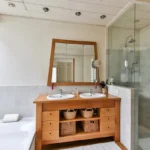
From my perspective, the best vanity walls behave like built architecture. They have enough width to feel intentional, enough storage discipline to keep surfaces quiet, and enough visual weight to anchor the room without turning into a performance piece. When that happens, even straightforward materials look considered. When it does not, the room tries to compensate with louder mirrors, busier tile, or hardware that is doing too much of the talking.
Start with proportion before finish

Most people begin with walnut versus oak, brushed nickel versus black, or pale stone versus bright white quartz. That is understandable, but the room asks a different question first. How wide is the wall? How much breathing room sits between the vanity and the shower glass, the toilet partition, or the adjacent return wall? Does the sink land where the body naturally wants it, or does the cabinet force an awkward reach every day?
The National Kitchen & Bath Association recommends at least 30 inches of clear floor space in front of fixtures, at least 20 inches from the centerline of a single lavatory to a side wall or tall obstacle, and 36 inches between the centerlines of two lavatories as a recommended planning distance. It also notes that vanity height commonly falls between 32 and 43 inches depending on the user. Those are planning dimensions, not style cues, but they often decide whether a vanity wall feels composed or compromised.
A wider cabinet is not automatically the better answer. In a narrow room, stretching the vanity too far can make circulation feel pinched even if the storage looks generous on paper. In a broader primary bath, the opposite problem appears. A cabinet that is too narrow can look stranded, especially beneath a mirror that runs well past its edges. In my experience, the wall should tell you what the vanity wants to be. Sometimes it wants a centered block. Sometimes it wants a lighter floating plane. Sometimes it wants a longer piece of joinery that quietly stabilizes the room.
Floating or freestanding, what changes visually and practically

Floating vanities earn their reputation for visual lightness, and fairly so. Showing more floor can make a compact room feel wider, and the shadow line underneath sharpens a modernist composition. Even so, a floating cabinet is not always the more architectural choice. In some bathrooms, especially where the wall is long and the surrounding detailing is spare, a freestanding piece gives the room the grounded presence it actually needs.
The practical side matters too. A floating cabinet can simplify cleaning and reduce apparent bulk, but it often asks more from the wall construction, the installation, and the plumbing setup. A freestanding option may offer deeper storage and a more furniture-like stance, though it can read heavy if the toe detail or side panels are clumsy. The better question is not which type looks more current. It is what kind of visual weight the room needs.
Future use should sit inside that decision as well. The U.S. Access Board explains that lavatories and sinks require clear floor space, and accessible layouts also involve knee and toe clearance considerations below the basin area. Even in homes that are not being designed to a strict accessibility brief, those dimensions improve comfort and make the room more adaptable over time.
Single basin or double basin, decide from routine

Shared bathrooms often default to a double vanity because it sounds efficient. Sometimes it is. Sometimes it simply narrows the usable counter, forces awkward mirror choices, and makes each basin feel too close to the side wall. Daily routine should decide this, not habit.
NKBA’s 36-inch recommended spacing between lavatory centerlines is revealing because it shows how much width two users actually need. If the room cannot support that spacing comfortably, the result often feels compressed rather than generous. A well-sized single basin with real landing space can work better than two cramped sinks, particularly in bathrooms where one person dominates the morning routine or where grooming, storage, and counter surface matter more than simultaneous use.
There is also a wider shift in how homeowners think about these rooms. Houzz’s 2025 U.S. Bathroom Trends Study surveyed 1,737 homeowners and found that 68 percent consider special needs in bathroom projects, while 84 percent hire professionals for bathroom renovations. That points to a planning culture that is less driven by generic resale formulas and more concerned with fit, comfort, and long-term function. In practical terms, the right vanity is often the one that introduces the least friction into ordinary life.
Use the Three-Line Test

When a vanity wall feels right, it usually resolves three lines.
The first is the floor line. Does the cabinet meet the floor in a way that feels grounded, or does it lift from it with enough confidence to justify the shadow beneath? A floating piece should look intentionally suspended. A freestanding piece should look intentionally planted.
The second is the counter line. This is the room’s main horizontal datum. It should sit at a comfortable height and read as a stable band across the wall. When the top is too thick, too contrast-heavy, or too interrupted by cluttered fittings, the line loses authority.
The third is the mirror or sconce line. This is where many remodels soften. The mirror is too wide for the cabinet, the sconces drift too far outward, or the lighting rhythm fights the drawer rhythm below. A good rule is simple. The mirror should usually feel related to the vanity width, not casually detached from it. In a 48-inch single-basin layout, a mirror that stays visually inside the cabinet width usually feels calmer than one that stretches beyond it. In a 72-inch double-basin setup, two mirrors or a carefully scaled long mirror should reinforce the sink spacing rather than blur it.
If you want a doorway test, ignore finish entirely and ask whether you can read those three lines in two seconds. If not, the room probably has a proportion problem, not a materials problem.
Common mistakes that flatten the architecture

One common mistake is choosing a vanity by drawer count alone. More storage can sound useful, but if the front elevation becomes too chopped up, the cabinet loses the broad, calm face that makes modernist joinery persuasive.
Another is oversizing the mirror. A mirror that runs far past the vanity can make the cabinet feel underscaled, especially in rooms where the side walls are already close. The opposite mistake happens too. A tiny mirror above a long cabinet leaves the wall unresolved and slightly adrift.
A third mistake is overcompensating with finish contrast. Rich wood can be beautiful, but if the stone is highly active, the tapware is dark and prominent, and the lighting is sculptural too, the vanity stops behaving like architecture and starts behaving like a display set.
Then there is the clearance issue, the problem that reveals itself only after move-in. A cabinet may look correct in elevation but still make the room awkward at the shoulder, elbow, or hip. Planning rules do not flatten creativity. They protect ease of use.
Trade-offs worth accepting

Not every bathroom can hold a long run of wood cabinetry and still feel open. Not every renovation can justify custom millwork. Not every wall can support a generous floating cabinet without installation compromises. Good bathrooms nearly always involve one or two clear trade-offs.
Sometimes the better answer is to accept a single basin so the room gains more landing space. Sometimes it is to trim cabinet depth slightly so circulation improves. Sometimes it is to choose a quieter stone because the timber grain is already doing enough work. Personally, I believe the better trade-off is usually the one that protects the room’s calm, even if it sacrifices a little storage drama.
That is also why warm wood remains so effective in modernist bathrooms. It softens the technical character of the room without asking for ornament. The Eichler interiors on e-architect make that point clearly. Warmth does not dilute modernism. It gives it a more habitable voice.
A quieter way to finish the room

The lesson from Palm Springs is not that every bath should look period-correct. It is that focal points work best when they are disciplined. One strong vanity wall, proportioned well, aligned clearly, and relieved of unnecessary noise, can do more for a bathroom than a long list of trend signals.
When the vanity reads like a considered piece of architecture, the room settles. The mirror stops arguing. The hardware stops performing. The finishes start working together. And the bathroom, which is often one of the smallest rooms in the plan, begins to feel like it belongs to the architecture of the house instead of sitting apart from it.
Comments on this guide to Mid-Century home bathroom focal points article are welcome.
Home Bathroom

Recently added building articles:
Shared bathroom spaces in urban residential
Curved shower enclosures in small bathrooms
Creating a functional and stylish bathroom layout
+++
Property Design
Contemporary Property Designs – recent architectural selection from e-architect below:
Comments / photos for the Mid-Century home bathroom focal points advice guide page welcome.