
Does Neon Improve Wayfinding in Public Spaces
3 November 2025
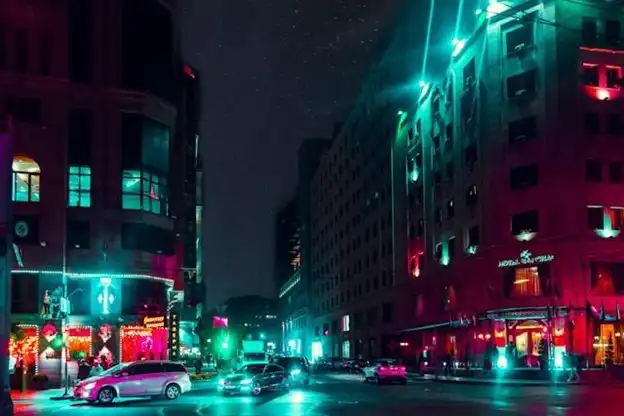
Photo by Levon Vardanyan on Unsplash
Illuminated signage has revolutionized our movement through intricate city spaces. When individuals arrive at unknown transportation centers, arts quarters, or government facilities, they depend on visual signals to position themselves and access their endpoints effectively. The issue isn’t if lighted indicators assist, but instead which systems provide the most distinct direction while satisfying realistic requirements for longevity and power usage.
Creating Memorable Cognitive Landmarks
The human brain constructs mental maps through identifiable anchor points. Research confirms that landmarks positioned along routes and at decision points prove most effective during wayfinding tasks.
Neon’s distinctive glow creates visual features that stand apart from surrounding architecture, particularly at junction points where travelers must choose between paths. The medium’s unique luminescence makes these markers easier to recall after a single exposure compared to non-illuminated alternatives.
Studies examining urban form and cognitive maps demonstrate that both local and global landmarks serve distinct navigation functions. While local markers guide immediate decisions at turns and intersections, globally visible elements allow people to maintain orientation throughout their journey.
Comparing Durability and Maintenance Requirements
Glass neon tubes of the traditional variety have shown exceptional durability in sheltered settings, with certain installations functioning for many years. Nevertheless, the delicate nature of glass materials and their vulnerability to vibration present upkeep difficulties in locations with heavy foot traffic.
LED options use considerably less power. Certain estimates indicate that LED neon consumes roughly eighty percent less energy than gas-filled tubes while achieving similar brightness outputs. The decreased thermal output of LED configurations also prolongs component durability and removes fire risks linked to high-temperature transformer functioning.
When organizations discover why brands choose Radikal Neon for public displays, the pairing of safety characteristics and personalization possibilities becomes clear. Low-voltage LED neon stays cool when touched, presents no danger from broken glass, and supports intricate letter shapes and symbols that would be challenging or unfeasible to produce in conventional glass tubing..
Enhancing Color Legibility Through Luminance Contrast
The success of wayfinding relies significantly on brightness differences rather than color by itself. Conventional neon performs exceptionally at generating intense colors with built-in luminosity, rendering directional details legible from substantial distances. This proves especially beneficial in dim-light situations typical of subway platforms and subterranean passages.
The gas-discharge mechanism produces unique light signatures for various colors, with argon creating striking blues while neon itself yields distinctive oranges and reds. These light frequencies sustain visibility through different surrounding light circumstances more effectively than numerous painted or printed options.
Contemporary LED neon technology duplicates this benefit while resolving previous drawbacks. The unbroken illumination throughout tube sections removes the dotted appearance that troubled earlier LED setups, where separate diodes produced visual interruptions that diminished readability from afar. This uninterrupted radiance guarantees that letter shapes and directional indicators stay sharp and understandable, even when observed from angled perspectives.
Managing Luminance Levels for Visual Comfort
Proper luminance control prevents the disability glare that impairs vision in transportation environments. Excessive brightness creates veiling luminance within the eye. This reduces the contrast needed to perceive surrounding details. Well-designed illuminated signage maintains sufficient intensity. This is usually for visibility without overwhelming the visual field. The Backlight, Uplight, and Glare rating system provides standards for exterior lighting installations, with requirements varying by lighting zone.
Contemporary neon installations incorporate dimming capabilities and proper shielding to minimize discomfort glare while maximizing directional effectiveness. The ability to adjust brightness levels means signage remains visible throughout daily lighting transitions without being annoying during evening hours. This flexibility proves essential in public spaces that serve diverse populations with varying visual sensitivities.
Supporting Spatial Knowledge Acquisition
Research indicates that landmarks facilitate both route knowledge and survey knowledge development. Route knowledge helps travelers follow sequential paths, while survey knowledge enables them to understand spatial relationships between locations. Illuminated markers positioned strategically throughout an environment support both learning processes. The permanence of installed neon creates consistent reference points that regular users internalize over repeated exposures.
Studies using virtual reality environments with eye-tracking technology reveal that first-time visitors rely heavily on signage, particularly near entry points where initial route decisions occur. The attention-capturing properties of luminous elements ensure these critical markers receive visual processing even in visually complex settings. This proves especially important during emergency evacuations when stress conditions reduce cognitive capacity for environmental scanning.
Addressing Light Pollution Concerns
Sky glow from inadequately shielded lighting fixtures impact astronomical observation. Targeted lighting fixtures with complete cutoff designs minimize skyward light discharge. They also preserve ground-level brightness for navigation needs. The concentrated beam of properly engineered neon setups directs light to required areas instead of dispersing it in all directions. This effectiveness serves both environmental concerns and operating costs.
Transportation agencies and city planners progressively reconcile visibility needs with wider environmental targets. The decreased power requirements of modern illuminated signage advance these aims while enhancing rather than undermining wayfinding performance. Light sensor mechanisms and schedule-based intensity adjustments additionally decrease energy use during quiet hours without removing critical orientation aids.
Facilitating Multi-Sensory Wayfinding Systems
Modern wayfinding draws upon studies from spatial meaning systems, information architecture, and behavioral sciences to develop frameworks that support varied user capabilities. Though visual components remain central for most passengers, effective methods combine touchable features, audible signals, and high-contrast presentations to assist vision-impaired passengers.
Illuminated signage adds to this multi-layered strategy by offering a distinct visual organization that enables all users to differentiate between main directional details and supplementary facility indicators.
The consistency that illuminated elements bring to wayfinding vocabulary reduces cognitive load during navigation. When directional signs, platform markers, and exit indicators share similar luminance characteristics and placement strategies, travelers develop pattern recognition that accelerates decision-making at subsequent decision points. This systematic approach transforms individual signs into components of a coherent communication system.
Endnote
The evidence backing illuminated signage in public navigation spans cognitive psychology, lighting engineering, and urban design disciplines. When deployed carefully with consideration for brightness intensities, color choices, tactical positioning, and upkeep factors, these frameworks measurably enhance orientation efficiency while adding to the identity and utility of communal areas.
Comments on this guide to Does neon improve wayfinding in public spaces, urban lighting article are welcome.
Property Neon Lighting
Neon Lights
Reviving Urban Spaces with Neon
6 reasons to ditch traditional neon for LED signs
++
Lighting Design Articles
Lighting Posts
How Lighting Influences Mood and Productivity
LED lighting systems on airport runways
How to Use Lighting, Space and Material in Architectural Design
++
Building Posts
Residential Architecture
Comments / photos for the Does neon improve wayfinding in public spaces, urban lighting page welcome


