Baku Buildings: Azerbaijan Architecture Designs
13 October 2026
Location: Baku, Azerbaijan
Baku Is Not a Minimalist City
The buildings I grew up loving — from Gothic wedding fantasies and Soviet monumentality to Zaha Hadid
Government House — boulevard jewel:

photo : Nemoralis, CC BY-SA 4.0 https://creativecommons.org/licenses/by-sa/4.0, via Wikimedia Commons
By Kamila Verdiyeva, Founder of Merci Baku
Architects are wonderfully difficult people to show around Baku. Give them the Caspian at sunset, caviar on the table and the Flame Towers switching on behind them, and somebody will still wander off to photograph a stone joint or spend dinner arguing about whether a façade is brave or vulgar. I rather love that about them.
ANAS Main Building — institutional Baku:

photo :Rəcəb Həsənbəyov, CC BY-SA 4.0 https://creativecommons.org/licenses/by-sa/4.0, via Wikimedia Commons
I grew up on the other side of that equation. As a Baku girl, I thought it was perfectly normal for a city to give you a medieval palace before lunch, an oil millionaire’s Gothic fantasy on the way to coffee, the sea glittering beside the boulevard, and a monumental government building waiting at the end of the view. The serious question was usually where we were having dinner.
Only later did I realise that my hometown is architecturally a little outrageous — and that is exactly why I love it.
Baku does not belong to one style or one period. It is medieval limestone, oil-boom exuberance, Soviet confidence and contemporary spectacle placed almost indecently close together. For a local, the buildings are not just monuments. They are part of the emotional map of the city: places you pass on the way to school, to dinner, to a wedding, to a concert, or simply while driving along the boulevard at night.
Ismailiyya Palace — Venetian Gothic:

photo : Diego Delso, CC BY-SA 4.0 https://creativecommons.org/licenses/by-sa/4.0, via Wikimedia Commons
So if I were showing Baku to an architect, I would not begin with a single star building. I would begin with the buildings we grew up with — the ones that made the city feel like Baku long before any international architecture magazine arrived.
These days, through Merci Baku, I get to watch visitors discover the same city I grew up taking for granted. The buildings that stop them are often the ones locals barely think to explain — which is perhaps the best reason to explain them properly.
The boulevard jewel: Government House
The building I would insist on showing first is the Government House on Azadliq Square, facing the boulevard. To me, it is one of Baku’s absolute jewels: huge, formal and theatrical, yet strangely elegant when the evening light comes on across the façade.
The project that became Government House emerged from a Soviet competition and was realised in the mid-20th century by the team led by Lev Rudnev with Vladimir Munts. It was conceived at civic scale — the kind of building meant to organize not only offices, but an entire urban scene around it.
What I love is the way it meets the Caspian. It is monumentality without isolation. Cars move past, people walk the boulevard, the sea is immediately there, and the building still holds the square with complete confidence. You can argue about Soviet monumentalism all evening; I will still tell you that this façade at dusk is magnificent.
Baku City Executive Power — red brick & marble:

photo : En Merker, CC0, via Wikimedia Commons
The city of science — and the city that believed in institutions
Another building that feels deeply local to me is the main building of the Azerbaijan National Academy of Sciences. Designed by Mikayil Huseynov and developed in the 1960s, it combines modern architectural language with classical references.
It represents a different Baku from the oil palaces: less private display, more institutional ambition. This is the Baku that wanted universities, academies, theatres, concert halls and public life to feel important. There is something reassuring about its seriousness. Even the most glamorous city needs buildings that look as though somebody inside is actually reading books.
And Baku has another Academy building with a completely different personality: Ismailiyya. Built by oil millionaire Musa Nagiyev in memory of his son and designed by Józef Płoszko in Venetian Gothic language, it is one of the great façades of central Baku. It is emotional architecture — rich, ceremonial, almost too beautiful for an office, which is probably why architects like it.
Palace of Happiness — wedding palace / knight detail:

photo : En Merker, CC0, via Wikimedia Commons
The wedding palace with a knight
Then there is the Palace of Happiness — the building many Baku people still think of instinctively as the wedding palace. This one is especially dear to the city.
Murtuza Mukhtarov commissioned the house for his wife, Liza, and Józef Płoszko designed it in French Gothic style. The building is all pointed arches, carved stone, turrets and romance. High above the entrance is the figure of the medieval knight Zawisza the Black — exactly the kind of unnecessary but wonderful detail that makes the building unforgettable.
There is something very Baku about a house built as a love gesture later becoming associated with marriage ceremonies. It is architectural melodrama, and I mean that as a compliment.
The oil-boom city: when rich people had excellent architects
The late-19th- and early-20th-century oil boom gave Baku one of its most distinctive architectural layers. Wealth arrived quickly, and the city spent it visibly. European architects and local craftsmen produced Gothic, Baroque, Neoclassical, Art Nouveau and Moorish references in pale local stone, often within a few blocks of one another.
House of Isa bey Hajinski — oil-boom eclecticism:

photo : Interfase, CC BY-SA 3.0 https://creativecommons.org/licenses/by-sa/4.0, via Wikimedia Commons
The House of Isa bey Hajinski beside the Maiden Tower is one of my favourites. Completed in 1909, it is gloriously eclectic: Gothic points, hanging balconies, carved stone and decorative flourishes all trying to attract your attention at once. It should probably be too much. Somehow, in Baku, it is exactly enough.
Azerbaijan State Philharmonic Hall:

photo : Sefer azeri, CC BY-SA 4.0 https://creativecommons.org/licenses/by-sa/4.0, via Wikimedia Commons
The Baku City Executive Power building on Istiglaliyyat Street is another essential stop. Designed by Józef Gosławski and completed in 1904, its red brick and coloured marble make it instantly different from the city’s limestone palette. Nearby, the Philharmonic Hall brings yet another mood — lighter, more elegant, almost resort-like — while the Opera and Ballet Theatre adds its own mixture of theatrical ornament and early-20th-century ambition.
Opera and Ballet Theatre:

photo : Mahmoodrezamo, CC BY-SA 4.0, via Wikimedia Commons
This is why I resist reducing Baku to a few famous landmarks. The pleasure is in the sequence: one façade after another, each with its own ego.
Icherisheher / Old City overview:

photo : Photo by MrArifnajafov (Photography from the original)., CC BY-SA 3.0, via Wikimedia Commons
Before all of that: Icherisheher
Of course, the city existed long before oil fortunes and grand boulevards. Walk into Icherisheher and the scale changes immediately. Streets narrow. Limestone walls hold the heat. Courtyards and passages appear unexpectedly, and the architecture moves from the scale of the avenue to the scale of the hand.
Palace of the Shirvanshahs:

photo : İhsan Deniz Kılıçoğlu, CC BY-SA 3.0, via Wikimedia Commons
The Palace of the Shirvanshahs offers monumentality through sequence rather than height: stone courts, arches, domes and changing levels. Close by, the Maiden Tower remains Baku’s most enigmatic vertical marker — massive, ancient and still resistant to a single easy explanation.
For me, this is the baseline of the whole city. Every later Baku — imperial, oil-boom, Soviet, contemporary — has had to negotiate with the fact that this older stone city is still here.
Baku Flame Towers

image from architecture office
Then Baku decided to curve
This is where Zaha Hadid enters the story — not as the beginning of Baku architecture, but as one of its boldest contemporary chapters.
Zaha Hadid Architects was appointed after a 2007 competition for the Heydar Aliyev Center, developed between 2007 and 2012. The project deliberately rejects the rigid monumentality associated with much Soviet civic architecture. The plaza lifts into the building; ground, wall and roof seem to become one continuous surface.
Architects love to explain the structure — the concrete system, the space frame, the skin, the geometry. Locals experience something simpler first: the building moves. It changes as you walk around it. It has no single polite façade. It behaves more like landscape than object.
That is what makes it feel surprisingly at home here. Baku has always enjoyed architecture with personality.
Heydar Aliyev Centre Building
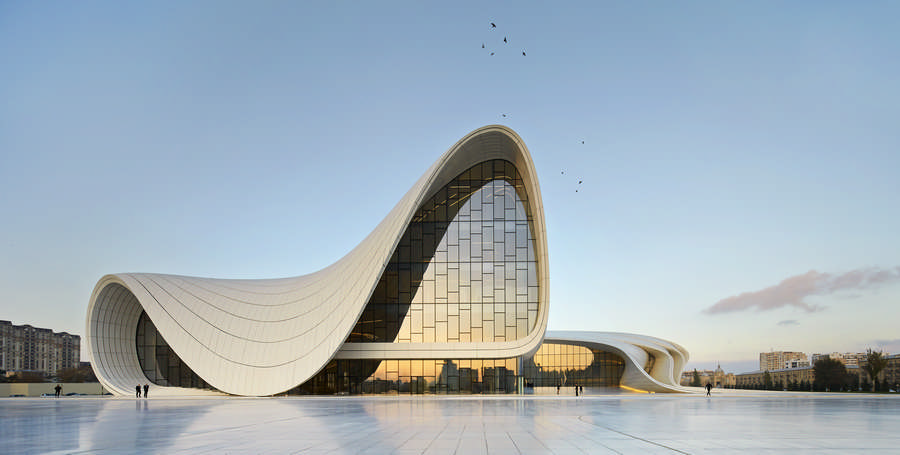
photo : Hufton + Crow
Fire, glass and the contemporary skyline
The Flame Towers operate at a different scale. Designed by HOK, the three curving towers bring hotel, residential and office uses together around a shared podium, while their forms refer to Azerbaijan’s long association with fire.
The best view is still from the old city. Medieval stone in the foreground; illuminated glass towers behind it. There is almost no transition. Two completely different ideas of Baku occupy the same frame.
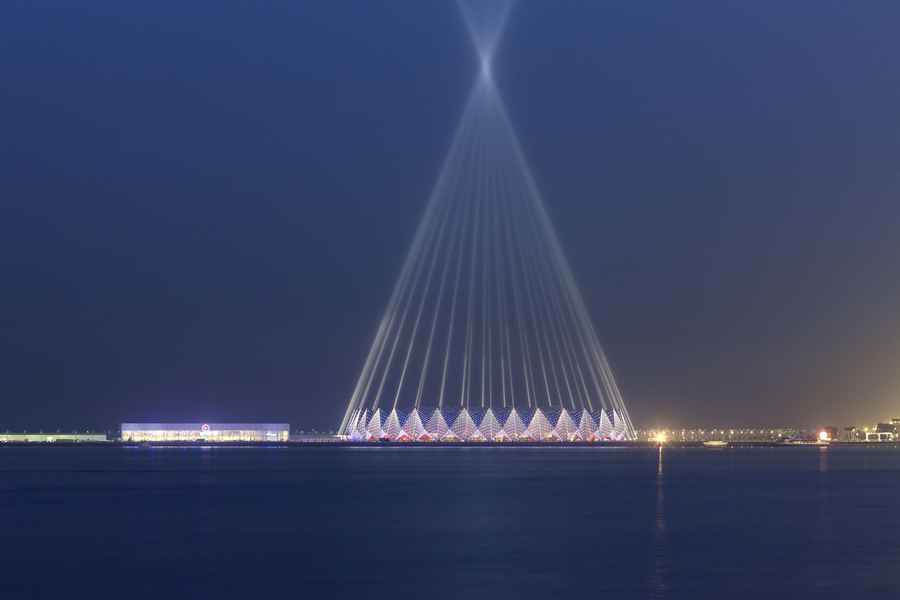
Crystal Hall – Sports Concert Complex Azerbaijan
photograph © Marcus Bredt
Along the waterfront, Crystal Hall adds the architecture of international events — designed by gmp for Eurovision 2012 and delivered on an exceptionally compressed timetable. The Azerbaijan National Carpet Museum takes symbolism even more literally, turning the idea of a rolled carpet into the form of the building itself. It is not subtle. Baku, to be fair, has never demanded that every building be subtle.
The architecture is in the argument
What makes Baku rewarding for architects is not that every building agrees with every other building. Quite the opposite.
The city gives you endless arguments: restraint versus spectacle; imported style versus local stone; private wealth versus civic monumentality; historic fabric versus icon architecture; context versus ambition.
Good. A city that gives architects nothing to argue about is probably not trying hard enough.
My favourite way to understand Baku is still the simplest: start inside the medieval walls, walk into the oil-boom streets, pass Ismailiyya and the wedding palace, look at the Academy and the Philharmonic, come down toward Government House and the Caspian, then look back toward the Flame Towers before crossing the city to Zaha Hadid’s white landscape.
The physical distance is small. The architectural distance is enormous.
Baku explains itself through the walk.
Author
Kamila Verdiyeva is founder of Merci Baku, a Baku-based cultural hospitality concept connecting international visitors with the city’s food, architecture and local life.
Website: www.mercibaku.org
Baku buildings, Azerbaijan architecture design images / information received 131026
Location: Baku, Azerbaijan, western Asia.
Azerbaijan Architecture
Azerbaijan Buildings : current, chronological list
Baku Expo Masterplan
Design: ZHA

image : ZHA
Botanica Residence, Baku
Design: Chapman Taylor
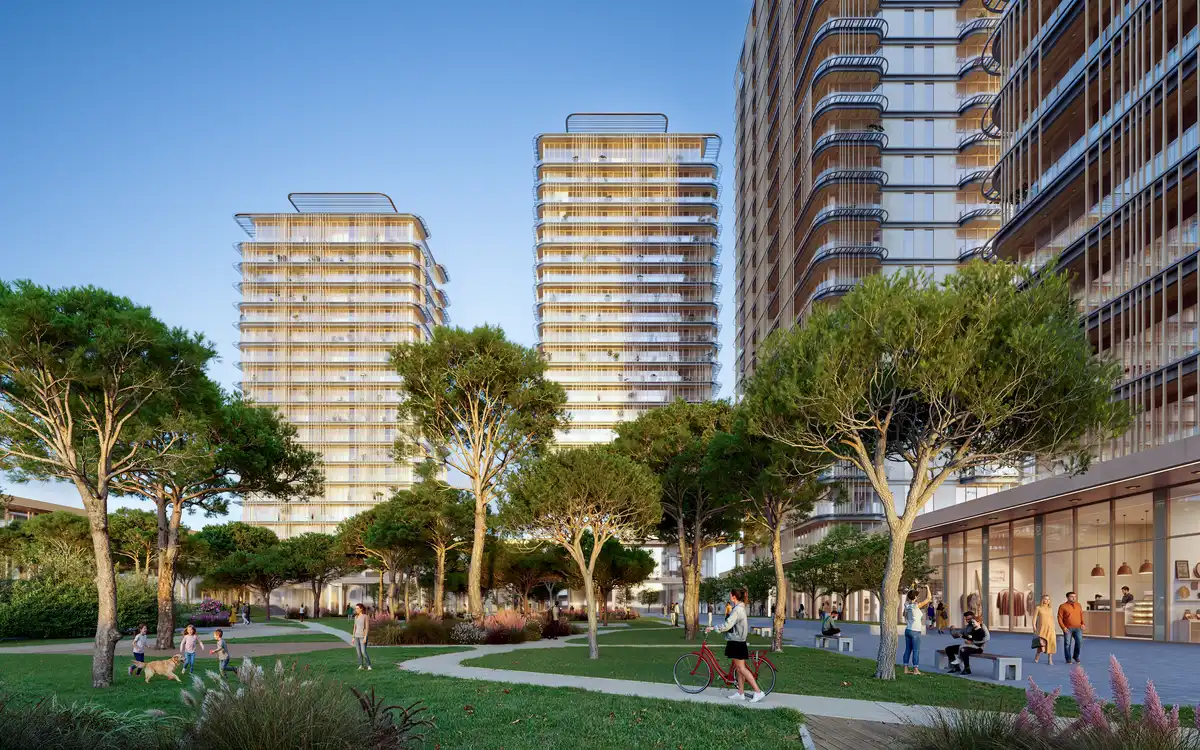
photo : Chapman Taylor / Studio Horak
Heydar Aliyev International Airport Building in Baku
Design: Autoban Studio
Zira Island Azerbaijan
Design: BIG
+++
Buildings in countries near Azerbaijan
Comments / photos for the Baku buildings, Azerbaijan architecture page welcome.