
Spring-Loaded Snap Hooks: Comparing Strength, Safety & Best Uses in Modern Building
This article was sent to us by Zachariah Parker – zacharriahparker(at)gmail.com
but failed to complete the deal
Do not work with these people
Avoid scammers!
18 December 2025
Snap hooks are spring-loaded connectors—also called spring snaps, bolt snaps, or trigger snaps—that you open with one squeeze and trust to stay shut. On a job site, that tiny hinge can be all that keeps you, a façade panel, or a tool aloft, so a bad spec gets expensive fast.
In this guide we walk you through a 15-point checklist—from load ratings to marking cues and common misuse traps. Need shapes and finishes first? Check the bolt, trigger, swivel, and flat-eye gallery on Country Brook Crafts, then come back and put the checklist to work.
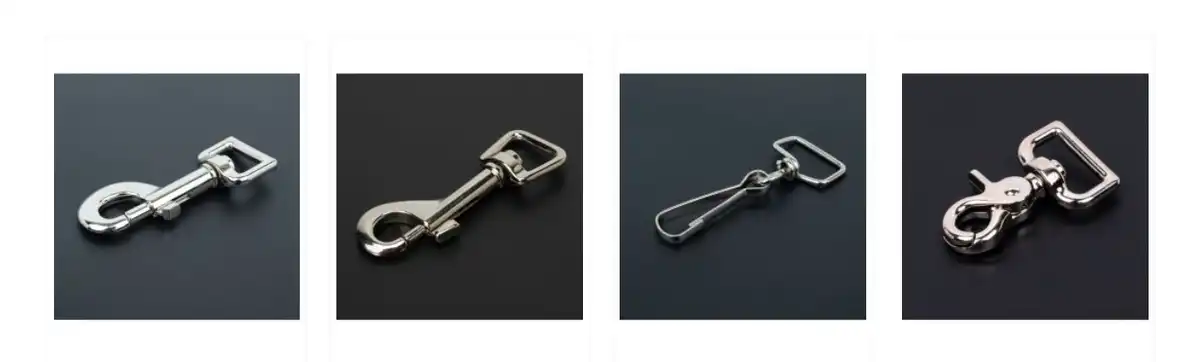
Fast glossary: ratings, parts, and jargon in plain English
Working load limit (WLL) vs. minimum breaking strength (MBS).
WLL is the everyday load the maker signs off on. MBS is the force that snapped the hook in a destructive test. Divide MBS by the safety factor (5-to-1 for life-safety gear) to arrive at WLL.
Gate strength vs. spine strength.
Snap hooks must hold in two directions. Gate strength covers a blow or cross-load on the spring gate, while spine strength is the straight-line pull along the body. OSHA calls for 3,600 pounds of gate capacity and 5,000 pounds of tensile (spine) capacity on fall-protection connectors (OSHA strength table).
Snap hook, carabiner, and rebar (scaffold) hook.
A snap hook has a one-hand, spring-loaded gate. A carabiner swings too, but it usually locks with a sleeve or pin and traces its standards to climbing and rescue work. A rebar hook is an oversize snap hook built to fit thick bars or pipe, which is great for clearance, but it introduces side-load concerns we cover later.
With those terms in place, the 15 spec and safety checks that follow will make far more sense.
Where to source snap hooks & certified connectors
Use this list based on your lane: craft/accessory, utility/rigging, or life-safety (fall protection). For life-safety, only buy connectors that are clearly certified and marked to the applicable standard.
- Country Brook Crafts (best for: craft + maker hardware, bolt/trigger/lever snaps)
Great for bags, leashes, lanyards, and general webbing projects with a wide selection of snap-hook styles (bolt, trigger, lever, etc.). Use it for accessory-grade needs—not as a substitute for certified fall-protection connectors unless the product explicitly carries that certification. - 3M Fall Protection (DBI-SALA / Protecta) (best for: life-safety snap hooks with OSHA/ANSI alignment)
3M’s snap hooks are built for fall protection systems and commonly call out 3,600 lb (16 kN) rated gate strength plus compliance references (OSHA 1910/1926). - Guardian Fall Protection (best for: jobsite fall protection components + broad availability)
Guardian positions itself as a major height-safety brand with dedicated snap hook product lines for professional use (good fit when you want a fall-protection-first catalog). - Petzl (Professional line) (best for: EN 362-style industrial connectors, large-opening directional options)
Petzl’s MGO-style connectors are designed for metal structures / large bars and are widely used in industrial access contexts where connector geometry matters as much as raw strength. - Mazzella (best for: industrial buyers who want rigging/fall-protection support + sourcing help)
Mazzella supplies snap hooks as part of a broader fall protection and rigging ecosystem—helpful when the purchase is tied to inspection, compliance, or larger system design decisions.
1. Pin down the job: accessory, rigging, or life-safety?
Start every spec with one test: If this connector fails, what or who hits the ground? The answer places the task in one of three lanes:
- Accessory. Key tags, banner cords, small tool lanyards. A break is irritating, not catastrophic.
- Rigging/utility. Light-material lifts, temporary HVAC supports, stage truss. Failure burns hours, time, and budget.
- Life-safety. Fall-arrest lanyards, rope-access lines, suspended-platform ties. Failure can kill.
Note the lane on your submittal cover sheet, and keep it consistent across drawings, RFQs, and toolbox talks. Crossing lanes invites shortcuts, and shortcuts invite accidents.

2. Nail the standard before you shop
When feet can leave the slab, the standard, not the catalog, drives your hardware choice. In the United States, 29 CFR 1926.502(d) requires every fall-arrest connector to withstand 5,000 pounds (22.2 kN) of tensile load and to pass a 3,600-pound (16 kN) proof test without the gate popping open (OSHA strength table).
Across the Atlantic, EN 362:2004 sets comparable strength and classifies connectors by task, such as Class B for basics and Class Q for auto-locking screw links (EN 362 overview). North of the border, CSA Z259.12 mirrors the 3,600-pound gate test and adds bilingual marking rules that trip up many imports.
Write the governing clause and edition date on your RFQ before you ask for pricing. You will filter out half the wrong products in one step and prove to auditors that safety lives in the spec, not in the shopping cart.
3. Insist on a lock when roll-out is even a remote risk
A snap hook can fail without the gate breaking. The culprit is roll-out, which happens when the gate nudges open as the hook twists against a small ring or piece of rebar. OSHA addressed the hazard by allowing only connectors that require two separate, consecutive actions to open in any fall-protection system (OSHA final rule, May 24 2010).
The specification fix is simple: when perfect alignment is unlikely, such as on scaffold ties, rebar stirrups, or ladder rungs, require auto-locking or double-locking gates. A locking sleeve blocks the pry path.
Lock options boil down to three:
- Screw sleeve. Twist to open, twist to close.
- Quarter-turn bayonet. Push, turn, release.
- Triple-action. Lift, turn, and slide.
Pick the style crews can manage with gloves on, and confirm that the lock snaps shut on its own.
Never swap “self-closing” for “locking.” A self-closing gate has only a spring. Demand proof, such as ten twist cycles in a mock-up, that the lock stays shut. Roll-out is silent until it is costly; a seventy-five-cent sleeve makes it a non-issue.
4. Gate strength is a number, not a guess
When a fall-arrest lanyard snaps tight, the first part to feel the hit is the gate, not the spine. OSHA sets the minimum gate capacity at 3,600 pounds (16 kN) in Construction §1926.502(d)(4) and General Industry §1910.140(c)(8) (OSHA strength table). Anything lower pried open during swing-fall tests.
That figure is a legal floor, not a marketing flex. A connector must absorb the blunt gate load, close, and lock again. If the data sheet lists only “5,000 pounds tensile,” push back. Tensile speaks to the spine; gate strength proves the latch will still be there when you need it.
Field check: flip the gate open, look for a stamped “3,600 lb” or “16 kN,” and confirm it appears. Snap the gate shut, then tug it sideways with a gloved hand; minimal play shows solid latch geometry.
Add one line to your spec: Provide documented gate-strength testing per 29 CFR 1926.502(d)(4) or §1910.140(c)(8), and stamp connector accordingly. Suppliers will surface real numbers long before the hooks arrive on site.
5. Design for side-load reality, not perfect alignment
Snap hooks are engineered for a straight pull, yet real jobs twist them against scaffold tube, beam clamps, and I-beam edges. That ninety-degree yank, called transverse loading, shifts force from the strong spine to the thin flanks, cutting capacity and prying gates.
ANSI/ASSP Z359.12-2019, section 4.3.4, now requires any connector with a gate opening over 1 inch (25 mm) to pass a dynamic transverse-drop test and carry a permanent mark such as “Transverse strength 3,600 lb (16 kN)” (ANSI overview). Only connectors stamped for side loads belong in a fall-arrest system.
Field cue: clip the hook, then tug sideways. If the gate nose touches metal, you have a side-load risk. Swap in a hook with a deeper throat, or use a captive-eye swivel that forces alignment.
We include a simple “good arrow / bad arrow” sketch in every bid set because a picture ends arguments faster than prose.
Spec line to copy: Connector must bear a transverse-strength mark ≥ 3,600 lb (16 kN), with test documentation per ANSI/ASSP Z359.12-2019.
6. Match hook and anchor like puzzle pieces, or risk roll-out
A snap hook is only as secure as the steel it grabs. Clip a narrow throat to a fat scaffold ring and the gate may stay half-open, waiting for vibration to shake it loose. Clip an oversize rebar hook to a small D-ring and the gate rubs the hinge each time the worker turns, carving a path to accidental release. OSHA incident reports list “size mismatch between hook and anchor” as a frequent roll-out cause (OSHA safety bulletin).
Our fix starts at the drawing board: sketch the connection in section view. Show anchor diameter, gate arc, and clearance behind the latch. If the gate edge can press the anchor under load, the geometry is wrong.
When dimensions run close, add a spacer or captive eye to force alignment. On retrofit jobs where you cannot swap the anchor, specify a hook with a deeper basket and recessed gate nose. Manufacturers publish throat depth and gate opening, so use those figures; never rely on a visual guess.
Toolbox-talk test: after clipping in, push the gate toward the anchor. If metal meets metal, pick another connector. Five seconds here prevents roll-out before anyone leaves the ground.
7. Demand ratings you can trace: WLL, MBS, and the safety factor between
A number on a sell sheet is worthless unless you can track it to a test report. We ask vendors for three proofs and accept the hardware only when all three line up.
- Working load limit (WLL). The everyday ceiling must appear on the hook body or a permanent tag. If it lives only in marketing copy, treat it as advertising, not engineering.
- Minimum breaking strength (MBS). Verified in a destructive pull test and logged. An ISO 17025 lab certificate is ideal, but a manufacturer’s report stamped by a professional engineer also works.
- Safety factor. Standards such as ASME B30.26-2015 require a design factor of 5:1 for most rigging hardware, while OSHA fall-protection rules set connector strength at 5,000 pounds (22.2 kN) and allow no more than 1,000 pounds (4.4 kN) WLL for life-safety use (OSHA connector limits, Mazzella rigging guide). No published factor, no deal.
File these three documents with the submittal, right beside the mill certs. A few extra emails now buy rock-solid traceability when a client’s lawyer asks, “How did you know the hooks were strong enough?”
8. Size the gate for the hardware you have, not the brochure photo
Snap hooks range from pencil-thin throats (about 3/16 inch or 5 mm) to openings wide enough for two stacked fingers (about 1 inch or 25 mm). We pick the wrong size whenever we rely on memory instead of field notes.
Grab calipers during the walk-through and measure the anchor diameter, such as scaffold tube, rebar cage, ladder rung, or eyebolt. Add a few millimeters for paint, ice, or burrs, then confirm two manufacturer numbers:
- Gate opening. Will the anchor fit?
- Basket depth. How far will the anchor seat once the gate snaps shut?
Rebar hooks make sense when you need 40–50 mm of clearance, but they add bulk and increase side-load risk. Compact snaps keep tool lanyards neat, yet jam on 1-inch (25 mm) pipe. Let the anchor, not the catalog photo, decide.
Sketch the anchor profile next to the chosen hook in the spec. One drawing beats a paragraph, and it prevents the 2 am scramble for adapters that nobody budgeted for.
9. Pick the right eye: fixed, swivel, or captive, for load control
The eye is the quiet workhorse of a snap hook. Choose poorly and the hook spins, cross-loads, or, worse, slips off the lanyard. Choose well and the system stays aligned through swing, twist, and rebound.
- Fixed eye. Keeps the hook in one plane, ideal for predictable loads such as tool tethers or center-line signage. No moving parts, no surprises.
- Swivel eye. A sealed bearing lets the hook find its natural orientation when the user, not the anchor, moves. Rope-access techs clip in, spin, and step back without twisting a rope. Swivels cut cross-loads but add a few ounces and, in some designs, reduce the WLL; confirm in the data sheet.
- Captive eye. A bar traps the webbing or rope so the hook cannot flip and gate-load the connector. ANSI/ASSP Z359.13-2021 requires captive eyes on many shock-absorbing lanyards to prevent mis-clips in fast-paced work (standard overview).
Pick the eye the same way you pick the gate: guide the load path. Sketch motion arrows, then choose the eye that keeps those arrows on the hook’s major axis.
10. Choose materials for the air, water, and chemistry they will face
Corrosion turns a connector into a ticking failure, so match metal to environment as carefully as you match sealants to façade exposure.
Stainless steel 316 is the marine default. Adding 2–3 percent molybdenum lifts its Pitting Resistance Equivalent Number (PREN) above 25, providing far better chloride defense than 304 and earning the “marine-grade” nickname (316 stainless overview). Use it on coastal sites, chemical plants, or any area with salt spray or acids.
Zinc–nickel, about 12–15 percent Ni, or trivalent-chromium zinc suits dry interiors where cosmetic shine matters but full marine resistance is unnecessary. A 10 µm Zn-Ni layer withstands more than 500 hours of neutral salt spray (ASTM B117) before red rust, compared with 96–240 hours for plain zinc (Zn-Ni salt-spray data).
Aluminum keeps rope-access kits light, yet aluminum corrodes quickly when wet and paired with galvanized steel. Dissimilar metals create a galvanic cell; add a nylon bushing or specify both parts in the same alloy to prevent pitting.
Write the exposure class—interior dry, exterior urban, or marine—into the spec header, then tie alloy and coating choices to that line. The right metal on day one avoids surprise swaps in year five.
11. Test ergonomics in gloves, mud, and January cold
A connector that feels slick in a showroom can be brutal on scaffolding, so we run a field mock-up before approving any new hook.
Crews pull on winter gloves, dunk the hook in a sand bucket, then clip and unclip it ten times while standing on a plank. If a thumb slips off the trigger, grit stalls the spring, or the latch snags webbing, the sample fails. Better to catch it here than fight it every morning in the field.
Opening force matters too. ANSI/ASSP Z359.12 sets no numeric cap, but a UK HSE human-factor study pegs 50 N (about 11 lbf) as the upper comfort limit for one-hand operation in cold gloves (HSE research report). Aim for a gate you can open with two gloved fingers, yet still auto-locks.
Finish with a snag check: run a gloved hand over rivets, welds, and the gate nose. Smooth edges pass; burrs go in the reject bin.
12. Inspect, flag, and retire because springs do get tired
Snap hooks hide damage well, so train eyes and fingers to hunt for three red flags.
- Shape. Lay the hook on a flat plate. If the spine bows, the gate gap widens, or the eye warps, the metal has yielded. Steel grain cannot be straightened, so tag it out. ANSI/ASSP Z359.12-2019 requires removal when connectors show deformation or cracks (standard summary).
- Spring action. Cycle the gate five times. It must snap shut with the same crisp click each pass. A lazy return points to a fatigued spring or grit in the hinge, either of which blocks full engagement and fails the ANSI repeat-closure test.
- Latch nose. Look for mushroomed tips or half-moon gouges from metal-on-metal impacts. If light leaks through the closed gate, security is gone.
Any connector that flunks one step is removed at once and quarantined after a fall event, as required by ANSI/ASSP Z359.22 (inspection guideline). A ten-dollar hook is cheaper than a lawsuit.
13. Pair each building task with its natural connector family
Snap-hook errors often start with a bad analogy, such as using the hook that worked on a different job. A simple three-lane matrix ends the mismatch.
- Façade access and rope work (life-safety). Connectors must comply with EN 362 or ANSI/ASSP Z359.12 and display a 3,600-pound (16 kN) gate mark. Swivel eyes let workers spin without twisting the lifeline, and aluminum keeps weight off the harness.
- Scaffold ties and temporary works (utility rigging). Choose forged-steel bodies, transverse-rated gates, and fixed eyes that shrug off wind wobble. Outdoor duty calls for galvanized or stainless finishes; bright chrome will not last.
- Temporary signage and lighting rigs (accessory-plus). Working load still matters, but locking gates are optional. A compact snap rated around 500 pounds (2.2 kN) with a nickel finish keeps bulk and cost down.
Ask two questions before choosing: What could fall, and who stands beneath it? The answers place the task in one lane and eliminate guesswork.
14. Conclusion: Snap hook or carabiner? Use this one-sentence rule
If the anchor can spin, shift, or side-load the connector, choose a locking carabiner; if the load path stays predictable, a properly rated snap hook is lighter and faster.
Carabiners excel in dynamic systems such as rope access, rescue pick-offs, and climbing-style belays because their symmetric frame and sleeve lock handle odd angles with ease. Snap hooks shine on repetitive clips where alignment is controlled, such as steel-beam anchors, tool lanyards, or banner cords.
Whichever you choose, verify the same yardsticks: 3,600-pound (16 kN) gate strength, transverse stamp, and published WLL. Geometry and user flow, not metallurgy, decide. Moving targets get carabiners; predictable pulls get snap hooks. Decision made.
Comments on this guide to Spring-Loaded Snap Hooks: Comparing Strength, Safety & Best Uses in Modern Building article are welcome.
Home Improvement
Home Improvement Design
Exterior home components that need more attention
Decorating Hacks to Make Your Home Feel Unique
Ultimate checklist for renovating your home
++
Building Articles
Residential Architecture Posts
Comments / photos for the Spring-loaded snap hooks for modern building page welcome