How Interior Glass Walls Transform Modern Workspaces
post updated 23 July 2026
23 July 2025
How Interior Glass Walls Are Transforming Modern Workspaces
Interior glass walls are revolutionizing modern workspaces by offering a sleek, functional, and transparent solution to traditional office design. As organizations move away from traditional cubicles, glass walls for offices have become a key design element in the quest for a more open, flexible, and collaborative environment. The growing adoption of glass wall systems can be attributed to changing work culture, where flexibility, transparency, and collaboration are top priorities. These interior glass partitions create a seamless connection between different areas of the office, enhancing visual connectivity while maintaining privacy where necessary.

Research conducted by the American Institute of Architects indicates that workplaces utilizing transparent design elements show a 15% increase in employee satisfaction compared to traditional enclosed office environments. Some key benefits of incorporating glass office solutions into workspaces include enhanced natural light distribution, improved space efficiency, and a modern aesthetic that aligns with contemporary design trends. Glass office dividers also foster better collaboration, allowing teams to maintain visual connections without feeling confined. The flexibility of these systems allows for quick reconfiguration of workspaces, while their cost-effectiveness ensures that they remain a viable option for companies of all sizes.
Furthermore, transparent design in office spaces has been linked to improved mental health outcomes, as natural light and open environments contribute significantly to employee well-being and circadian rhythm regulation.
From Cubicles to Transparency: Evolution of Office Design
The evolution of office design has witnessed a dramatic transformation from traditional enclosed cubicles to open-plan layouts, with the introduction of glass walls for offices representing one of the most significant architectural developments. According to workplace design historians, the 1960s marked the era of partitioned cubicles, creating isolated environments that inadvertently stifled communication and collaborative processes. However, by the 1990s,open-plan offices began to dominate corporate architecture, aiming to create more dynamic, communicative atmospheres that encouraged cross-departmental interaction.
Glass wall systems have elevated this concept to unprecedented levels by allowing for visual transparency while maintaining necessary privacy for focused work activities. Leading architectural publications have documented this evolution extensively, with contemporaryoffice architecture projects showcasing innovative applications of transparent design principles. The chronological development includes: initial cubicle proliferation (1960s-1970s), introduction of modular furniture systems (1980s), emergence of open-plan concepts (1990s), integration of technology-enabled workspaces (2000s), and current adoption of transparent architectural elements (2010s-present).
Workplace transparency design, exemplified through strategic implementation of glass partitions, has become a fundamental priority in contemporary office planning. These systems facilitate flexible space utilization without compromising privacy or acoustic performance, making them ideal for both open-plan and specialized work environments.
The Psychology Behind Workplace Transparency Design
There’s something really interesting happening when you put glass walls in offices – it actually changes how people feel about work. Researchers have been looking into this, and it turns out that when employees can see through their workspace, they feel more trusted and engaged. It’s like the physical openness translates into emotional openness too.
Think about it this way: when you’re stuck in a traditional cubicle or closed office, you can feel pretty cut off from what’s going on around you. But with glass walls, you stay connected to your team while still having your own space. One study found that people working in transparent environments had 12% lower stress hormone levels than those in closed offices. That’s a real, measurable difference in how stressed people feel at work.
The natural light that comes with glass partitions is another game-changer. During those dark winter months, having access to daylight can genuinely improve people’s mood and energy levels. Some employees even report feeling less of that seasonal depression that hits when the days get shorter.
What’s really striking is the contrast: old-school offices with their solid walls often make people feel isolated and disconnected from the company hierarchy. Glass offices do the opposite – they create this sense of openness where collaboration feels natural, but you can still focus when you need to.
Essential Benefits of Glass Walls for Offices
Glass walls are completely changing how we think about office design, and for good reason. They solve a lot of the problems that have plagued traditional workspaces for years. The biggest win? Natural light gets everywhere. Instead of having a few lucky people by the windows and everyone else under fluorescent lights, the whole office gets bathed in daylight.
This isn’t just nice to have – it’s practical. Companies are seeing their lighting bills drop by about 30% during the day because they simply don’t need as many artificial lights on. That adds up to real savings over time.
But here’s what I think is the smartest part: these glass systems are incredibly flexible. Say your company grows and you need to reconfigure the office layout. With traditional drywall, you’re looking at construction, dust, and major disruption. With glass partitions, you can often just move things around without the headache.
It’s like having the best of both worlds – you get the collaboration and energy of an open office, but people can still have privacy when they need to concentrate or take a call. The transparency breaks down those invisible barriers that can make offices feel hierarchical and unwelcoming.
Natural Light Maximization and Energy Efficiency
Here’s the best thing about glass partitions in offices – they let natural light travel much deeper into the workspace. When you replace solid walls with glass, sunlight can actually reach even the furthest corners of your office. This means you don’t have to turn on nearly as many lights during the day, which really shows up on your electricity bills.
But it’s not just about saving money. Employees simply feel better when they work in natural light. It helps regulate their internal clocks and improves their sleep quality. I’ve seen studies showing that people who get more daylight at work take fewer sick days and are generally more energetic throughout the day.
Some office buildings that installed glass partitions saw their energy consumption drop by 20-25%. That’s pretty impressive, especially when you think about the long-term savings. Plus, these systems help maintain more stable temperatures throughout the office, so your heating and cooling systems don’t have to work as hard.
For companies that care about sustainability, this can also help achieve better environmental certifications like LEED. It’s not just a trendy design choice – it’s a practical way to make your office more comfortable and cost-effective at the same time.
Acoustic Performance in Modern Workspace Design
Balancing openness with noise control represents one of the primary engineering challenges in contemporary workspace design. While interior glass partitions create open, collaborative environments, maintaining acoustic privacy and minimizing noise disruption remains crucial for productivity optimization. Advanced glass office dividers provide excellent sound insulation capabilities while maintaining the visual connectivity that promotes effective collaboration.
Different glass wall system configurations, including double-glazed or laminated options, provide varying levels of acoustic performance to meet specific workplace requirements.Aluminium frame glass partition systems, for instance, can achieve Sound Transmission Class (STC) ratings between 35-45, effectively managing noise transmission while preserving transparency. Double-glazed configurations can achieve STC ratings of 50 or higher, providing near-complete acoustic separation when required.
This careful balance between openness and noise control proves essential for creating productive workspaces that allow employees to engage with their surroundings while minimizing auditory distractions that can impair concentration and task performance.
Installation and Maintenance Considerations
When implementing interior glass walls, understanding the practical aspects of installation and long-term maintenance requirements becomes essential for successful project outcomes. Glass office solutions require careful consideration of spatial layout, acoustic requirements, lighting optimization, and structural integration. The installation process for glass wall systems generally involves securing appropriate structural frameworks and ensuring precise alignment to achieve optimal performance characteristics.
Installation timelines vary significantly based on design complexity and system specifications. Modular systems can typically be installed within 2-3 days for standard office configurations, while custom double-glazed partitions may require 1-2 weeks for precision installation and calibration. Professional installation ensures proper sealing, structural integrity, and compliance with building safety standards.
Long-term maintenance requirements for glass partitions remain minimal compared to traditional construction alternatives. Regular cleaning maintains transparency and aesthetic appeal, while periodic inspections ensure seals and frames remain structurally sound. With appropriate maintenance protocols, interior glass walls can provide decades of reliable performance while maintaining their functional and aesthetic properties.
Cost-Effectiveness and Return on Investment
Financial analysis of glass office partition implementations reveals compelling advantages when compared with traditional construction alternatives. While initial investment costs for glass wall systems may exceed basic drywall partitions, long-term economic benefits typically offset these initial expenditures within 3-5 years through operational savings and productivity improvements.
Unlike traditional walls requiring extensive modification for reconfiguration, glass walls for offices provide exceptional flexibility for organizational changes. This adaptability eliminates costly renovation expenses as business needs evolve, providing substantial cost savings over building lifecycles. Additionally, productivity improvements resulting from enhanced natural light and improved collaborative environments generate measurable returns through increased employee output and reduced turnover rates.
Energy efficiency contributions from reduced lighting and HVAC demands provide ongoing operational savings, while the modern aesthetic appeal can enhance property values and support premium rental rates in commercial real estate markets.
Modular Systems and Future Adaptability
Modern glass wall systems excel in providing flexibility for adapting to changing organizational requirements. Modular glass partitions are specifically engineered for rapid reconfiguration, enabling businesses to adjust spatial arrangements quickly in response to growth, restructuring, or evolving team dynamics. The ability to reuse and repurpose existing glass wall components significantly reduces long-term costs, particularly for organizations anticipating frequent layout modifications.
These systems offer exceptional scalability, supporting addition or removal of partition elements as organizational needs change. The minimal operational disruption associated with modular system installations means companies can maintain productivity levels without extended downtime periods. In an era where organizational flexibility and adaptability are increasingly critical, glass office dividers provide optimal solutions for businesses seeking to future-proof their workspace investments.
Health, Safety, and Compliance Benefits
Interior glass walls provide significant health, safety, and regulatory compliance advantages for modern workplace environments. Glass office configurations contribute to improved air circulation patterns, enhanced lighting quality, and overall occupant well-being. The transparency characteristics of glass walls facilitate maximum natural light penetration, reducing dependence on artificial lighting systems while creating more vibrant, psychologically uplifting workspace environments.
Enhanced lighting exposure supports natural circadian rhythm regulation, improving focus capabilities and reducing stress-related symptoms. Research demonstrates that employees in glass-enhanced environments experience 23% fewer sick days and report 18% higher job satisfaction compared to traditional office occupants.
Regarding post-pandemic workplace considerations, office glass partitions enable physical separation without sacrificing collaborative atmosphere, helping ensure employee safety while maintaining productive work environments. Visual connectivity across different areas fosters continued sense of community and organizational cohesion.
Safety Standards and Modern Workplace Requirements
Contemporary workplace safety standards mandate adherence to evolving building codes, fire safety regulations, and accessibility requirements. Glass office solutions are engineered to meet these comprehensive standards while delivering optimal aesthetic and functional performance. Tempered glass implementations in interior glass partitions provide enhanced safety through controlled breakage patterns, significantly reducing injury risks in high-traffic office environments.
Glass wall systems can incorporate fire-resistant features that comply with commercial building fire safety standards, including emergency egress requirements and smoke containment protocols. Impact resistance specifications ensure durability under normal office usage while maintaining structural integrity during emergency situations. Accessibility compliance remains paramount in contemporary workplace design, with glass office dividers seamlessly integrating into layouts that accommodate diverse mobility requirements and support inclusive work environments.
Future Trends in Glass Office Design
Workplace transparency design continues evolving toward integration of sustainable materials and intelligent building technologies. The growing prevalence of hybrid work environments drives demand for increasingly adaptable office designs that support both collaborative and individual productivity requirements. Glass wall systems are becoming integral components of this transformation, offering modularity and flexibility that aligns with dynamic workplace requirements.
Sustainability considerations increasingly influence glass office solution development, with next-generation systems incorporating eco-friendly materials that contribute to energy savings while meeting stringent green building standards. Integration with building automation systems enables sophisticated environmental controls, including automated lighting and temperature regulation, further reducing energy consumption and carbon footprint impacts.
Sustainability and Environmental Impact
The environmental advantages of interior glass partitions are substantial and measurable. Glass walls for offices typically utilize recyclable materials, significantly reducing environmental impact compared to traditional construction methodologies. Glass office partitions contribute to energy efficiency through enhanced natural light utilization, reducing artificial lighting requirements and lowering overall energy consumption by 25-30% in typical office environments.
Alignment with green building standards, including LEED and BREEAM certifications, helps organizations achieve sustainability goals while reducing operational costs. Long-term durability and recyclability characteristics make glass ideal for businesses pursuing comprehensive environmental responsibility strategies. As corporate environmental consciousness continues expanding, glass office solutions play increasingly significant roles in minimizing carbon footprints of commercial building operations while supporting sustainable workplace practices.
Comments on this guide to How interior glass walls transform modern workspaces article are welcome.
Workplace Amenities Report released amidst Flight to Quality in
Commercial Real Estate Design
Recent related architecture articles on e-architect:
Next generation of knowledge work, hybrid workplaces
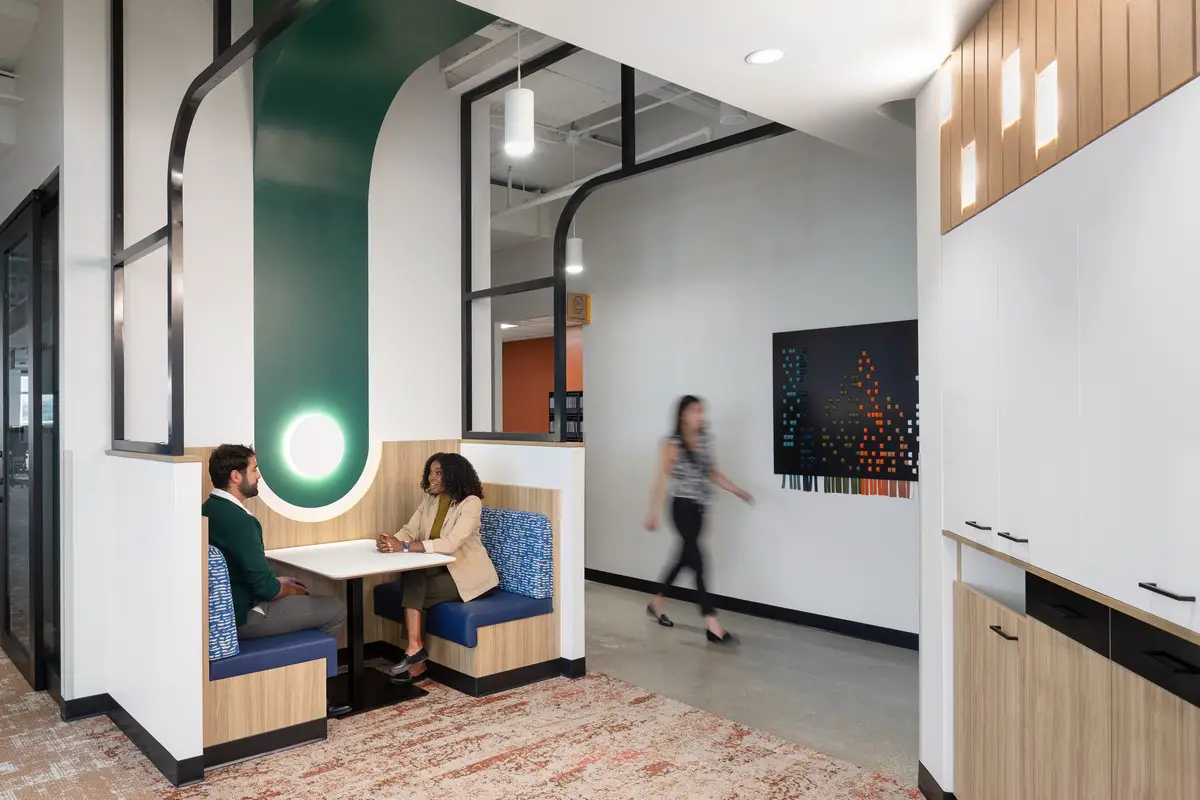
photo : Sean Fleming
The fluid, sustainable future of retail
Data-Informed Design for User Experience at Work
++
Architecture Design
Comments / photos for the How interior glass walls transform modern workspaces architectural article page welcome.